
Orff Schulwerk: More than Pentatonic
and Why Completing Levels II and III Matter
By Karen Benson, AOSA Professional Development Director
A longtime AOSA Teacher Educator, who has taught in level courses for many years, recently relayed a story of a conversation with a fellow music educator. The subject of utilizing various modes, scales, and genres of music with children arose. The Teacher Educator said, “Oh, that sounds like Orff Schulwerk” to which the other teacher who had only taken a Level I course replied, “Really? I thought Orff Schulwerk was just C-pentatonic!”
Orff Schulwerk is much more than “C-pentatonic!” That wonderful set of tones commonly used in Orff Schulwerk classrooms is the basis for endless music making experiences but it is not the end of the story. In fact it is only one of many five-note sets found in the world and a small portion of what is found in the AOSA Teacher Education Curriculum. Carl Orff and Gunild Keetman, who developed the Music for Children Volumes1, compiled the exercises and songs as models. Even though many of the pieces in Volume I are written in C Do-based pentatonic, they are certainly not meant to all be played as written but instead, as Jane Frazee suggests in her book Orff Schulwerk Today2, exploration with the materials provides four critical outcomes: skill development, concept development, invitation to improvisation, and aesthetic potential.
The AOSA Teacher Education Curriculum used in AOSA Level Courses became a reality in 2012 and is currently undergoing a revision process. However, the overarching and continuing goal of the curriculum is to provide a comprehensive understanding of the many aspects of Orff Schulwerk and consistency in concepts and skills covered at every AOSA approved course. The completion of all three levels of the curriculum also creates the pathway to AOSA certification.
The chart below outlines the curricular focus for each level:
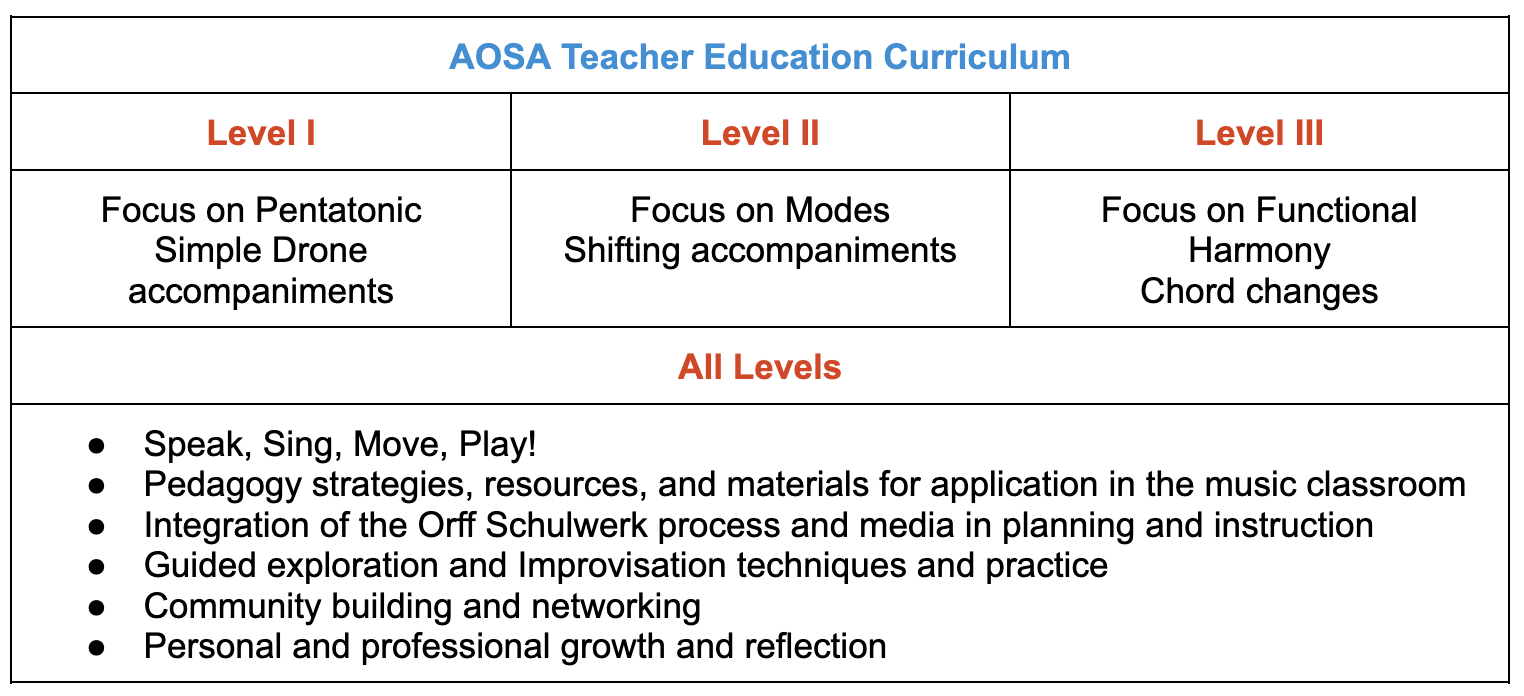
Concepts and skills presented in Level I are reviewed and expanded in Level II and again in Level III. New outcomes are added as participants progress through the level courses.
.jpg) It is important to note that no specific age or grade levels are assigned to specific levels. All learners can progress through the concepts of each level, including the music educators who are taking the course! The challenge lies in developing lessons that are age and skill appropriate for the students you teach.
It is important to note that no specific age or grade levels are assigned to specific levels. All learners can progress through the concepts of each level, including the music educators who are taking the course! The challenge lies in developing lessons that are age and skill appropriate for the students you teach.
Starting from the beginning with short-range songs with simple drones – and moving through to understanding and playing music with chord progressions – Orff Schulwerk Level Courses set the stage for continued learning for a music educator’s students but also for themselves as the teacher. Reaching the goal of completing Level III isn’t the end, but the beginning of a lifetime of learning for Orff Schulwerk teachers and their students who benefit the most from this growth mindset.
Go to the AOSA website for more information on the AOSA Teacher Education Curriculum and the current list of available course Level Courses.
Start the journey and then continue onward until completion becomes commencement! You will be a better teacher and your students will be enriched in ways you’ve never imagined from pentatonic and beyond!
1. Carl Orff and Gunild Keetman, Music for Children, Volumes I – V (London, Schott and Co. Ltd)
2. Jane Frazee, Orff Schulwerk Today: Nurturing Musical Expression and (nderstanding (2006 New York, Schott Music Corporation) p. 26
Reverberations – April 25, 2023

© 2026 AOSA, all rights reserved. See our copyright policy.