
Level I:
An Elemental Shift
By Dylan Teut, PhD Seward NE
|
The author holds undergraduate degrees in Early Childhood Education and Music, supplemented by graduate work in intervention support and literacy assessment. His diverse career includes roles as a self-contained first-grade teacher, an elementary reading specialist, and a university instructor teaching literacy methods and children’s literature. He eventually transitioned into graduate-level course design and instruction. After several years in academia, he felt a pull back to the classroom, realizing that “…children are where there’s the most joy! When I got the offer to teach music, I jumped at the chance. I’ve been all over the place, but I am so glad I wound up where I am!” Below, he shares how AOSA Teacher Education fundamentally transformed his approach to teaching. |
After fourteen years of teaching experience, I’ve learned that growth often requires a leap of faith. Last year, I transitioned from teaching language literacy to music education – a move that challenged my existing skill set and highlighted new areas for professional development. I am now focused on refining my musical instruction to bring a new level of excellence to my classroom.
When a respected colleague recommended an American Orff Schulwerk Association Teacher Education course, I reviewed the Level I requirements with a mix of curiosity and dread:
- Pedagogy: That sounds manageable enough.
- Recorder: Seriously? I’m not sure my fingers can even navigate an instrument that small.
- Movement: Are you kidding? I can only hope the room is dark enough that no one actually has to watch me dance.
I did some research and noticed a consistent theme in the testimonials: past participants described the experience as joyful, deeply relevant, and transformative. Inspired by their accounts of how pertinent and engaging the levels were, I decided it was worth the leap.
When July rolled around, I walked into the building with my soprano recorder, my Schulwerk texts, and a sense of cautious confidence. By the end of the first day, any lingering skepticism had vanished, swept away by the instructors’ expertise, the camaraderie of my classmates, and the sheer rigor and optimism of the curriculum. What followed were two of the best weeks of professional growth in my entire career.
Level I of Orff-Schulwerk forced me to pause and overhaul everything – and I mean everything – about my music teaching. While the program provides a wealth of practical tools, the real game-changer is the constant push to integrate all aspects of the Schulwerk into an approach tailored to your specific students and setting. It is demanding work that forces deep reflection, but by the time those first two weeks wrapped up, my only question was: “When and where do I sign up for Level II?”
Here are some of the most significant ways my approach has changed since completing Level I:
- Camaraderie: Between the approachable instructors and your fellow classmates – plus the entire AOSA network – you are never working in a vacuum. The instructors are genuinely invested in your success, and the community is incredibly supportive, always ready to cheer on beginners and share resources to help everyone thrive.
- Curiosity and Control: Once you realize that Orff-Schulwerk is an elemental, process-oriented approach, it completely transforms how you design your daily instruction. It isn’t an overnight change; rather, as you slowly implement Level I techniques, the process becomes more intuitive and efficient. Eventually, you’ll find yourself wondering how you ever taught any other way.
- Coachability: Let’s be honest: much of what we ask of our students is built upon a foundation of trust. We regularly ask them to be vulnerable – to test their voices, minds, and bodies in both familiar and unfamiliar ways. Taking these levels puts us right back in the trenches, allowing us to own our own vulnerability as we try things for the first time. If we expect our students to shed their insecurities for the sake of learning, we must be willing to do the same. The levels provide the perfect space to practice exactly what we preach.
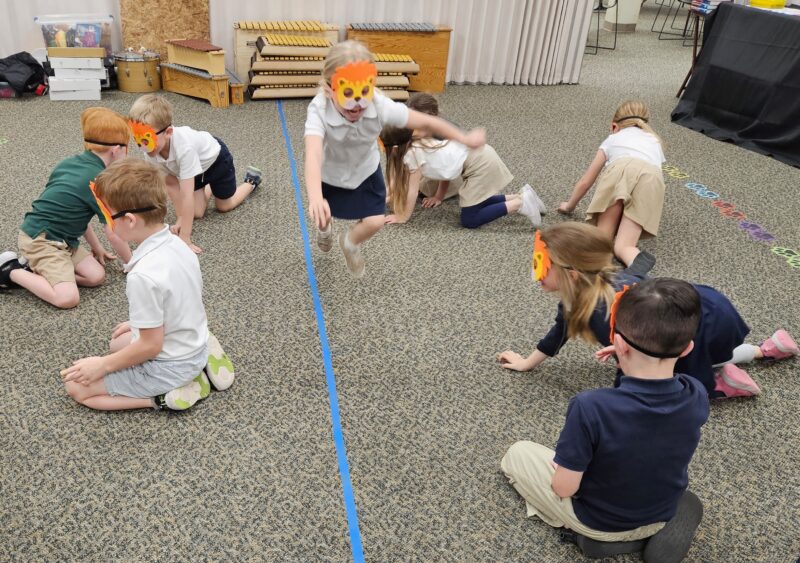
Since completing Level I, these are the most impactful changes I implemented immediately:
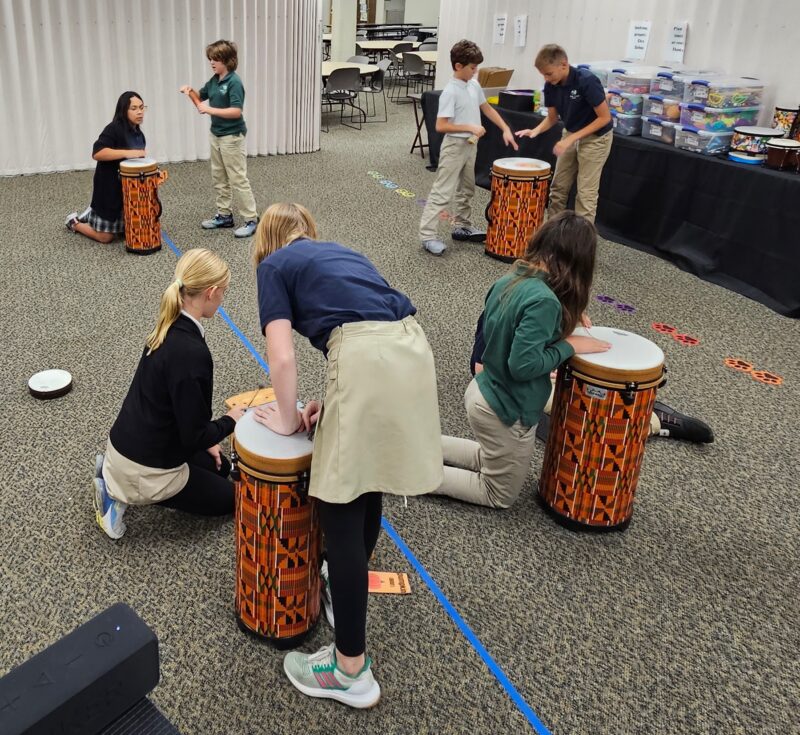
- Environment: I cleared out the chairs and most of the furniture to create a large, open space for movement and play. Aside from the instruments and materials lining the walls, my room looks empty—but purposefully so. If it were cluttered with furniture, there would be no room for students to move, sing, speak, and collaborate.
- Movement: We now move in every single class, whether through folk dance, free exploration, body percussion, or a mix of all three. While this is the area where I still feel I need the most growth, it has also become the one component I could never imagine giving up.
- The Volumes: I’ve stopped viewing the Orff Schulwerk Music for Children volumes as a collection of pieces to be played and started seeing them as springboards for exploration. Instead of a prescriptive model, the volumes are a “sampler platter” of possibilities. I now work with my students to decide how these notes and patterns will evolve – from speech and body percussion into song and eventually onto instruments. Now, every time I turn a page, I look at a selection through the lens of my students’ interests, using their curiosity as the starting point for our journey.
- Literature: Children’s literature and poetry practically beg to be woven into the Schulwerk. Some books have such natural musical ties that they fit seamlessly into my lessons. I’ve started adding refrains, pitched and unpitched percussion, movement, and recorder parts to the stories we read. Before Level I, I felt like I had to justify using picture books in a music room. Now, they are simply part of what we do.
- Recorder: As it turns out, my hands still fit around a soprano recorder just fine. One of the most valuable takeaways from Level I was the realization that I didn’t want my recorder instruction to resemble the way I was taught years ago. “Recorder is honestly kind of fun” is a phrase I often hear from fourth graders.
- Joy: While I am working harder than ever, I am also experiencing a daily sense of joy and curiosity. I never know where we might hit a snag or where we might glide effortlessly over a challenge. My students are laughing, exploring, and creating – and I love receiving emails from parents sharing how something we did in class found its way home and “leveled up.”
There are only 105 days until Level II begins – but who’s counting?
 Dr. Dylan Teut currently serves as K-5 Music Educator at Christ Lincoln Schools in Lincoln, NE. He is also a regular organist for worship services and provides private piano lessons. He is a member of the Great Plains Orff Chapter. He lives with his wife Rachel in Seward, NE, where you can find him busy with the Kiwanis Club, Rotary Club, and in the garden. If he’s not there, he’s an avid birder and either volunteering to teach others about birding or out chasing the next “lifer” species to add to his life list.
Reverberations – April 21, 2026
© 2026 AOSA, all rights reserved. See our copyright policy.