
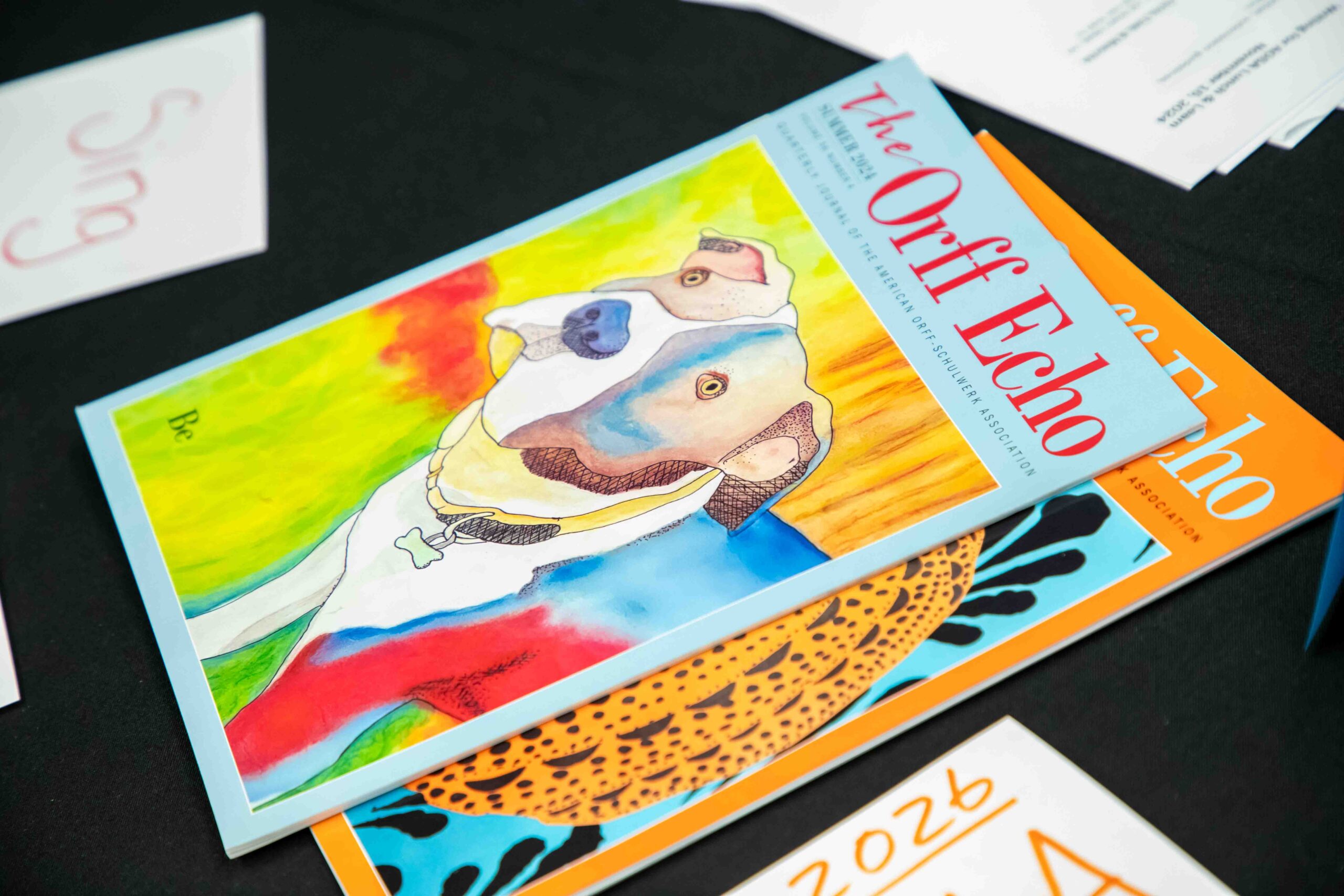
The Orff Echo is the national, peer-reviewed quarterly journal and philosophical voice of the American Orff-Schulwerk Association. Our mission is to demonstrate the value of Orff Schulwerk and promote its widespread use; to support the professional development of our members; and to inspire and advocate for the creative potential of all learners. Non-members may contact the editor for information.
Interested in writing for The Orff Echo? Check out how to get involved in the process:
Extensions to articles published in The Orff Echo can be found in the AOSA Resource Library.

List of Orff Echo Articles
From Chaos to Harmony: Embracing the Orff Schulwerk Approach and Guiding Students Through the Musical Shift
Transformative account illustrating how engaging with the Orff Schulwerk approach resulted in a more student-centered and process-oriented teaching practice.
Orff Schulwerk teacher education, early teaching, musical shift, process, novice teacher, pivotal, imitation, exploration, creation, levels
Free Play – Improvisation in Life and Art
Professional Development Book Review: Puts readers directly into the flow of the inquiry and encourages them to penetrate the mystery.
I Can Make a Train Noise
Children’s Book Review: Permutations of the title encourage discussions of musical elements.
Embracing Stillness: Breathwork and Mindfulness for Educators and Their Students
Explores strategies for integrating breathwork and mindfulness in the Orff Schulwerk classroom that offer teachers and students a means to manage stress in school and in their daily lives.
teacher emotional care, student emotional care, breathing exercises
Transforming Ethnomusicological Recordings into Curricular Resource
Describes decision-making process of sorting through The Global Jukebox, a collection of archival ethnomusicological recordings, to create curricular materials and flexible arrangements for use with students.
historic recordings, folk music, world music, curriculum
Orff Schulwerk Levels Courses and Teaching Self-Efficacy
Details study that investigated elementary music teachers’ self-efficacy before and after Orff Schulwerk Teacher Education Levels Courses using Tschannen-Moran and Woolfolk Hoy’s (2001) scale.
music teacher self-efficacy, Orff Schulwerk teacher education, professional development
Creative Aging and Orff Schulwerk
Combines the National Wellness Institute’s Six Dimensions of Wellness and the Orff Schulwerk approach to facilitate music and movement and details the effect on the overall wellness of older adults.
elderly, intergenerational, wellness, memory care, aging
Student-to-Student Discourse in the Orff Schulwerk Classroom
Through social interaction, students discuss key concepts, evaluate their understanding, and deepen their engagement with musical objectives. Author explores strategies to promote meaningful discourse in the Orff Schulwerk classroom to ensure all students develop speaking and listening skills.
critical thinking, metacognition, discourse, musical growth, cognitive growth
Teaching Musicianship Through Movement
Article explores how movement concepts present in an Orff Schulwerk classroom and levels courses transfer to musicianship skills in middle school and high school student musicians.
movement education, musicianship development, Laban efforts, creative movement
Responding to the Music We Hear: Music Listening as an Active Experience
Responding to music is both universal and uniquely personal, with listening experiences ranging from passive to deeply engaged. The author explores how, through understanding these diverse responses, teachers can develop
Responding to music is both universal and uniquely personal, with listening experiences ranging from passive to deeply engaged. The author explores how, through understanding these diverse responses, teachers can develop active listening practices that enhance student experiences and align naturally with Orff Schulwerk-inspired classrooms and typical musical activities.
SPICES Up Your Life: Considering Quaker Testimonies in an Orff Schulwerk Classroom
The author considers connections between Orff Schulwerk and Quaker testimonies, and offers suggestions for how teachers of all backgrounds might draw on the values of the SPICES: Simplicity, Peace, Integrity, Community, Equity, and Stewardship to better respond to students, colleagues, and the world.
Quaker, friends school, peace, community, values, spiritual, supporting students
Going Off Book, a Different Way of Planning
The responsive, improvisational nature of “off-book” teaching at the core of the Orff Schulwerk approach can allow students and educators space to thrive together. The authors draw on their experience to share the benefits of improvisational teaching and offer early-career teachers advice on the skills and knowledge necessary to venture comfortably and successfully into forming a more responsive relationship with students and a more sustainable way to plan.
teaching career, professional development, teacher skills, improvisational teaching
Responding to the Needs of Our Military Community: Creating Orff Schulwerk-Inspired Veterans Day Programs
Veterans Day programs provide a venue in which to honor service members while fostering a deeper understanding and sense of belonging among students from military families. The author considers the challenges these students face and suggests ways to leverage the Orff Schulwerk approach to create Veterans Day programs that honor veterans, resonate with students, and support student growth and learning.
military families, military children, patriotic, responsive classroom, concert, performance
Responding to Movement: Journaling in Levels Courses
Studies have shown a correlation between critical reflection and deepened learning. Drawing inspiration from the journaling responses of his Levels course students, the author explores how students’ critical reflection facilitated and documented meaningful learning experiences, shaped work in their Orff Schulwerk classrooms, and informed and enhanced the author’s teaching as a Levels instructor.
movement education, journaling, teacher reflection, Levels courses
Roll the “R”: The “Mari-education” of the Orff Ensemble
Mariachi practices and Orff Schulwerk processes share multiple parallels that foster cultural connections in music education. The author discusses the connection between mariachi and Orff Schulwerk and how this alignment enriches pedagogy by enhancing students’ sense of belonging and opportunities for creative expression
Mariachi education, cross-cultural teaching strategies, improvisation, ensemble pedagogy
Strategies for Success in Musical Theatre: A Guide for Music Directors in School, College, and Community Theatre
Professional Development Book Review: Useful resource for practitioners, novice and experienced, in all aspects of producing a musical.