
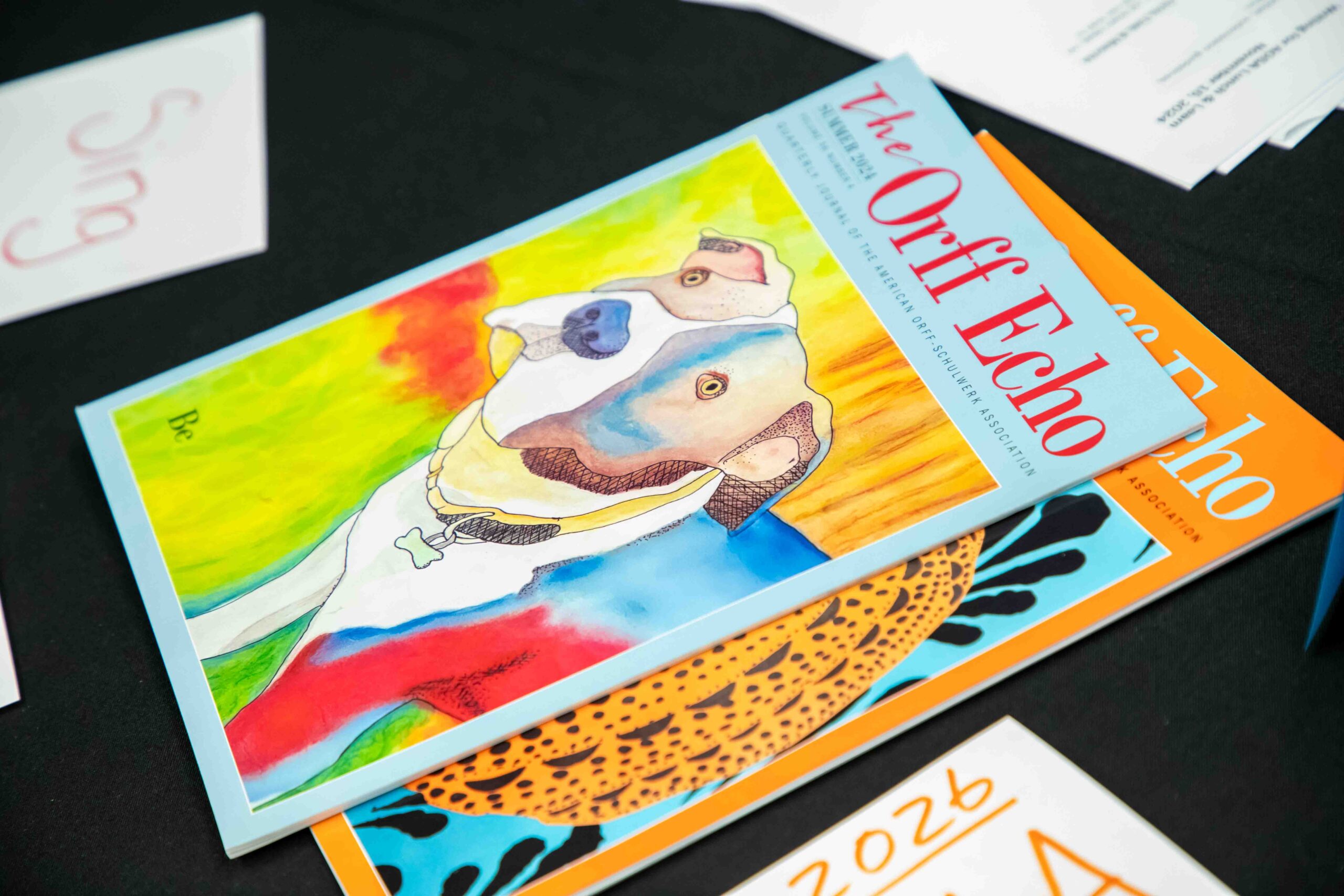
The Orff Echo is the national, peer-reviewed quarterly journal and philosophical voice of the American Orff-Schulwerk Association. Our mission is to demonstrate the value of Orff Schulwerk and promote its widespread use; to support the professional development of our members; and to inspire and advocate for the creative potential of all learners. Non-members may contact the editor for information.
Interested in writing for The Orff Echo? Check out how to get involved in the process:
Extensions to articles published in The Orff Echo can be found in the AOSA Resource Library.

List of Orff Echo Articles
National Core Arts Standards Series: Respond
Classroom activities based on NCAS Responding
Have You Ever Seen a Flower?
Children’s Book Review: Story filled with questions, inviting readers to think, pretend, and connect to the world around them.
The Orff Echo and Early Childhood Music Education: A Content Analysis
The Orff Echo has a long history of publishing articles about working with the youngest learners. In this article, the author researches the history of articles pertaining to early childhood and suggests potential future paths for Orff Schulwerk practitioners who want to better serve their youngest students.
Early childhood, elementary music, resources for teachers, The Orff Echo, content analysis, historical research
Musiqueando: School Concerts in the Street
Orff Schulwerk teachers are presented with a unique challenge when working with an instrumental ensemble, such as an orchestra. The author explores how to remain true to Orff Schulwerk in an orchestral setting by incorporating speech, singing, and student creativity.
Orff Schulwerk, orchestra, performance, process, student-centered, creative
Ear Worm!
Children’s Book Review: Playful lessons in perseverance, tolerance, and cooperation.
Stuck
Children’s Book Review: Activities using humor to facilitate learning in the music classroom.
Performance as a Habit
By creating a culture of performance, teachers can empower students to showcase their skills and celebrate their mastery while addressing performance anxiety. In this article, the author examines how the Orff-Schulwerk approach integrates performance with music education that emphasizes student agency and creativity, and contends that performances should be viewed as extensions of the learning journey, fostering exploration and collaboration.
Orff Schulwerk, Dalcroze, performance, process, student-centered, movement
Beginning Orchestra with an Orff Schulwerk Approach
Redefining performance as the sharing of music and movement with someone outside the initial experience, the author shares some ways of working with multi-age classrooms in a Montessori school community. From holding space for Upper Elementary students to create and bloom to welcoming parents to join younger students in the Orff process and performance, Orff in a Montessori school is a potential field of wildflowers.
Orff Schulwerk, orchestra, performance, process, student-centered, creative
Jazz, Joy and Justice
Professional Development Book Review: Resource for students and teachers presenting jazz greats and advocates from historical and social justice perspective.
National Core Standards Series: Perform
Classroom activities based on NCAS Performing.
Space for Wildflowers to Perform
Redefining performance as the sharing of music and movement with someone outside the initial experience, I share some ways of working with multi-age classrooms in a Montessori school community. From holding space for Upper Elementary students to create and bloom to welcoming parents to join younger students in the Orff process and performance, Orff in a Montessori school is a potential field of wildflowers.
performance, mixed-age, community engagement, curricular planning
Metamorphosis: An Evolution of Performance in the Orff Schulwerk General Music Setting
Orff Schulwerk prioritizes process over product, yet many general music teachers are required to put on performances with their students. It can be challenging to meet performance goals while not giving up valuable instructional time. In this article, the author provides suggestions for balancing limited instructional time while maintaining the integrity of the Orff Schulwerk approach in performances for the school community.
Orff Schulwerk, performance, themes, create, creativity, growth
National Core Standards Series: Create
Classroom activities based on National Core Standards Series (NCAS): Creating.
“Yes, and . . .”: Growing Awareness and Collaboration with Theatre Improvisation Principles
Using theatre improvisation “rules” and Dalcroze Eurhythmics is an effective means for developing students’ awareness of others and building skills necessary for musical and creative collaboration. In this article, the author offers examples and suggestions for applying this process when working with students from the young child to elementary school through college and beyond.
Orff Schulwerk, Dalcroze and Orff, theatre improvisation and teaching music, music education collaboration, teaching for student awareness, Spolin theater games and music education
Montessori-Orff: Creating a Unique Music Curriculum for Independent Students
Integrating the Montessori Method and Orff Schulwerk to support independent learners in elementary music
Montessori, Orff, Elementary Music, Independent Learning, Manipulatives
Creating the Minnesota Orff Course
Brief history of Minnesota Orff Schulwerk course. Showcases Minnesota as an example to highlight significant cross-pollination between various Orff Schulwerk dispersal sites. Transfer of knowledge and tradition between geographic regions continues to contribute to the rich and dynamic nature of Orff Schulwerk throughout the United States and North America.
Orff Schuwerk, Minnesota Orff, University of St Thomas, Jane Frazee, AOSA history, Orff dispersal in North America, Orff course history, Jos Wytack