
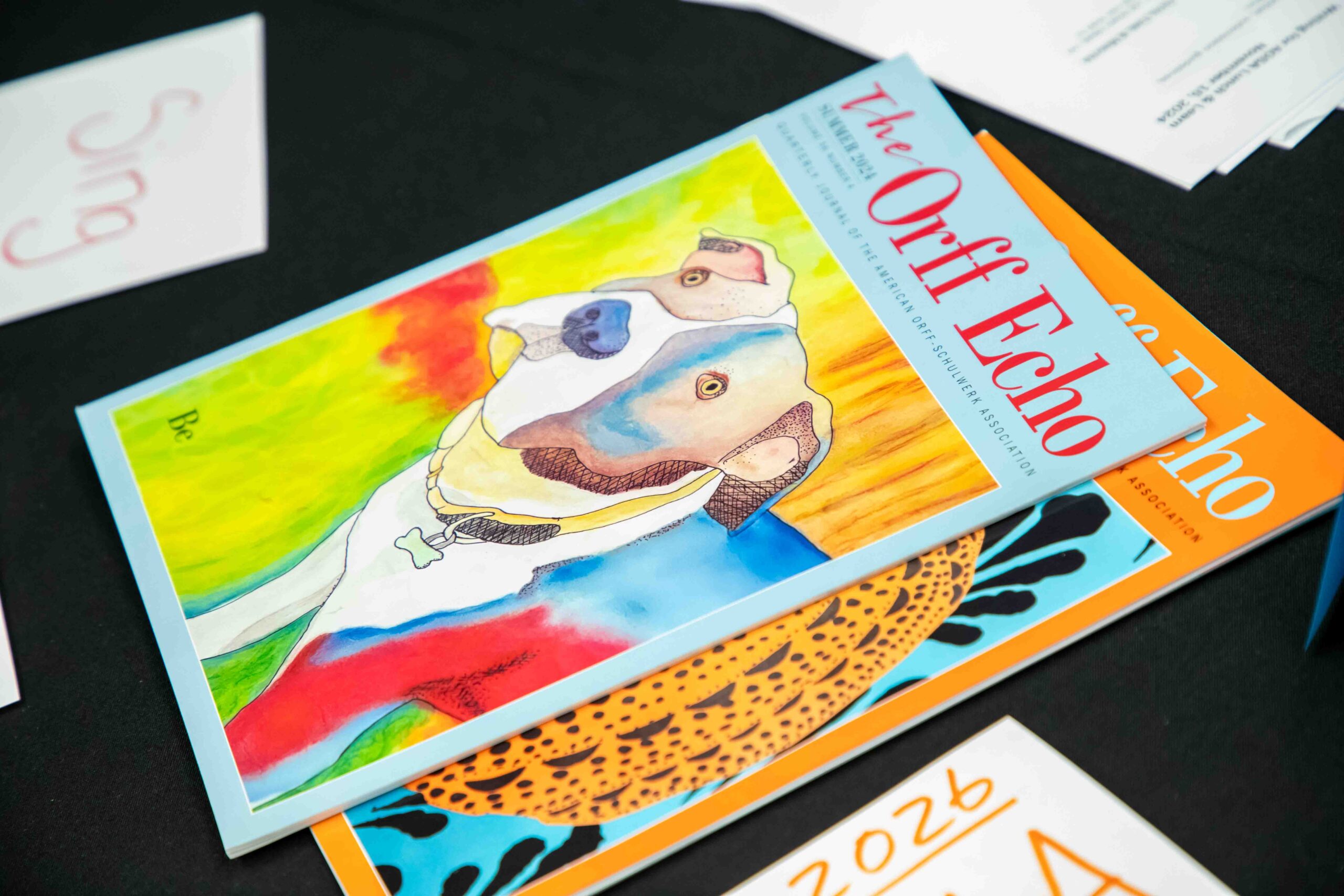
The Orff Echo is the national, peer-reviewed quarterly journal and philosophical voice of the American Orff-Schulwerk Association. Our mission is to demonstrate the value of Orff Schulwerk and promote its widespread use; to support the professional development of our members; and to inspire and advocate for the creative potential of all learners. Non-members may contact the editor for information.
Interested in writing for The Orff Echo? Check out how to get involved in the process:
Extensions to articles published in The Orff Echo can be found in the AOSA Resource Library.

List of Orff Echo Articles
Orff Schulwerk For Senior Adults
A vision for serving senior adults in new ways.
Music in Early Childhood: Setting A Sturdy Stage
Discussion of the importance of child’s play, construct-knowledge, and social interactions in early childhood music education. Orff Schulwerk teachers balance child/teacher initiated musical activities/simple to complex experiences.
The Jossey-Bass Reader on Gender in Education/Boys and GIrls Learn Differently!
Two professional development book reviews: The Jossey-Bass Reading on Gender in Education is meant to be a guide on issues found within gender and education. Boys and Girls Learn Differently: A Guide for Teachers and Parents contains storeis with suggestions on making the classroom more conducive to the learning needs of boys and girls.
Teaching Recorder in the Music Classroom
Professional Development Book Review: A well organized and easy to understand recorder resource including intro to recorder, selection, basics, national standards, teaching tips and program planning.
The Drummers in Golden Gate Park
Drums come together in OS to create a spirit of communion, the thirst to be connected to the earth, and a fundamental, elemental experience.
Four Days Way to a Lappish Drum
An account of building a Lappish drum in 4 days. Once you build it, it needs to be inaugurated and then it becomes your personal drum.
Using Orff Schulwerk in the African Tradition by W.K. Amoaku
W.K. Amoaku’s book Orff-Schulwerk in the African Tradition with examples of Ewe, Twi and Ga music from Ghana is an invaluable resource. The author furnishes background material and directions for some of the songs, games and instrumental arrangements based on research and interviews with Amoaku.
Sophisticated Simplicity: North and South Indian Rhythmic Concepts as Applied to Orff Schulwerk
An introduction to the Jati system of south Indian drumming rooted in math and language.
An American Orff Pioneer: Ruth Pollock Hamm
A biography of one of AOSA’s founders, her contributions to OS, and a teacher of the forerunner to AOSA Teacher Education Courses.
Leadership in AOSA 1968-1998
The results of a survey taken by former AOSA leaders regarding common themes, beliefs, and philosophies of American OS.
A Reflection: Orff Schulwerk as the Phoenix of Music Education
After WWII, with the destruction and then reconstruction of German musical life and culture, Orff Schulwerk was part of the rebirth and rebuilding of the foundation and blueprint for music-making.
Trying out a new way of teaching music: The Origins of Carl Orff’s Schulwerk
An historical account of the Gunther School, Carl Orff, Dorothee Gunther, Mayja Lex, Gunild Keetman, and Orff’s philosophy that music is movement and movement is music.
Tanzgruppe Gunther: The Legacy of Keetman and Lex
A story of the dance group that gave success to Orff Schulwerk. As Keetman and Lex collaborated through movement, song and play, these became a foundation for possibilities of a new way of teaching and learning.
Doreen Hall: What She Undertook To Do, She Has Brought To Pass
This is the amazing story of Doreen Hall, a violinst who turned to teaching music through Orff Schulwerk and brought OS to North American. The author acknowledges important figures who had influence making OS the force in music education that it is today.
A Composing Community: Portrait of an Orff Classroom
Researching “Portraiture,” the author helps teachers reflect on their OS training and how this shows the way to cultivate children as composers.
The Schulwerk: Vol. Three of his 8 Volume Autobiography, CARL ORFF/Documentation: His Life and Works
Professional Development Book Review: “The Blue Book,” translated by Margaret Murray offers a definition of Orff Schulwerk. It outlines Carl Orff’s meeting of historical figures through photos, stories, compositions, speeches and comments.