
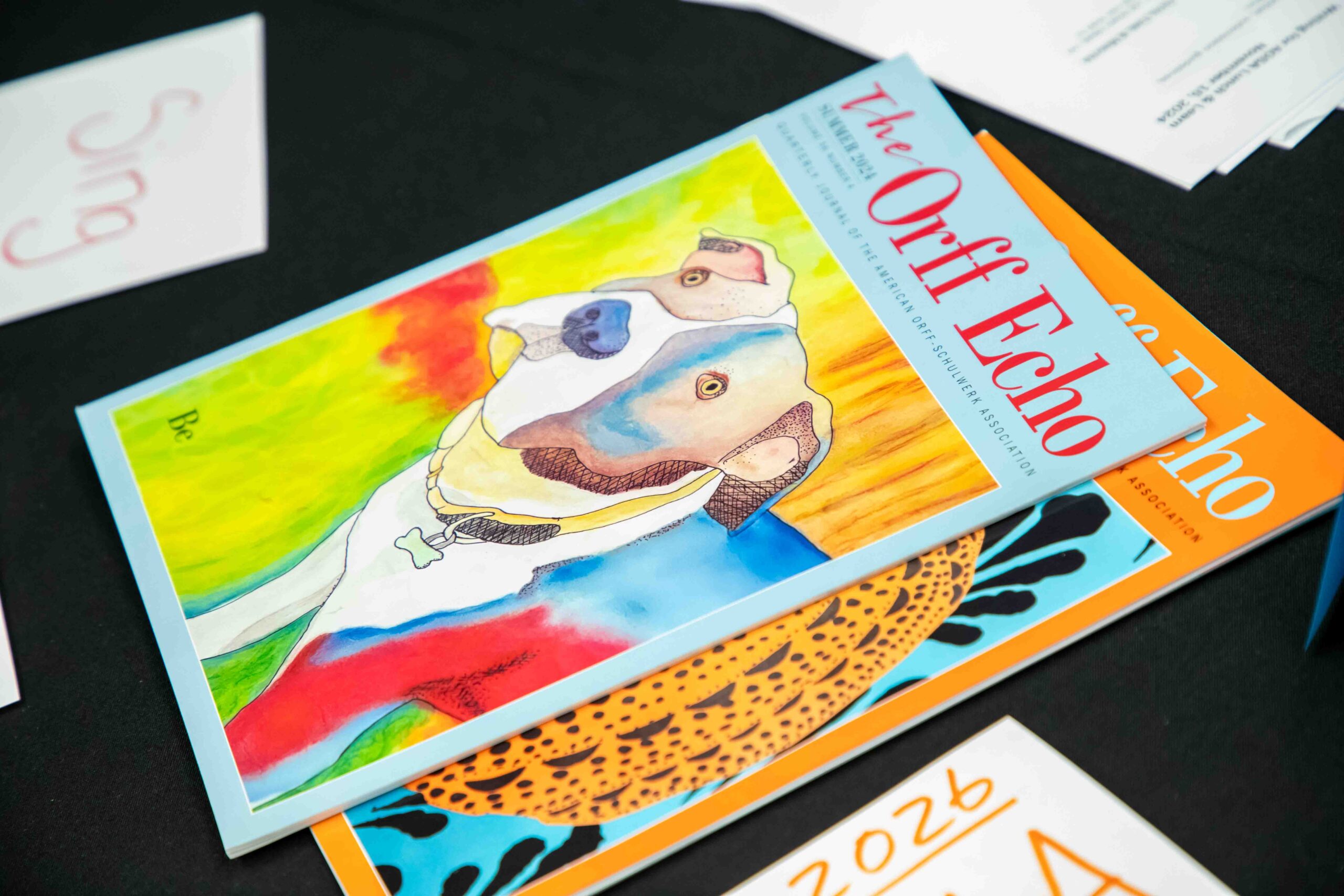
The Orff Echo is the national, peer-reviewed quarterly journal and philosophical voice of the American Orff-Schulwerk Association. Our mission is to demonstrate the value of Orff Schulwerk and promote its widespread use; to support the professional development of our members; and to inspire and advocate for the creative potential of all learners. Non-members may contact the editor for information.
Interested in writing for The Orff Echo? Check out how to get involved in the process:
Extensions to articles published in The Orff Echo can be found in the AOSA Resource Library.

List of Orff Echo Articles
Preparing to Teach: Essential Experiences in Music and Movement
University level music educator, Dale Misenhelter, writes about the challenges of preparing elementary classroom teachers to include authentic music activities in their classrooms.
A Whimsical Approach to Contemporary Music
Worth and Deininger discuss a year-long study of diverse cultures undertaken by their fourth and fifth grade students, culminating in a significant student-led performance.
Canon Corner: Snowflakes
Tossi Aaron offers a new take on a traditional German canon.
Four in All
Children’s book Review: This picture book consists of four-beat word chains paired to create simple rhyming poetry about humble things that become eloquent though the presentation and texture in sound and sight.
What is Aesthetic Education?
When children experience teachers who practice Orff Schulwerk, they benefit from the aesthetics of its approach.
Sharpening the Senses: Teaching and Thinking Like Leonardo da Vinci
Nash shows how teachers can encourage children to use their five senses, as da Vinci did, to make connections and discover relationships. Orff Schuwelk activates children’s sensory responses, thus allowing them to experience the world more fully.
The Gift of Curiosity: The da Vinci Project
Description of a school in Arlington, VA in which students are invited to investigate myriad elements their the five senses.
I Hear, I Wonder, I Know: Cultivating the Aesthetic in an Orff Schulwerk Context
When applied thoughtfully, the Orff Schulwerk approach addresses perception, imagination, and cognition. Through expressive improvisations, students may exercise aural memory as they experience the aesthetic.
Sounds I Am Thankful to Hear
The author compiled a list of approximately 300 sounds that children find pleasing and that offer the beginnings of a lifetime of aural memories.
Canon Corner: Train Canon
A fun canon based on signage in British trains that can be sung in up to 12 parts. Includes teaching suggestions by Tossi Aaron.
From the Classroom: Bringing Art to Life, Life to Art
Lesson idea pairing works of art with classical music selections.
The Genius of Play: Celebrating the Spirit of Childhood
Professional Book Review: Using her experience with Waldorf Education, Sally Jenkinson challenges the reader to reexamine the social, emotional, spiritual, and physical value of play.
Teaching by Heart
This article shares a personal journey toward curriculum integration promoting OS in the classroom. Classroom teachers using OS strategies can see how important music is for all children.
Weaving Literacy Strands Through Orff Process
A clear aid for classroom teachers using OS with materials and activities taught with dual purposes, stressing process rather than product improving literacy skills.
Orff, the Arts and the Civil War
An integrated approach using Orff process that explains the benefits of doing so. Musical skills and academic knowledge improve and are retained when using an arts-centered curriculum.
I Can Do It!
Empowering future elementary educators through Orff. OS teachers can impact pre-service classroom teachers by positive experience in music-making greatly increasing their value of using music in their classrooms.