
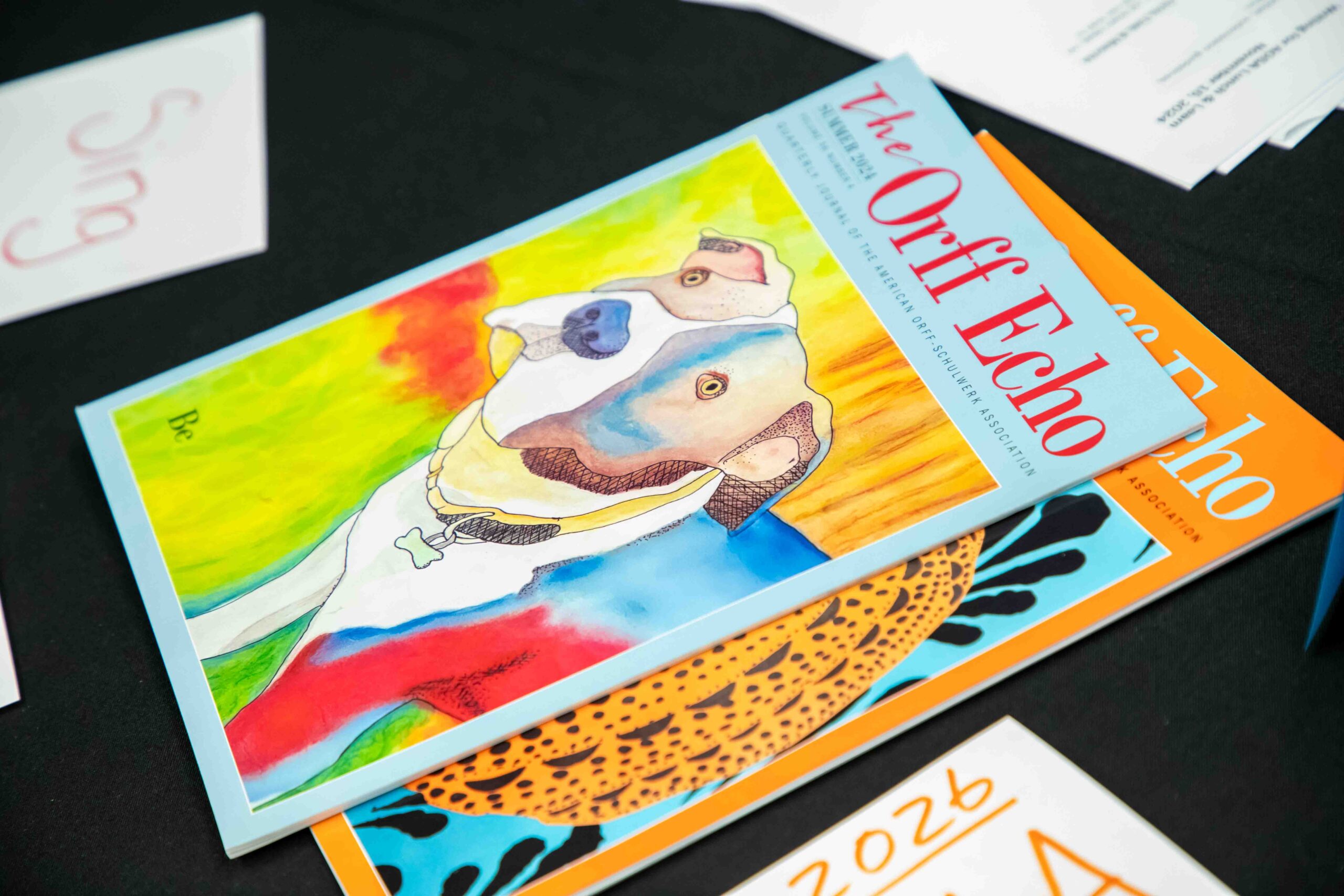
The Orff Echo is the national, peer-reviewed quarterly journal and philosophical voice of the American Orff-Schulwerk Association. Our mission is to demonstrate the value of Orff Schulwerk and promote its widespread use; to support the professional development of our members; and to inspire and advocate for the creative potential of all learners. Non-members may contact the editor for information.
Interested in writing for The Orff Echo? Check out how to get involved in the process:
Extensions to articles published in The Orff Echo can be found in the AOSA Resource Library.

List of Orff Echo Articles
Touching Eternity: The Enduring Outcomes of Teaching
Professional Development Book Review: This book embraces a view of teaching as a humanistic and artistic endeavor. Aimed at researchers and the scholarly community.
Arnold Burkart: AOSA’s first president
Portrait Series, biographical sketch and contributions to AOSA
Process teaching: Finding the Elements
Orff Process versus Orff process – discussion and examples of ways elemental music can be prepared to create process-oriented lessons. Elemental creative exploration of small units of rhythm and melody.
A Process of Reflection
Student assessment and self-evaluation as part of group process and creativity shown in 2 examples – one for older students inspired by a Taiko drumming video and one for younger students based on the book Listen to the Rain. Rubrics suggested for both.
Listen to the Rain
Children’s Book Review: Picture book with a lovely text that brings to life the sounds and silence of a rainstorm. Opportunities for music and movement abound for developing the musical and artistic sensibilities of children.
Orff Process Applied to Folk Dance
Applying ideas of Orff process to teaching folk dance facilitates an enjoyable experience for students. Play party games, simple folk dances, how to create dances, and learning the English country dance “Three Meet” are included.
The Question Song
Children’s Book Review: Picture book presenting questions about real-life dilemmas in which children may find themselves answered by an adult who soothes the child’s fears and provides creative solutions.
Life after Levels: My Year in Salzburg
A year at the Salzburg Special Course at the Orff Institute affirms that student creativity through exploration and improvisation is at the heart of Orff Schulwerk. Experience, explore and play, connecting body, voice and instruments to discover concepts and create music.
Botany 101: The Roots of the Wildflower
A conversation between Carol Erion and Roger Sams about their understanding of Carl Orff’s metaphor of the wildflower as a way to describe Orff Schulwerk.
From the classroom: Multi-tasking, individualizing and playing
A teacher improvises using an unplanned moment to inspire a lesson. The game “Stella Ella” leads to creating borduns, ostinati, and improvisation on barred instruments and recorders.
Let Us Praise Sound!
A canon in four parts using I-IV-V harmony.
Was It You, Mister Music?
A four-part canon in mixolydian mode.
Process as content in Orff-Schulwerk
It’s not what you say to students that’s important, it’s what they do with it. Process should be seen as the “key destination.” Process is categorized with examples in 3 categories: the intake-acquisition processes, the manipulative-divergence processes, and the manipulative-synthesizing processes.
The Ritual Power of Revels
Rituals are living customs, communal festivals, practiced by amateurs all over the world, offering the transformative power of folklore, with singing, dancing and mumming.
East Meets West, North and South: Students Anywhere Can Ring in the New Year
Learn how schools celebrate the Lantern Festival on the 15th day of Chinese New Year celebrating the ancestors, gods and heaven and earth with dragon and lion dances, puppet plays and dragons.
Create Music Classroom Rituals
Use routines and rituals to manage classes and define standards in artful and routine ways (applied to housekeeping, singing.)