
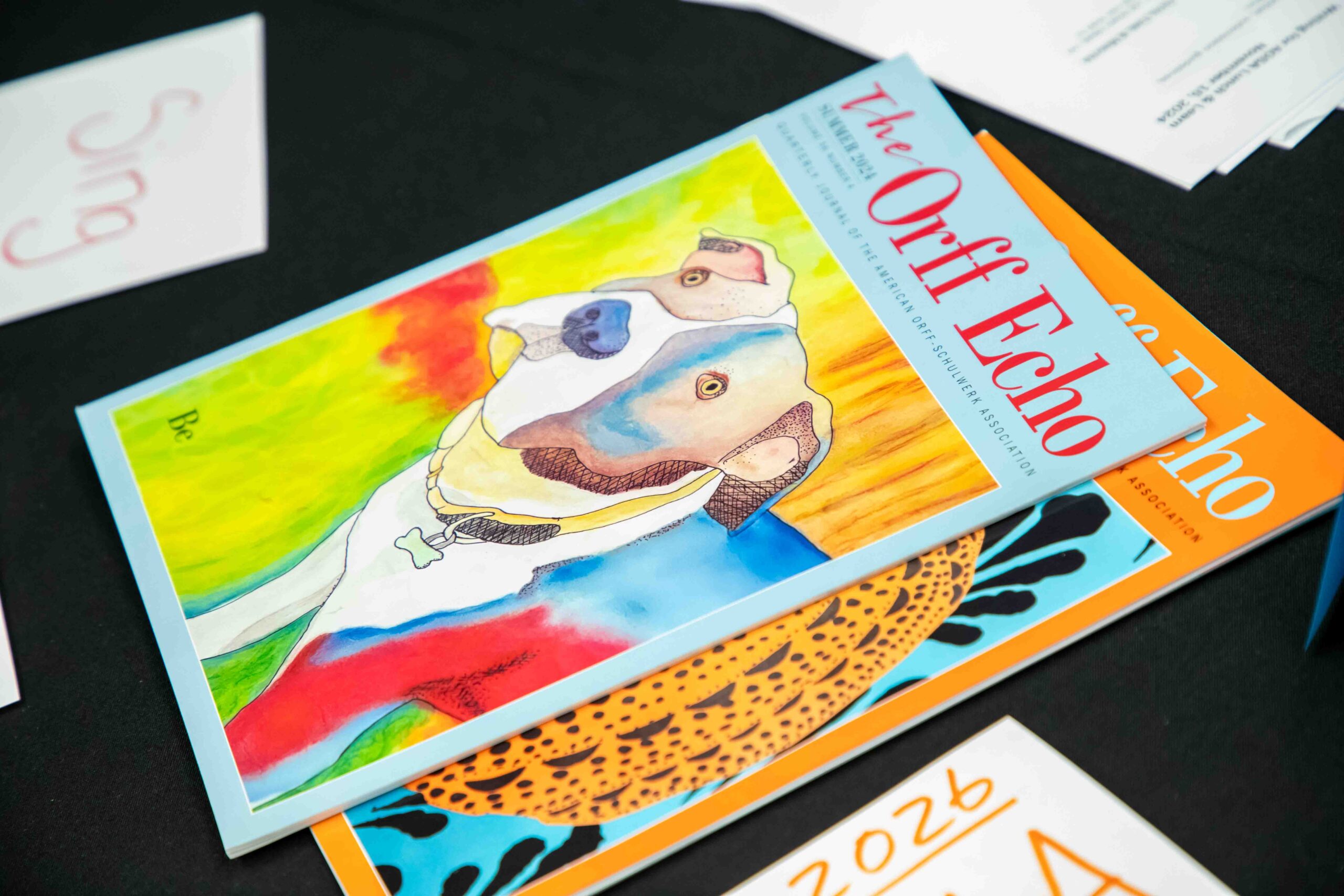
The Orff Echo is the national, peer-reviewed quarterly journal and philosophical voice of the American Orff-Schulwerk Association. Our mission is to demonstrate the value of Orff Schulwerk and promote its widespread use; to support the professional development of our members; and to inspire and advocate for the creative potential of all learners. Non-members may contact the editor for information.
Interested in writing for The Orff Echo? Check out how to get involved in the process:
Extensions to articles published in The Orff Echo can be found in the AOSA Resource Library.

List of Orff Echo Articles
Focus on Research: Discovering Interconnections between Music Description and Language Development
Flowers explores the connections between language and music with implications for teaching.
Folk Music of African American Culture Offers Perspective
Campbelle-Holman discusses the many threads that led to the African American culture and it’s music.
Sing Around the Dishpan
Goodkin interviews famous folk musician Jean Ritchie about her life and her music.
Portrait Series: Norm Goldberg and the Power of Music
Norm Goldberg has contributed to AOSA and Orff Schulwerk for nearly 40 years. This article is based on Hetrick’s interview with Goldberg.
Folk Songs are Valuable Teaching Tools
Woody discusses reasons to use folk songs in the Orff classroom.
The Orff Approach in Creating a Wayang
This article recounts Schuck’s experience helping her students in Stuttgart, Germany create a Wayang- a Chinese opera.
Dia de Muerte: Day of the Dead, a Lively Celebration
The Day of the Dead celebrations, associated with the Christian celebration of All Saints day, are prevalent in Mexico and Hispanic families and culture groups througout North America.
Piano Improvisation Develops Musicianship
Kertz-Welzel writes about the importance of improvisation at the piano. Carl Orff said the ideal piano improviser should “get ears on his fingers.”
Abiyoyo Returns
Children’s Book Review: The sequel to the original title, this children’s book features the lullaby song of the Xhosa people of South Africa and the message of kindness and cooperation while providing opportunities to meet multiple musical objectives.
The Schulwerk, Early Music, and Renewal
Andrews discusses the relationship of the early music revival in the early 20th century and the Schulwerk. Orff and Keetman were greatly influenced by this music and included it in their work at the Guntherschule.
Translating Balinese Music from Gamelan to Orff Ensemble
Harnish discusses the Gamelan ensemble of Bali. In 1997 he arranged some simple Balinese pieces for Orff ensemble. The article discusses that process.
The Zen of Orff-Schulwerk
Goodkin relates Orff-Schulwerk teaching to the study of Zen Buddhism. He says “Orff practice is as simple as this: tend the soil and trust in the bloom.”
Orff Process and Performance Changes College-student Attitudes
Trenfield recounts her experiences as a college music education methods teacher using the Orff approach to help her students prepare a program presented to an elementary school audience.
The Creative Process Reflected in Nature
Shultz discusses the legacy of the writings of Arnold Burkhart, first president of AOSA, and John Holt, author of several books on educational reform in elementary educatiion. Both called for a change in the schools from content to process.
The Rote Song: Does One Size Fit All?
Gault talks about teaching rote songs in the elementary music classroom, citing research on song acquisition by children. He also discusses his own research project on two ways to teach a song.
Don’t Let Science Bug You
The author relates how she was able to emphasize science in her music classroom.