
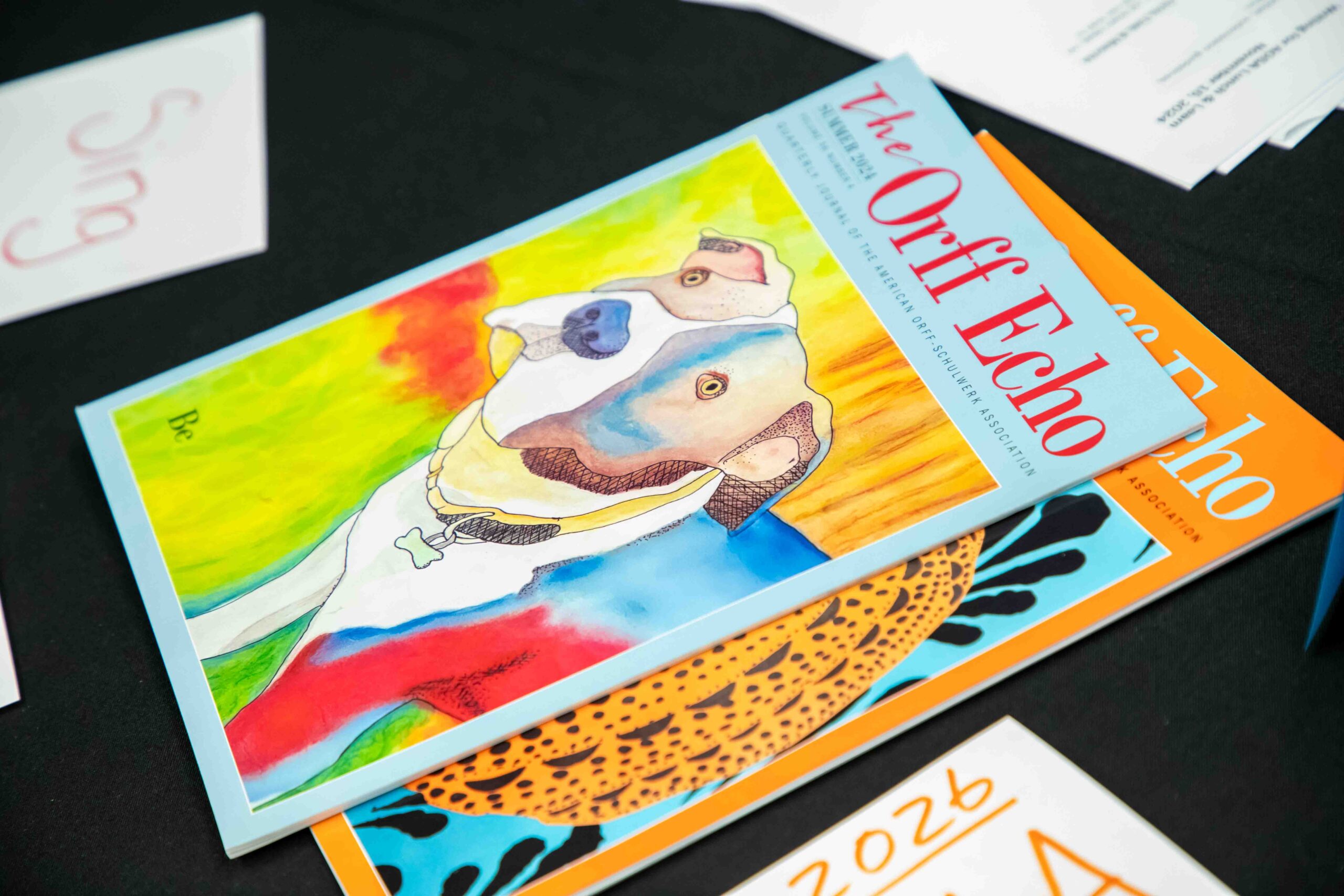
The Orff Echo is the national, peer-reviewed quarterly journal and philosophical voice of the American Orff-Schulwerk Association. Our mission is to demonstrate the value of Orff Schulwerk and promote its widespread use; to support the professional development of our members; and to inspire and advocate for the creative potential of all learners. Non-members may contact the editor for information.
Interested in writing for The Orff Echo? Check out how to get involved in the process:
Extensions to articles published in The Orff Echo can be found in the AOSA Resource Library.

List of Orff Echo Articles
The Singer’s Ego
Professional Development Book Review: A review of the book The Singer’s Ego by Lynn Eustis. The conclusion is that everyone working with singers, including teachers and conductors, would benefit from reading this work.
Snow Music
Children’s Book Review: Picture book about a child in pursuit of his escaped dog across the winter landscape encountering meandering wildlife, traffic, and a helpful friend along the way.
Boa Viagem: a Good Journey Brings the Schulwerk from Rochester to Recife
The authors journey to Recife, Brazil where they help Flavio Medeiros introduce Orff Schulwerk and a new instrumentarium to his university students. Descriptions of Maracatu, and Frevo, with music for the passing game Escravos De Jo, and a song about the folk bandit Lampiao.
The Musical World of the Wagogo Children of Tanzania
Every aspect of life among the Wagogo people of Tanzania is expressed in their musical repertoire. Everyone is a musician. The author describes and gives examples of children’s music, the xylophones found in every house, the songs from the Makumbi initiation rite, and the ways music is learned.
High-flying Dancing into Language
The author describes a project where students are inspired to write through movement experiences. Using the theme of “flying” students find words to create movement, and move to create poems. Students observe, discuss and enjoy each other’s work.
Lights! Camera! Action: Orff Schulwerk and the Moving Picture
Film is explored as a new media for Orff Schulwerk creativity, using readily available technology. Student groups choose a short film from Lumiere and Company to create a musical accompaniment, using strategies of film composing. With video-editing software, the resulting soundtracks are added to the film for viewing.
‘Round the Oak Tree
Three part canon with movement suggestions.
Taking Morris Dances Beyond the Cotswold Hills
Cotswold Morris Dancing is the most well-known type of Morris dancing; here the author describes 3 others: Welsh Border Morris with directions for the dance “Much Wenlock”, Molly dancing and Northwest Morris. History, costumes, music, and resources are provided.
Sing To Springtime
Two-part canon in celebration of spring.
Portrait Series: Sarah Goldstein
An interview with Sarah Goldstein on the occasion of her 97th birthday reveals the importance of her work from the early 1960s into the 70s and her crucial role in the foundation of Orff Schulwerk in the United States.
Making Language Connections Through Orff Schulwerk
The author discovered that, through her work as an Orff Schulwerk teacher, she was also teaching phonemic awareness, syllables, rhyme, parts of speech, grammar, vocabulary, spelling, and other early literacy concepts and skills.
Tanka Tanka Skunk
Children’s Book Review: Picture book featuring two musical friends who play drums to the rhythm and rhyme of their names and the names of their friends whom they encounter along the way.
No Mirrors in My Nana’s House
Children’s Book Review: Poetic picture book with African American words of wisdom telling of the beauty and love that exists all around us, as told by a little girl raised in her Nana’s house. CD with accompanying song included.
Orff Schulwerk and Literacy Follow Parallel Paths
This article discusses the complementary and parallel processes that that occur in emerging language literacy and Orff Schulwerk experiences.
Puzzles, Structures, and Journeys: Learning to Read and the Orff Process
The author explains how Orff process, applied to music and movemen,t builds the skills required for reading.
Focus on Research: A Research Base
New research validates an integrated curriculum of music and reading in specific areas: learning transfer, engagement, aural discrimination, and visual discrimination.