
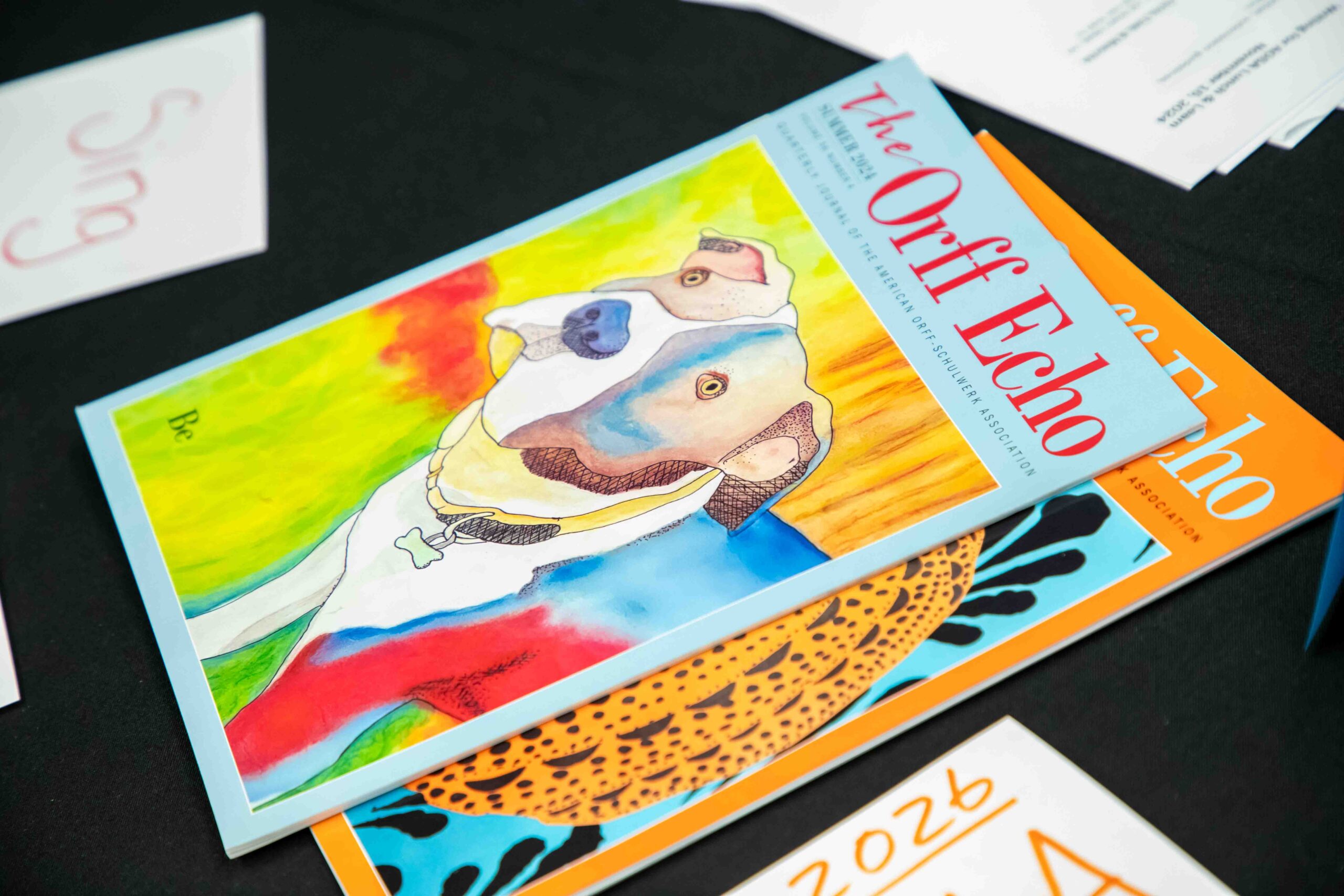
The Orff Echo is the national, peer-reviewed quarterly journal and philosophical voice of the American Orff-Schulwerk Association. Our mission is to demonstrate the value of Orff Schulwerk and promote its widespread use; to support the professional development of our members; and to inspire and advocate for the creative potential of all learners. Non-members may contact the editor for information.
Interested in writing for The Orff Echo? Check out how to get involved in the process:
Extensions to articles published in The Orff Echo can be found in the AOSA Resource Library.

List of Orff Echo Articles
Waiting for Wings
Children’s Book Review: Vividly illustrated picture book by Lois Ehlert featuring the life cycle of the butterfly that invites a music and dance interpretation.
The Musical Heritage of Keiki, Hawaii’s Rainbow Children
Author compares the ethnicities in Hawaii’s musical culture to the wildflower of Orff Schulwerk. Children model what diverse cultures living/learning together can achieve.
Acknowledging the Cultures in Our Classrooms: Welcoming Children to Music
Hamilton explores the role music class can play in easing the way for a student of a different cultural heritage to integrate into a school community.
Children’s Musical Surroundings: What Can Children Tell us About Music Eucation?
Author explores the need for children’s belief systems to be honored. Social context of home, classroom and playground reflect and celebrate autonomy of individual.
Letting High School Children “Be Their Own Composers”: The Schulwerk and Popular Music
Thibeault chronicles his growth toward creating a classroom where HS students can explore their ideas, uniting educational meaning with their musical culture.
My Isamic Journey After Sept. 11
Post 9/11 assumptions about immigrants and Muslims propelled author to personal quest: how music can link people without regard to religion, culture or ethnicity.
From the Classroom: Ambassadors to the Music Room
Webster invites students and families with multi-cultural backgrounds to share connections by teachinng classmates.
Los Gatos Black on Halloween
Children’s Book Review: Bilingual Halloween poem and picture book introduces young readers to a spooky array of Spanish words and creepy sounds for vocal and musical exploration.
The First Four Are The Amazing Musical Years
Exposure to the musical elements in early childhood is the catalyst for successful music making on a personal and professional level.
Using a Conceptual Approach to Dance Education
The author describes how she helps students to experience the communal nature of dance, as well as its ability to show meaning and emotion through movement.
Orff Schulwerk and Reggio Approaches Are Interwoven Successfully
The fundamentals of the Schulwerk, like the Reggio approach are constant. In the application of both, changes occur as we understand children, the brain, culture, and teaching.
From Constructivist Theory to Orff Practices in the Early Childhood Music Classroom
Orff Schulwerk is intrinsically related to constructivism as children are invited to interact with music concepts and explore composition.
Language + Movement: Fostering Steady Beat Competence in Young Children
Studies in kinesiology and music education suggest that overt speech can foster rhythmic accuracy.
Responding to the Ecologies of Music Making in Early Childhood
Musical beginnings occur within the ecology of the home and expand as the child’s world widens into new places.
All the Pretty Little Horses
Children’s Book: Review: This picture book shares a traditional lullaby with roots in the rural south and African American culture provides opportunities for sociological/ historical discussions, and provides a context for students to compare their lives with the children in the lyrics.
Handsprings
Children’s book Review: This picture book includes 48 poems about the new plants, animals, and warming weather of spring, the renewal of the life cycle, and our release into the outdoors after a long, cold winter.