
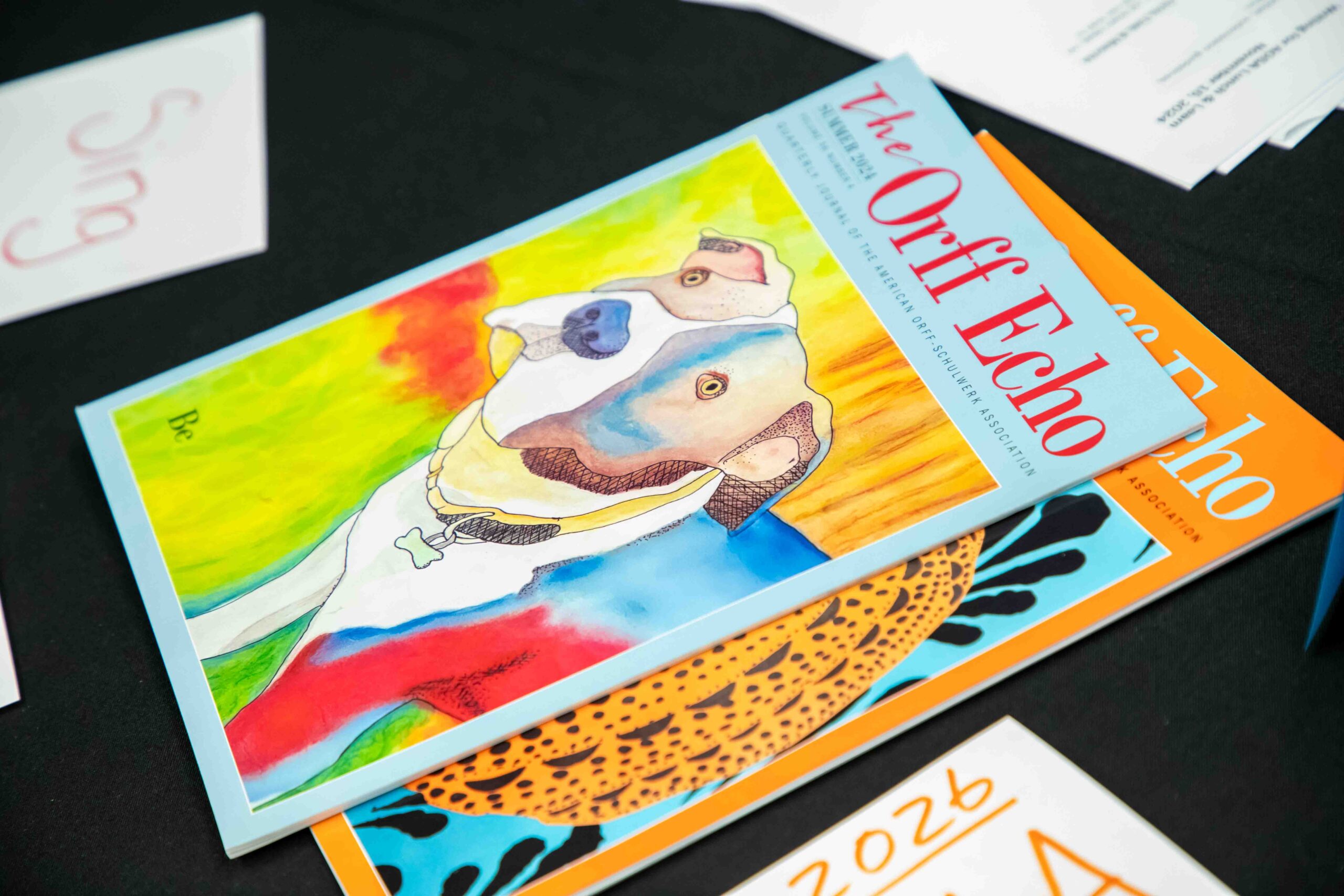
The Orff Echo is the national, peer-reviewed quarterly journal and philosophical voice of the American Orff-Schulwerk Association. Our mission is to demonstrate the value of Orff Schulwerk and promote its widespread use; to support the professional development of our members; and to inspire and advocate for the creative potential of all learners. Non-members may contact the editor for information.
Interested in writing for The Orff Echo? Check out how to get involved in the process:
Extensions to articles published in The Orff Echo can be found in the AOSA Resource Library.

List of Orff Echo Articles
Middle Eastern Music Resources
Children’s songs and games from Iran as shared by an Iranian culture-bearer. Includes information about Iranian children’s musical development and an annotated bibliography of music teaching materials from the Middle East.
A Brief Comparison of Rhythm Pedagogy Systems
Cole presents various rhythm syllable teaching systems. Keetman discussed this but said that it is left to the teacher to decide how to do it. Cole suggests teaching beat and rhythm function at the aural/oral level instead of being notation dependent.
Research and the Little Red Hen
Wang discusses the need for all music educators to do research and proposes a global model for research in Orff Schulwerk.
Finding a Musical Voice of Cooperation and Teamwork: Teaching in a Children’s Home
The author shares her experiences teaching residents of a children’s home, a residential facility for children who have behavior disorders attributed to neglect and abuse. Her Orff Schulwerk training helped with the challenge.
Teaching Kids To Sing
Professional Development Book Review: In Teaching Kids to Sing, Kenneth Phillips has compiled a text that fills an important, yet often overlooked niche—the study of the developing voice in young children.
Old Turtle
Children’s Book Review: Picture book about ecology, peace, and the inter-connectedness of all beings; a parable that explores the diversity of thinking about spirituality, humankind, religious differences, and tolerance.
Let’s Play Now…But Seriously
While play is an important part of teaching, the reality of school requires other ways of learning as well. Teachers must be careful not to make play utilitarian. Truly play with your students, with no other objective, so they may enjoy your inner child.
From the Classroom: The Work of Children is Play
The author explores the song Sarasponda in a playful way through warmups, text, exploring meaning with movement, rhythm, dynamics, articulation, a passing game, body percussion, partner clapping, faux folk dance, xylophones, harmony and literature.
Clatter Bash! A Day of the Dead Celebration
Children’s Book Review: A picture book celebrating the Mexican holiday, El Día de Los Muertos, honors Spanish speakers in the classroom while engaging all students in rhythmic word play.
There Is a Flower at the Tip of My Nose Smelling Me
Children’s Book Review: Alice Walker celebrates the beauty and wonder of nature and creativity. This children’s book, by the well known author of The Color Purple and other books, was inspired after a walk in the woods with her dog.
Playing the Old Games
Archetypal children’s games are found worldwide, and are central to Orff Schulwerk, developing social and group skills, creativity and musical skills. Students make observations about Brueghel’s painting Kinderspiele and their own world of play which leads to playing the games, further preserving children’s culture.
The Role of Play in Early Childhood Education
Brief history of play theory in early childhood education with focus on High/Scope, Montessori and Reggio Emilia. Statements on play by NAEYC and MENC are given as well as a suggestions how to promote play in music education.
Portrait Series: Elizabeth Nichols – Orff Schulwerk Influences
Elizabeth Nichols’ Orff journey is described, from early days in the 1960s where she was first introduced to the Orff process by Barbara Grenoble, to teaching and lecturing worldwide, writing books and discovering the Native American flute.
Exploration and Learning Through Play
Inspired by a 1998 Orff Echo article by Giovanni Piazza, MrCreary demonstrates with many photos how her students explore, discover, and create using barred instruments, recorders and small percussion. Through play children learn design, form, resonance, low/high, cooperation, patterns, and more.
The Musical Heritage of Keiki, Hawaii’s Rainbow Children
Author compares the ethnicities in Hawaii’s musical culture to the wildflower of Orff Schulwerk. Children model what diverse cultures living/learning together can achieve.
Acknowledging the Cultures in Our Classrooms: Welcoming Children to Music
Hamilton explores the role music class can play in easing the way for a student of a different cultural heritage to integrate into a school community.