
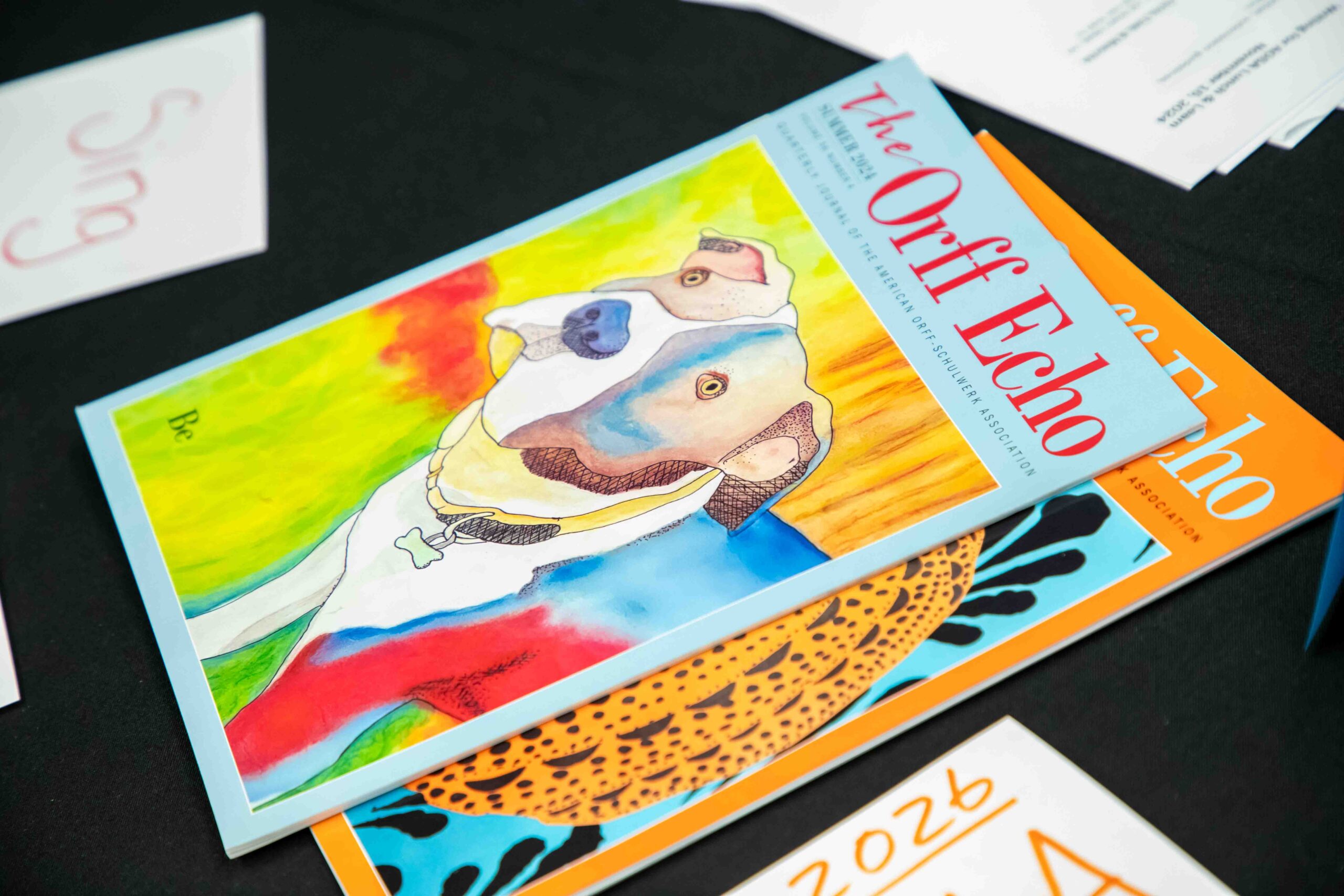
The Orff Echo is the national, peer-reviewed quarterly journal and philosophical voice of the American Orff-Schulwerk Association. Our mission is to demonstrate the value of Orff Schulwerk and promote its widespread use; to support the professional development of our members; and to inspire and advocate for the creative potential of all learners. Non-members may contact the editor for information.
Interested in writing for The Orff Echo? Check out how to get involved in the process:
Extensions to articles published in The Orff Echo can be found in the AOSA Resource Library.

List of Orff Echo Articles
Cracking Open the Volumes: Volume III, Riddles
DeStefano details a teaching sequence for Volume III, Riddles and shares new perspectives.
The Boy Who Loved Words
Children’s Book Review: This delightful picture book about words invites children to collect their favorite words. In the music classroom these word collections can become the source of rhythmic invention, movement exploration, and more.
Mocking Birdies
Children’s Book Review: A picture book written in elemental question and answer form invites children to explore many possible variations.
Flamingos on the Roof
Children’s Book Review: This picture book is a marvelous addition to the library of teachers who enjoy language-based musical exploration.
Best-Loved Folktales of the World
Children’s Book/Professional Development Book Review: A collection of folktales from around the world with an introduction about the purpose this genre has served over time.
Helping Your Students Sing In Tune
Roberts discusses ways to help children sing in tune. He advocates having students sing by themselves to address individual problems.
The Place of the Voice in Orff Schulwerk
Arvida Steen discusses the place of the voice, especially singing, from the beginnings of the Schulwerk. She discusses Keetman’s view that singing was integral to music education.
Four Music Teachers Discuss the Challenges of Teaching Children to Sing
Beam interviewed four male music teaches, all on the staff of the Indianapolis Children’s Chorus, concerning the challenges of teaching young children to sing.
Benefits of Folk Songs in the Elementary Classroom
Gerber discusses the importance of using folk songs in the elementary music classroom. He provides examples often used by Koday-inspired teachers.
Singing in the Schulwerk: What are it’s Roles and Importance?
The article is the result of Scott’s interviews with six music teachers who are instructors for AOSA Teacher Training Courses. All felt that singing is of great importance in an Orff Schulwerk classroom.
The Music Teacher’s Voice
Spurgeon discusses ways that music teachers can prevent voice problems, even while teaching children all day.
Do Re Mi: If You Can Read Music, Thank Guido d’Arezzo
Children’s book Review: Picture book about the life of Guido d’Arezzo and the history of music notation. Brings this time in music history alive for children through artful storytelling based on historic facts and events.
Papa, Please Get the Moon for Me
Children’s book Review: Picture book by Eric Carle about a little girl who wants to play with the moon. The text provides an introduction to the lunar cycle with many possibilities for music and movement activities.
Exercising the Young Voice: What I Know for Sure
The article discusses vocal warm-ups for children that will help prevent vocal problems as they sing later in life. She discusses body alignment, breathing, vowels, and extending the child’s vocal range.
Orff Schulwerk as Interdisciplinary Education, a Goldilocks Approach
Dixon explains that cross-disciplinary teaching provides an opportunity for meaningful learning that passes fluidly back and forth between the disciplines of music and dance. She points out that Orff and Keetman conceived the Schulwerk as interdisciplinary, focused on developing the whole child.
Middle Eastern Music Resources
Children’s songs and games from Iran as shared by an Iranian culture-bearer. Includes information about Iranian children’s musical development and an annotated bibliography of music teaching materials from the Middle East.