
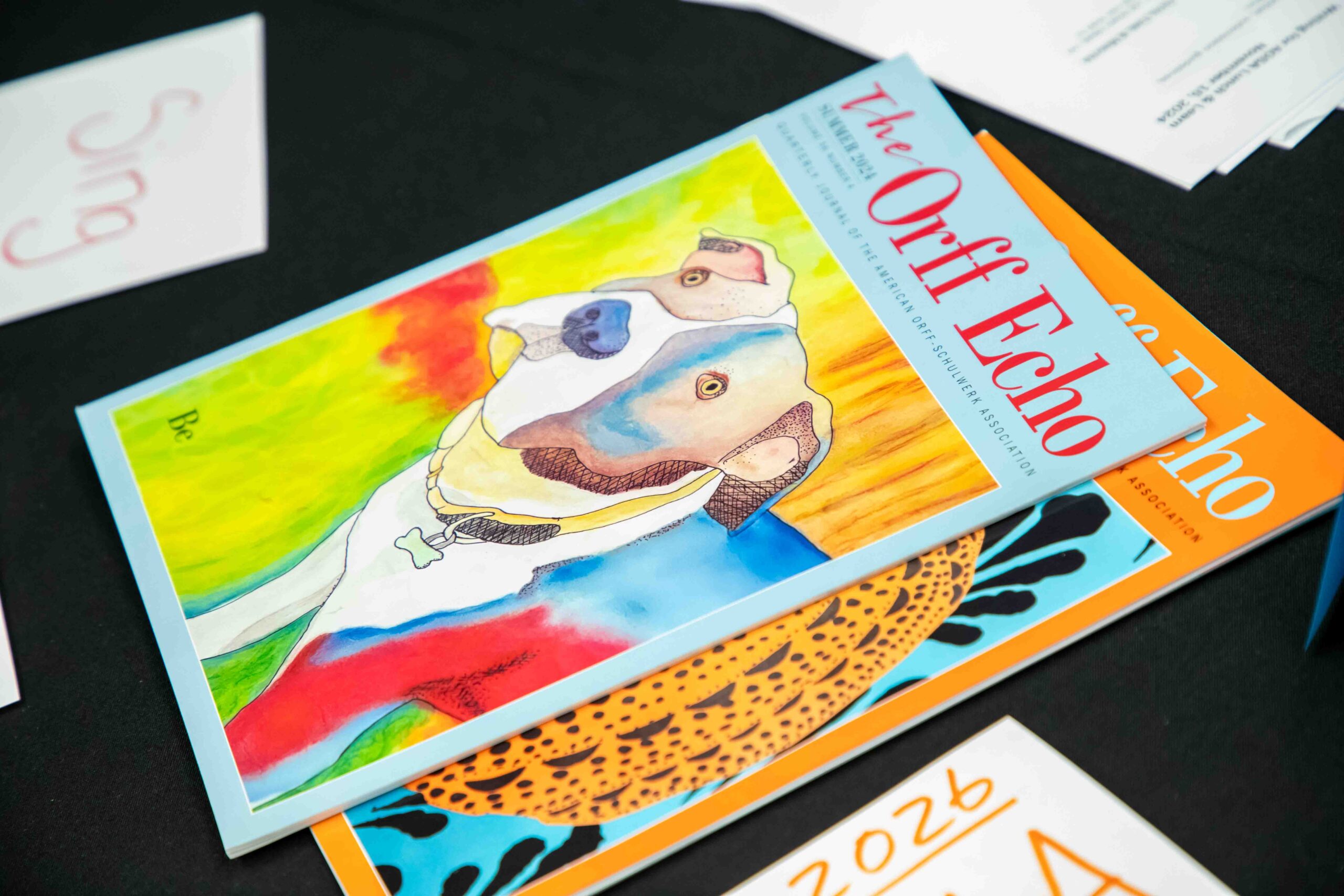
The Orff Echo is the national, peer-reviewed quarterly journal and philosophical voice of the American Orff-Schulwerk Association. Our mission is to demonstrate the value of Orff Schulwerk and promote its widespread use; to support the professional development of our members; and to inspire and advocate for the creative potential of all learners. Non-members may contact the editor for information.
Interested in writing for The Orff Echo? Check out how to get involved in the process:
Extensions to articles published in The Orff Echo can be found in the AOSA Resource Library.

List of Orff Echo Articles
The Joy of Singing Games
Roberts discusses reasons to combine play and song and also discusses potential pitfalls while doing singing games.
The Maestro Plays
Children’s picture book describing the many ways the maestro plays his instruments using rhyming adverbs words to describe the timbre, emotion, and expression of each instrument.
Carrying the Torch: The Legacy of Carl Orff
Goodkin relates the Schulwerk to a living trust, making Orff’s ideas forever contemporary and striving to be worthy of the legacy entrusted to us.
Brain-based Education in Music: A New Science or Scinece-fiction?
Persellin discusses some of the promising new studies and their implications for music education. She cautions that there are yet no definitive conclusions.
This Jazz Man
Children’s Book Review: Picture book offering a swinging version of the folk favorite, “This Old Man,” featuring famous jazz musicians and their instruments, scat singing, and movement. Includes a brief biography of each musician.
Focus on Research: What it Means to Leave New Orleans.
The article offers a glimpse into some of the musical traditions of New Orleans and invites teachers to consider the place pf those traditions in the music classroom.
Movement to Music, Music to Dance
Inspired by photos and ideas from the Guntherschule, the author describes a process of creating movement from music and music from movement with her second grade class. Doreen Hall’s arrangement of “Three Blind Mice” provides a springboard.
Dalcroze Eurhythmics and the Quick Reaction Exercises
A brief description and history of Dalcroze’s music/movement philosophy of eurhythmics is given. The author provides many useful examples of musical prompts called Quick Reaction Exercises and includes working with children with disabilities.
Body Percussion in the Pacific Islands
The author describes the wide variety of body percussion used in traditional performances of the Pacific Islands. Examples include the Yapese slap dance and Lahan Tenbat dance from Micronesia, and the Sasa and M ‘ulu ‘ulu sitting dances from Samoa.
The Joy of Teaching World Dance
Ideas and tips for teaching folk dance are shared by a master folk dance teacher. Directions for three folk dances are included, with emphasis on civility, cooperation and community.
Teaching Movement and Dance to Adults: A Reflection
The author muses about the similarities between the college music education class and Orff Level Training at their best. Bringing the feeling of trepidation and joy with new aesthetic experiences to students is essential to both.
From the Classroom: Laban Prompts
The author provides delightful prompts for the eight Laban “efforts” as well as music to inspire creative movement.
Smart Moves
Professional Development Book Review: In this book, Hanford explains that even the simple activities of running, jumping, skipping, and twirling have great impact upon developing the brain’s ability to learn.
Movin’ Up
Part of a series on former Orff Schulwerk students, the dancer Cody Green is asked how Orff Schulwerk contributed to his success – from dancing on Broadway to Twyla Tharpe. His mother is Susie Green, dancer, choreographer and Orff teacher.
Calabash Cat and His Amazing Journey
Children’s Book Review: In this children’s picture book, a West African cat sets out one day to find where the world ends. With illustrations inspired by the calabash engravers of Chad, we are asked to see the world through eyes and languages other than our own.
From the Classroom: The Sounds of Music
Students design and build their own instruments out of recycled materials.