
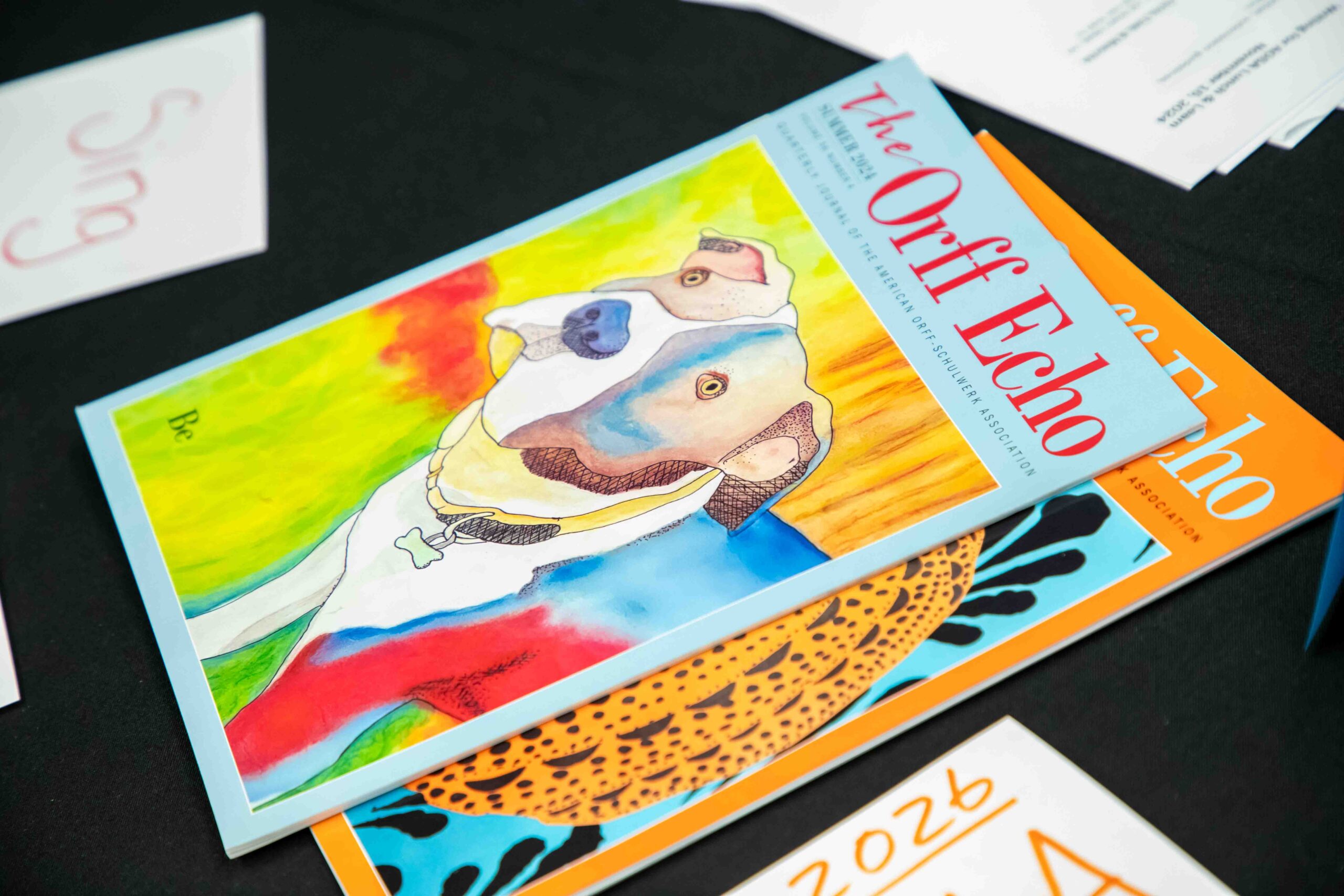
The Orff Echo is the national, peer-reviewed quarterly journal and philosophical voice of the American Orff-Schulwerk Association. Our mission is to demonstrate the value of Orff Schulwerk and promote its widespread use; to support the professional development of our members; and to inspire and advocate for the creative potential of all learners. Non-members may contact the editor for information.
Interested in writing for The Orff Echo? Check out how to get involved in the process:
Extensions to articles published in The Orff Echo can be found in the AOSA Resource Library.

List of Orff Echo Articles
Rediscovering the Elemental Source: Experiencing Spirit Through the Schulwerk
Bliss, flow, feelings, community, liberation of human spiritual core are achieved through the mastery of creative process; Orff’s intention to reconnect humanity to primal music, spirituality, and dance in community; using three types of lessons: imitation, exploration and creation to create performance or ritual and creative prayer.
Joint Attention and the Orff Process
Music therapy, Gertrud Orff and unlocking autism through teaching shared (“joint”) attention; ostinati create a safe environment for engagement; layered orchestrations support autistic learner’s sensitivities to sounds.
An Interview with Cathy Ross
Art teacher and non-musician attends Orff Levels to teach music and art classes; learns classroom management for music by trial and error, then uses instruments, song, puppetry, drumming in community procession.
Let it Shine: Three Favorite Spirituals
Children’s Book Review: This book features three favorite spirituals, “This Little Light of Mine,” “Oh, When the Saints Go Marching In,” and “He’s Got the Whole World in His Hands,” with colorful illustrations, music notation, and historical notes.
Remembering “Yesterday,” Envisioning Tomorrow
Active music making teaches children thinking skills; advocate for active and reflective music education.
Releasing the Dancer Within
Author used OS to teach dance to elders in the community through improvisational structures, creating a movement ensemble, using arts integration.
The Orff Adult Ensemble Experience
By participating in Patschwork, personal enrichment and professional development are gained through exploration, improvisation and creativity based on elemental music.
Summer Psalmody: A Creative Arts Church Camp
In week long multi-media, with arts integration, campers create and perform worship service.
Orff-based Music Therapy in the Pediatric Hospital Setting
Family-centered care model in a medical setting provides participatory healing, mood elevation, pain relief and more.
Orff-Schulwerk: Process, Not Method
Without student choice, process remains imitation. Guiding change and transformation is essential and results in students becoming confident citizens in a free and democratic society.
Milestones in the History of Orff Schulwerk in the United States
Brief summations of AOSA landmark advances and leaders over the years from 1953-2009.
Lollipops Concerts: Interactive or Inactive?
Community music education through OS and partnerships with local orchestra and musicians using story telling, mime, and group improvisation performed by orchestra and arranged by children and students.
Movement Beyond the Classroom
At 60 years, overcoming self-consciousness about movement, the author took classes, read, learned choreography and technique; it changed her from “shy klutz” to embodied, healthier and enthusiastic dance and movement teacher.
My Musical Journey with Dyslexia
The influence of Grace Nash and OS levels changed the course of author’s relationship to dyslexia, to her instruction of adults, college-age and children; Orff process used for successful negotiations with administrators and for music for healing and transition.
Orff Schulwerk: A Naturalized Garden
OS process, media, and movement changes the work of an artist in residence; now teaching science through arts integration: songwriting and dance; applications of OS in general education, creative thinking, collaborative learning and student compositions; early examples of STEAM.
Carrying the Torch: The Legacy of Carl Orff
Goodkin relates the Schulwerk to a living trust, making Orff’s ideas forever contemporary and striving to be worthy of the legacy entrusted to us.