
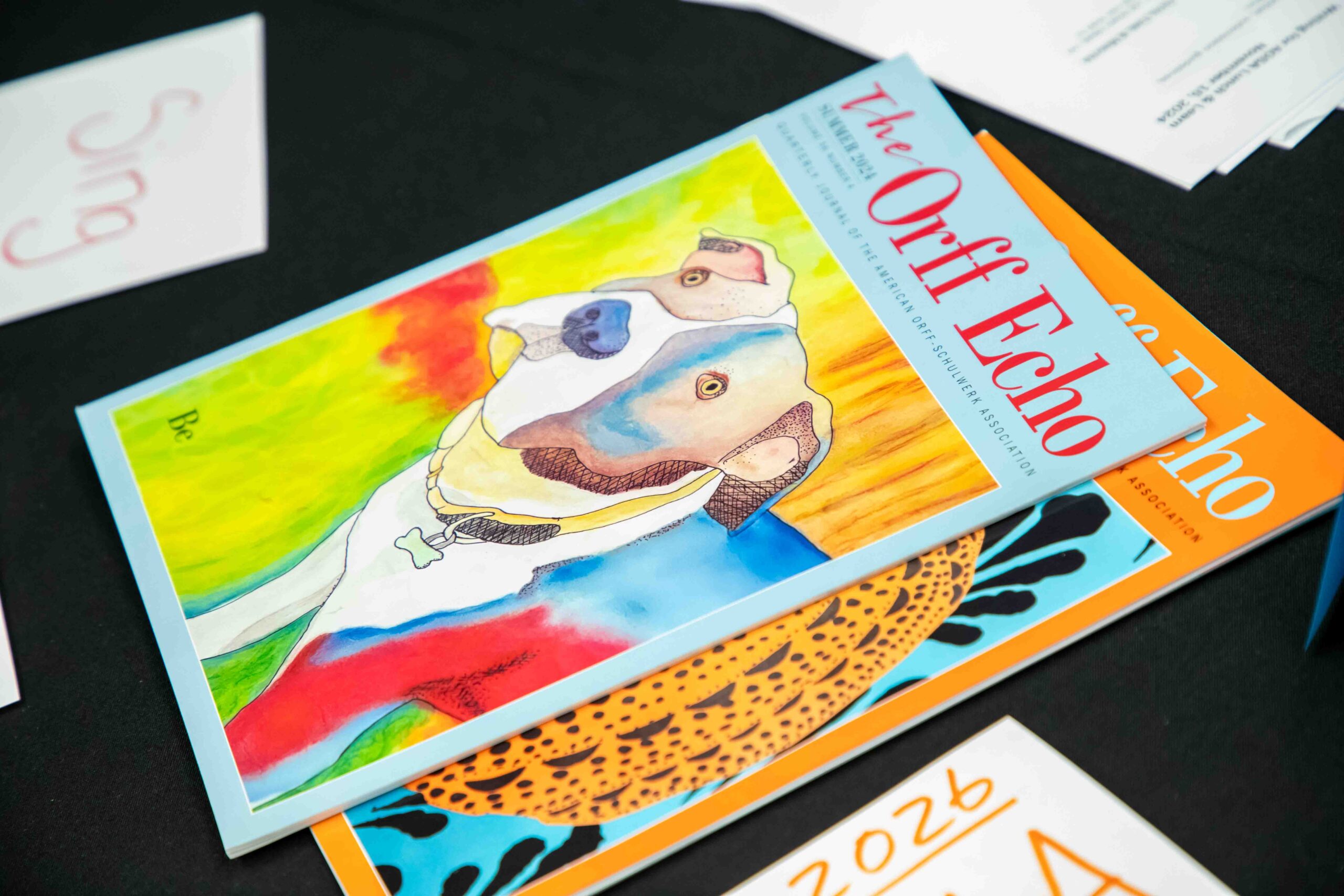
The Orff Echo is the national, peer-reviewed quarterly journal and philosophical voice of the American Orff-Schulwerk Association. Our mission is to demonstrate the value of Orff Schulwerk and promote its widespread use; to support the professional development of our members; and to inspire and advocate for the creative potential of all learners. Non-members may contact the editor for information.
Interested in writing for The Orff Echo? Check out how to get involved in the process:
Extensions to articles published in The Orff Echo can be found in the AOSA Resource Library.

List of Orff Echo Articles
The Squeaky Door
Children’s Book Review: This picture book is a retelling of a Puerto Rican folk tale based on the song “La Cama.” The squeaky door at his Grandma’s house frightens a boy and his animal friends who add their own voices to the tale.
From the Classroom: Folk Music that we Bring into the Classroom
McRae discusses the challenge of choosing folk songs that are intrinsically worthy and finding ways to teach them authentically.
The Importance of Studying the Volumes
The Music for Children Volumes are starting points and continuous set of workbooks for our teaching. A clear understanding of the sequence of the Volumes, allows teachers to create a better curriculum for their classrooms.
Merging and Emerging: The Path of the Schulwerk
There is a definite connection between the Music for Children Volumes and history. This article outlines the sequence of the Volumes in an historical context, including the importance of elemental music.
The Yellow Umbrella
Children’s Book Review: A picture book about a yellow umbrella turns into a visual rainbow as the rain falls and a parade of colorful umbrellas begins. An accompanying CD contains short piano compositions and the song “Underneath the Sky.”
Volumes of Possibilities
This article provides multiple examples of how to explore and extend endless possibilities from pieces in the Music for Children Volumes.
The History of the Orff Schulwerk Murray Editions
This article gives details on how Margaret Murray translated and adapted the original German Musik für Kinder Volumes for use in America and other English-speaking countries.
The Genesis of the American Edition of Music for Children
Jane Frazee provides an overview into the process of creating the Music for Children, American Editions. Her recount includes stories of Jos Wuytak, Brigitte Warner, Miriam Samuelson, and Orff Institute director Hermann Regner.
The Volumes and Documentation in Sound
Explore the history of Orff Schulwerk audio recordings from the1930’s to recent Orff Schulwerk recordings. Trace the timeline of Bavarian Radio broadcasts through the Music for Children recordings, to today’s recordings from around the world.
Using Brain Gym and Power Teaching in the Schulwerk
Stafford discusses her use of the Brain Gym activities in her music classroom.
Students with Disabilities Making Music
The authors discuss their work introducing jazz at a school for children with limited motor skills. They talk about how they adapted instruments for the children’s use.
The Impact of Training in the Orff Schulwerk Process on Music Therapy Session Plans
Colwell and Edwards discuss their research with university music therapy students in an Orff-oriented music therapy class.
From the Classroom: The Moon in a Hand Drum – Orff Goes to Outer Space
Inspired by a moon landing, this unit is designed for children kindergarten through second grade and is intended to be a general exploration of the dimensions of time and space.
The Magic of Middle School Musicals
Professional Development Book Review: In this book, Victor V. Bobetsky offers beginning teachers a foundation of information upon which to base plans to produce a middle school musical.
The Challenge of Creativity in the Classroom
Cave encourages the reader to ignore traditional educationalists who present obstacles to pedagogies, like the Schulwerk, that focus on chidren’s creativity.
The Harmonic Series: a Constructivist Teacher and a Sound Curriculum
This article demonstrates how the harmonic series can be used to inform teachers in their pedagogical design for the scope and sequence of instruction.