
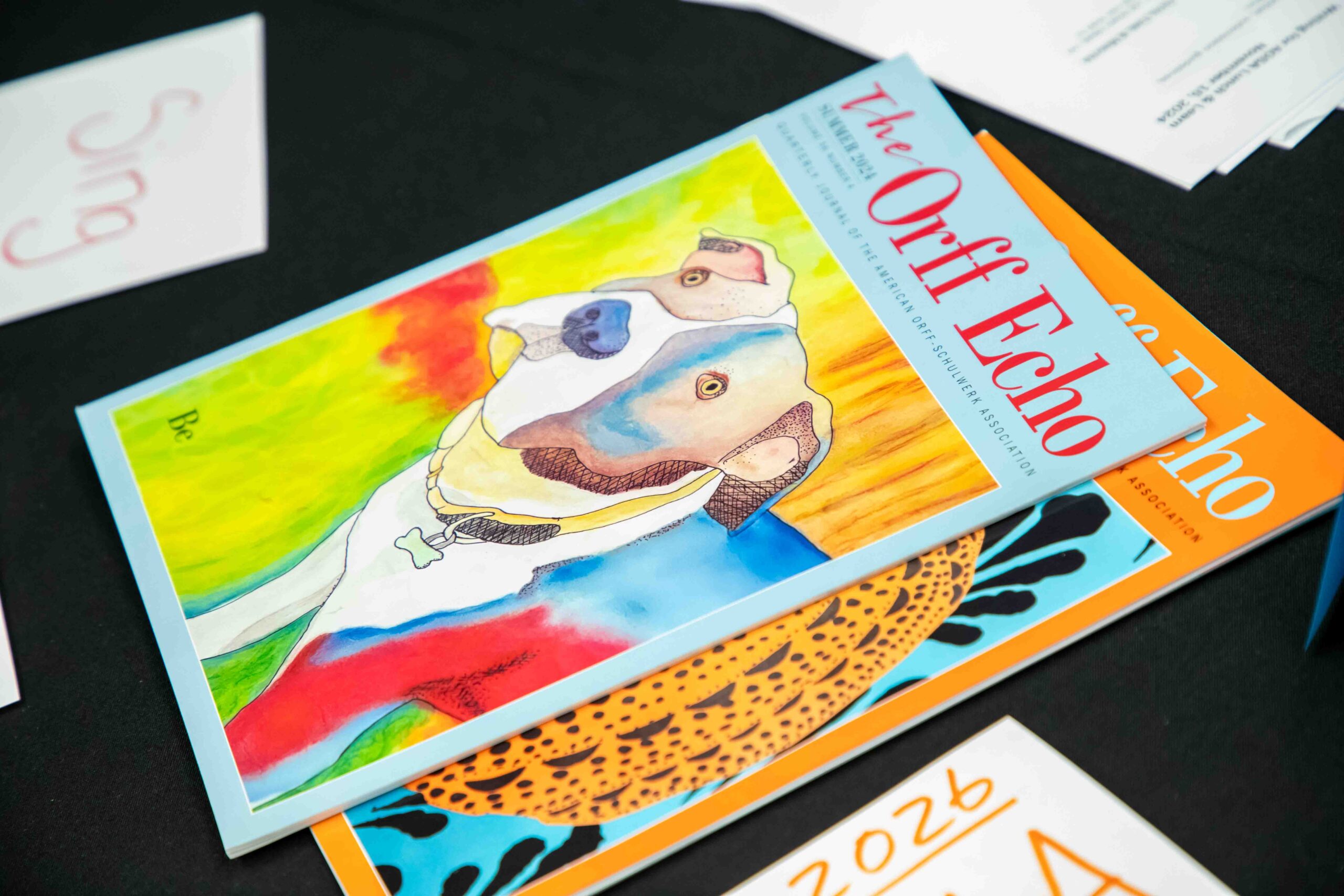
The Orff Echo is the national, peer-reviewed quarterly journal and philosophical voice of the American Orff-Schulwerk Association. Our mission is to demonstrate the value of Orff Schulwerk and promote its widespread use; to support the professional development of our members; and to inspire and advocate for the creative potential of all learners. Non-members may contact the editor for information.
Interested in writing for The Orff Echo? Check out how to get involved in the process:
Extensions to articles published in The Orff Echo can be found in the AOSA Resource Library.

List of Orff Echo Articles
The Magic of Arrangements: Orff and Jazz
This article discusses ways to create jazz arrangements that are aligned with the Orff approach.
Deep Connection: Blues at the Heart of American Music
Barringer discusses the evolution of the blues and how to bring this genre into the Orff music classroom.
African American Crossroads: the Blues
Debrot discusses the blues and Orff pedagogy. She says the genre provides valuable insight into American culture.
Swing Music and Dance for Children in the Orff Schulwerk Style
The author provides an introduction to swing dancing, shares tips for teaching swing dance to children, and offers suggestions for how students can choreograph their own dances.
Licks, Grooves, and Jams: Using a Blues Improvisation Approach to Teach Recorder
Lawton discusses teaching recorder improvisation using the blues as the foundation.
Delta Blues: The Life and Times of the MIssissippi Masters Who Revolutionized American Music
Professional Development Book Review: This book offers the reader an historical account of characters, relationships, setting, and plot. Ted Gioia frames the journey with a spirit of questioning and curiosity.
The Music Teaching Artist’s Bible: Becoming a Virtuoso Educator
Professional Development Book Review: Booth’s book is a meaningful and practical resource for the preparation of any practitioner in arts education.
A Women’s Folk Music Ensemble: an Interview with Libana Performers
Shamrock interviews members of the Libana ensemble and they explain their support for Orff Schulwerk.
From the Classroom: Children’s Songs from Afghanistan
Rogers discusses the work of Louise Pascal in translating Afghan songs into English. She also discusses her own work in teaching Afghan songs to children and how the experience expanded the students’ understanding of this country at a time when it was perceived to be an enemy.
Lost Delta Found: Rediscovering the Fisk Univeristy-Library of Congress, Coahoma County Study, 1941-1942
Professional Development Book Review: Spurgeon reviews the book, mostly the work of Fish University researcher, John W. Lewis. The book was published by Alan Lomax in 1993.
The Squeaky Door
Children’s Book Review: This picture book is a retelling of a Puerto Rican folk tale based on the song “La Cama.” The squeaky door at his Grandma’s house frightens a boy and his animal friends who add their own voices to the tale.
From the Classroom: Folk Music that we Bring into the Classroom
McRae discusses the challenge of choosing folk songs that are intrinsically worthy and finding ways to teach them authentically.
Choosing Folk Songs for the Classroom
Spurgeon urges Orff-trained teachers to carefully select folk songs from cultures throughout the world, giving suggestions of collections of appropriate songs.
Action Research: Folk Songs in a Global Classroom
Beam teaches at an international school in India with students from 60 countries. He discusses his procedures for choosing songs that are as diverse as his students and also discusses some of the research in multicultural music for children.
Research to Resources: Appalachian Folklore in the Music Classroom
The authors discuss the work of Kentucky folklorist Leonard Ward Roberts. They interview three of his former students including musician Jean Ritchie.
My Life with Folk Song: A Meditation on Music and Music Education
Ethnomusicologist, Bruno Nettl, writes about the difficulty of defining the term folk song in American culture.