
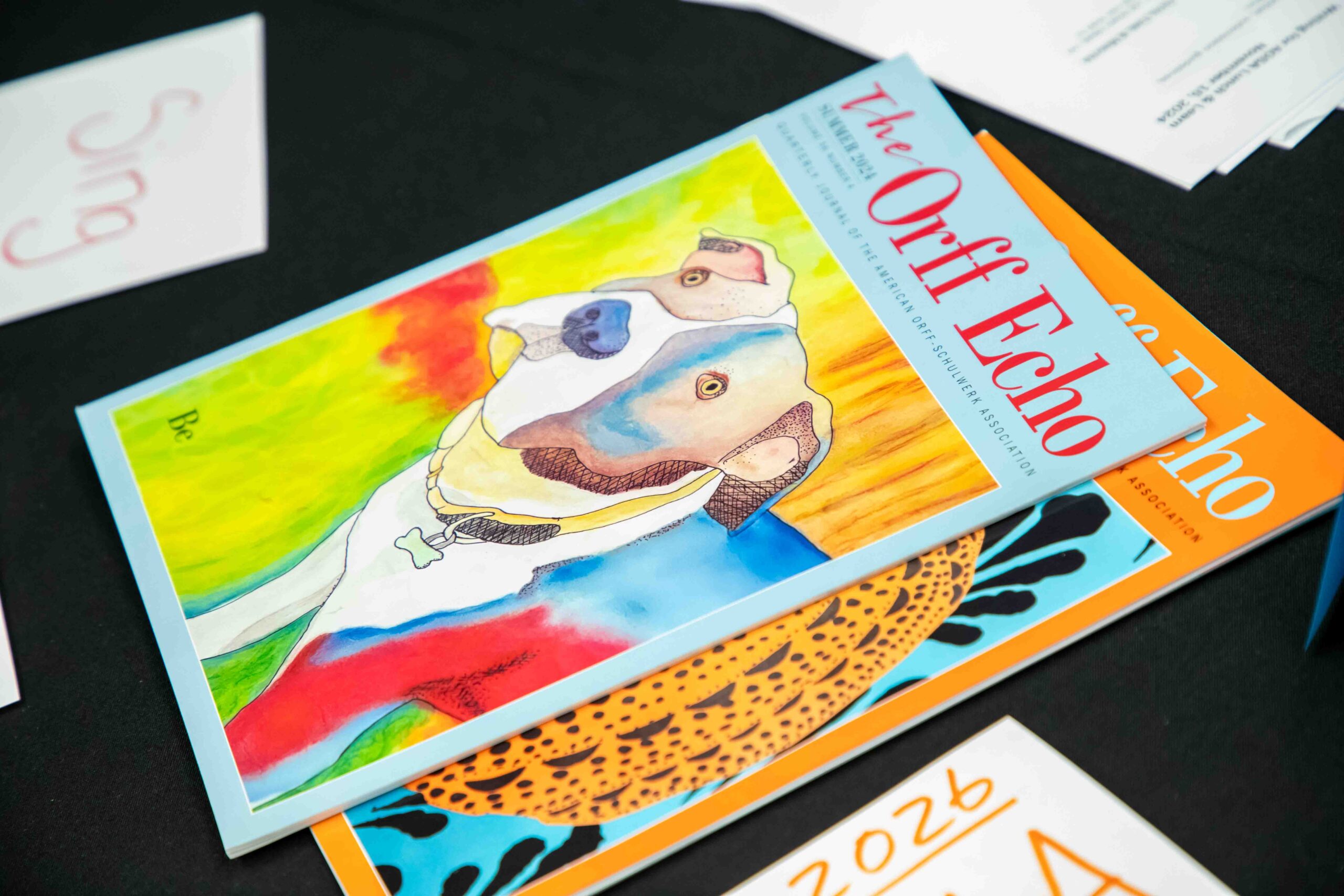
The Orff Echo is the national, peer-reviewed quarterly journal and philosophical voice of the American Orff-Schulwerk Association. Our mission is to demonstrate the value of Orff Schulwerk and promote its widespread use; to support the professional development of our members; and to inspire and advocate for the creative potential of all learners. Non-members may contact the editor for information.
Interested in writing for The Orff Echo? Check out how to get involved in the process:
Extensions to articles published in The Orff Echo can be found in the AOSA Resource Library.

List of Orff Echo Articles
Teaching Early Childhood Music: An Orff Schulwerk Perspective
Zook describes a music curriculum for an arts-based preschool using the Orff approach as a guide.
Artful Beginnings: Preparing Young Children For A Life of Aesthetic Experiences
Olson describes a project using improvisatory dance sequences with her own son beginning at age one to develop an aesthetic experience.
Patterns For Learning
Panning describes experiences based on patterns drawn from the music itself and learned through the body.
Play It Again: Observing the Music Play of Young Children
Edwards investigates the types of child-iniated music play that college students get to observe in preschools and how these relate to instruction.
Transitions: Journey into Early Childhood
The author describes how the Schulwerk helped her change from elementary to preschool music teaching.
The Contributions of William Wakeland
Portrait Series – Brandon examines the life of one of the founders who brought the Schulwerk to the United States.
Embracing Every Child: Understand Your Students’ Individual Needs to Differentiate Instruction
Davila describes a process for identifying students’ own needs and using that information in order to develop instruction.
Hearing, Feeling, Playing: Music and Movement with Hard-of-Hearing and Deaf Children
Professional Development Book Review: Edited by Shirley Salmon, this publication is a collection of fascinating and informative articles about the impact of music and movement with hard-of-hearing and deaf children. It offers numerous strategies to benefit hearing- impaired persons of all ages.
Inclusion and Orff Schulwerk
Salmon discusses how the Schulwerk can enable all students to participate in movement, playing instruments, and improvisation activities in the music room.
Structure and Improvisation in Creative Teaching
Professional Development Book Review: In this book the authors explore the interaction between structure and improvisation within many diverse situations, from mathematics and English-language learning classrooms to professional theaters and dance choreography settings.
The Instrumentarium and Children with Disabilities
McCord discusses how to adapt instruments for use with children with disabilities.
Orff-Based Music Therapy for Students With Traumatic Brain Injury
Colwell provides strategies that Orff teachers and therapist may use in a therapy setting to address the challenges for working with students with TBI.
Music Education Preparation for Teaching Students with Disabilities
The authors describe a project using vitural learning in order for future music educators to learn how to work with students with disabilities.
Interview – Sarah Paull: The Love of Music and Horses
Hetrick interviews Sarah Paull about her memories of elementary music class with her teacher, Judith Thomas.
Five Live Bongos
Children’s book Review: Picture book about a family who makes music with a variety of household found sounds creating a noisy combination of text, music, and art.
Drive: The Suprising Truth About What Motivates Us
Professional Development Book Review: This book by Daniel Pink identifies three motivating systems that each human operates within – biological, extrinsic, and intrinsic – each of which can produce desired behaviors from students.