
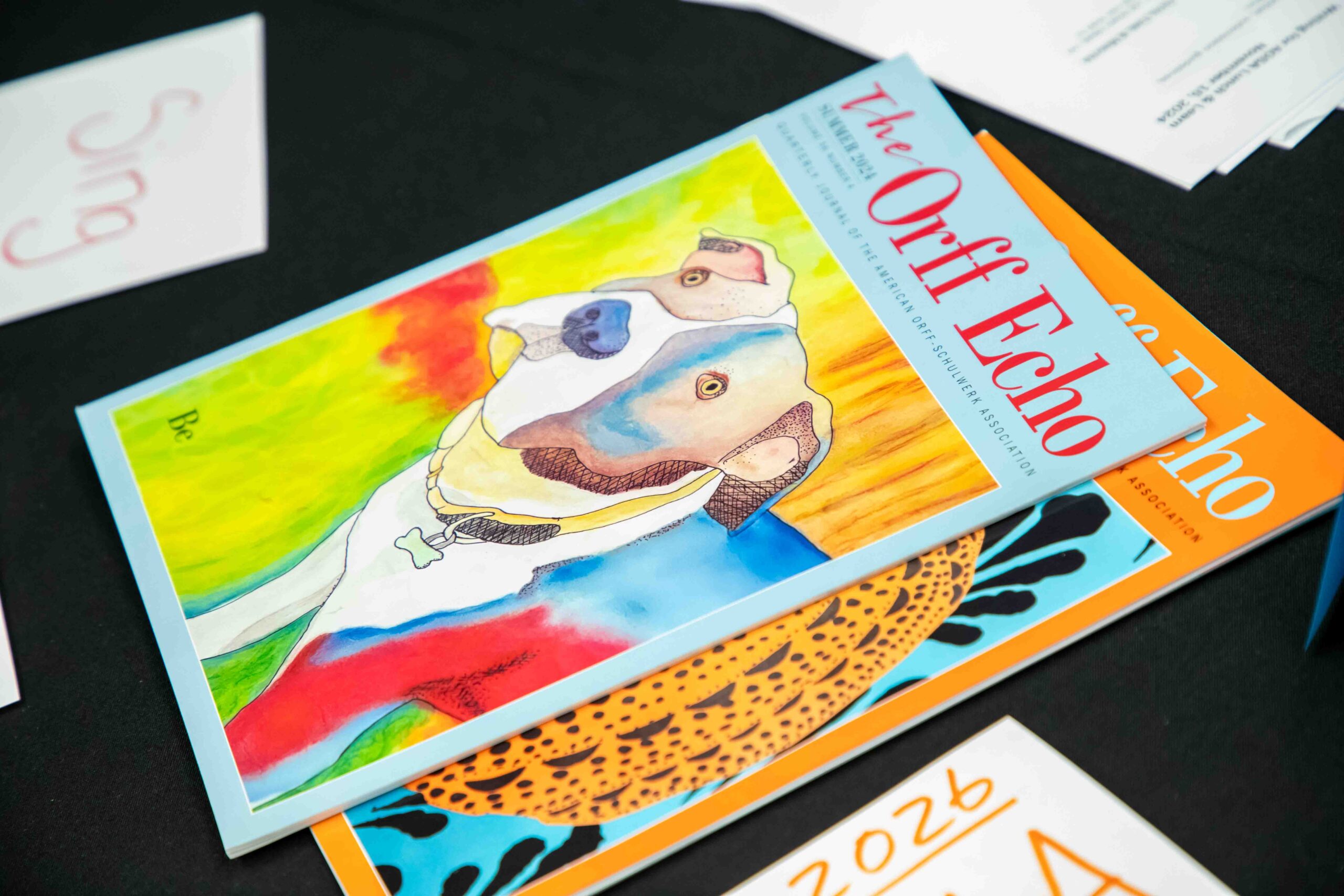
The Orff Echo is the national, peer-reviewed quarterly journal and philosophical voice of the American Orff-Schulwerk Association. Our mission is to demonstrate the value of Orff Schulwerk and promote its widespread use; to support the professional development of our members; and to inspire and advocate for the creative potential of all learners. Non-members may contact the editor for information.
Interested in writing for The Orff Echo? Check out how to get involved in the process:
Extensions to articles published in The Orff Echo can be found in the AOSA Resource Library.

List of Orff Echo Articles
Integrating Music Learning Theory With The Orff Approach
Details provided on how Orff Schulwerk and Music Learning Theory approach compliment each other to help children learn and how to combine them logically into an effective curriculum.
Active Music Making Without Moving Around The Room?
A Kodály trained educator explains that “active” is about the opening the student’s mind to be alert and lively. Explains how teachers can guide seated students to listen and learn actively in the classroom, even from their chairs.
Working Together: Interdisciplinary Ideas for Middle School
Hughes discusses her work with middle school students and her successful efforts to create an interdisciplinary environment in her school.
The Primary Years Programme: an Interdisciplinary Approach for Music Education
Wixon discusses her work with the Primary Years programme at her school in India. She includes suggested interdisciplinary teaching units.
Learning Through Collaboration: Using Integrated or Interdisciplinary Approaches for Upper Elementary and Middle School Learning
The author discusses working with teachers of other disciplines to design learning experiences for students.
Making Musical Connections Through Core Commonalities
The author discusses how to make music instruction relevant and correlate it to learning in other disciplines.
Musical Math: a Schulwerk Approach to Combining Disciplines
Staford points out that the Orff Schulwerk approach provides many opportunities to incorporate mathematical higher-order thinking skills without sacrificing core musical learning or opportunities for creativity.
Heightening Creative Sensibilities: an Integrated Arts Approach
The authors discuss their experiences with children in their integrated arts summer camp.
Diary of a Compulsive Integrator
Greene writes about teaching to that enables students to make connections between disciplines.
Field Trips: “Slow and Deep” Through Arts Education
The author discusses the importance of arts-oriented field trips.
Early Childhood Music Instruction
In this research article, Lange discusses teaching children to audiate (sing in tune), and keep a steady beat.
In-Class Collaboration: Studying Ecosystems with Orff Schulwerk
The author discusses her student’s work tying the “prairie scape” to music.
Bats on Parade
Children’s Book Review: This picture book gives the reader an introduction to the instruments in a marching band, offers cool math problems through multiplication, and it is told in rhyme.
Engaging Young Children in Musical Activities
This article examines how to occupy very young children in musical activities as a part of their development, using the Orff Schulwerk approach.
Teaching Early Childhood Music: An Orff Schulwerk Perspective
Zook describes a music curriculum for an arts-based preschool using the Orff approach as a guide.
Artful Beginnings: Preparing Young Children For A Life of Aesthetic Experiences
Olson describes a project using improvisatory dance sequences with her own son beginning at age one to develop an aesthetic experience.