
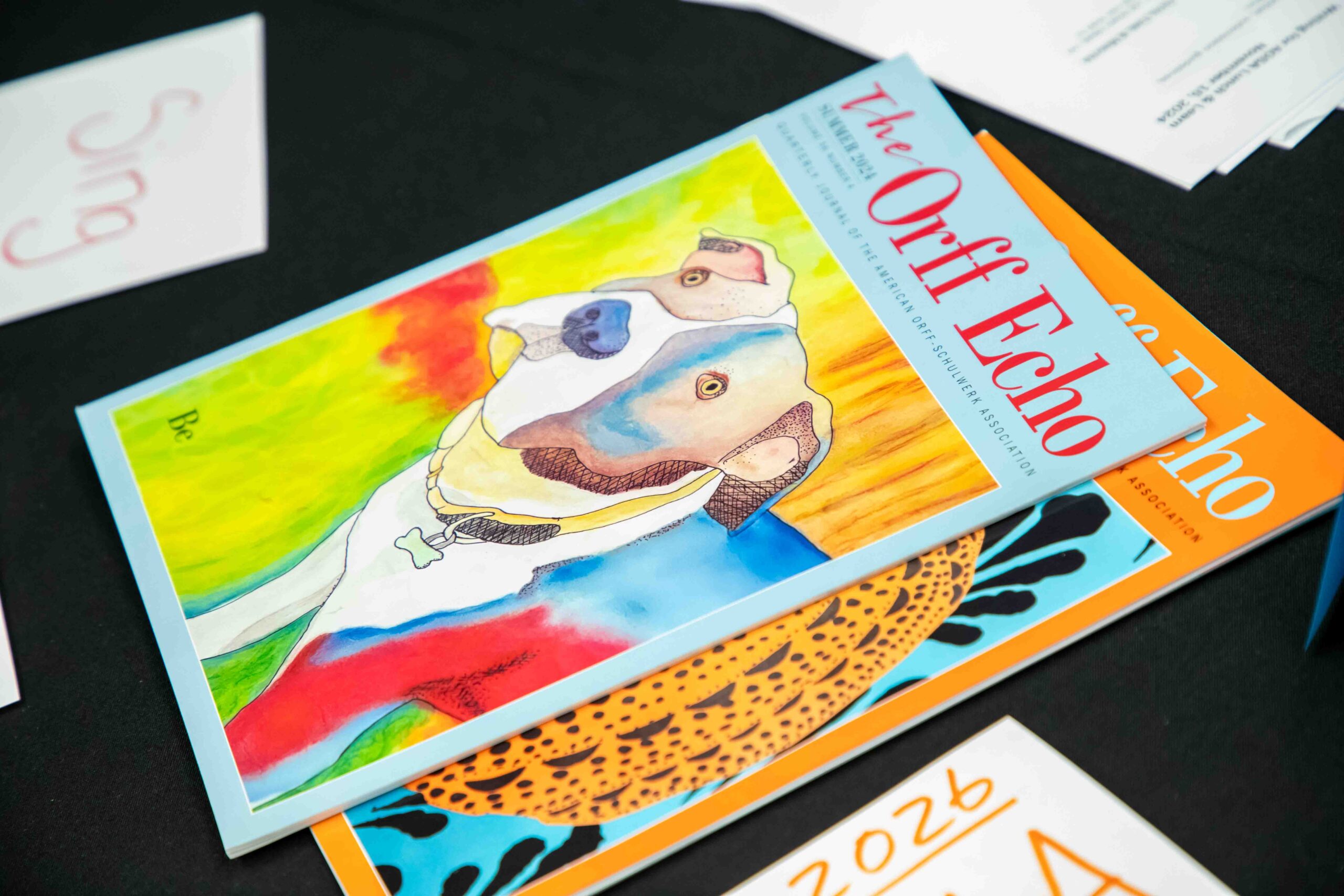
The Orff Echo is the national, peer-reviewed quarterly journal and philosophical voice of the American Orff-Schulwerk Association. Our mission is to demonstrate the value of Orff Schulwerk and promote its widespread use; to support the professional development of our members; and to inspire and advocate for the creative potential of all learners. Non-members may contact the editor for information.
Interested in writing for The Orff Echo? Check out how to get involved in the process:
Extensions to articles published in The Orff Echo can be found in the AOSA Resource Library.

List of Orff Echo Articles
Texts on Theory and Practice of Orff Schulwerk: Basic Texts from the Years 1932-2010
Professional Book Review: Jane Frazee reviews the new book by Barbara Haselbach, ed., and Margaret Murray, translator. Includes articles on ways Orff Schulwevk has been adapted since the 1970s by Michael Kugler, Keetman Gunther, Barbara Haselbach, Hermann Regner, Dorothy Bunther, Carl Orff.
Quiet Bunny
Children’s Book Review: This is a great picture book for vocal exploration as children imitate the sounds of the animals. The low sounds of the bear cub and frog contrast with the high sounds of the mosquito, cricket, and owl.
Listening, Feeling, Playing: Music and Movement for Children with Hearing loss
In this article (reprinted from Musicworks 10, the journal of the Australian Orff Association), Salmon discusses the use of elemental music and dance education, according to Orff Schulwerk, for children with hearing loss.
When Difficult Notes Seem Beyond Our Reach
Creating recorder adaptions for special education students in the inclusive classroom.
The Orff Process in the ESL Classroom: Teaching Suprasegmental Pronunciation
Teaching Suprasegmental Pronunciation. Examine rhythms of different languages to help ESL students adapt their speaking rhythms to match those of English.
Teaching Music to Students with Special Needs: a Label-Free Approach
Professional Development Book Review: This book by Alice M. Hammel and Ryan M. Hourigan guides the teacher to meet the needs of all students through good teaching. Practical strategies for teaching and meeting the needs of each student include a team approach and label-free learning.
Old Makana Had a Taro Farm
Children’s Book Review: The song “Old MacDonald” gets a Hawaiian (Asian-Pacific American) makeover in this children’s book and introduces aspects of traditional Hawaiian language and culture. (CD included.)
What’s in a Name? Referring to Students with Disabilities
A list of principles, approaches, terminology and appropriate environments for teaching students with disabilities.
How Else Can I do it? Teaching in an Inclusive Orff Classroom
A foundation describing ways to adapt to each child’s situation ranging from autisum to behavior disorders. Universal Design for Learning (UDL) table discussed.
Teaching Students with Disabilities: A Heart of Acceptance
Ways to teach and gain acceptance with students who have disabilites using the Orff approach to enable all to learn.
Complementing the Schulwerk: Three Essential Questions
Explains what the different approaches (Dalcroze, Kodály, Orff Schulwerk, Music Learnig Theory) have in commmon and how to intergrate them in the classroom.
Preparing the Next Generation of Music Teachers
Explains the value in exposing future music teachers to the four approaches (Dalcroze, Kodály, Orff Schulwerk, Music Learnig Theory) through an integarted curricula.
Connecting to Dalcroze: Active Music Making Through Basic
Ideas on Dalcroze activites: using basic rhythmic movement, simple interactions and improviation, while integrating playfulness and learning with fun.
Integrating Music Learning Theory With The Orff Approach
Details provided on how Orff Schulwerk and Music Learning Theory approach compliment each other to help children learn and how to combine them logically into an effective curriculum.
Active Music Making Without Moving Around The Room?
A Kodály trained educator explains that “active” is about the opening the student’s mind to be alert and lively. Explains how teachers can guide seated students to listen and learn actively in the classroom, even from their chairs.
Active Improvisation In The Classroom
Principles and activities explored from Dalcroze, Kodály, and Orff Schulwerk that extend children’s musical knowledge into successful improvisation.