
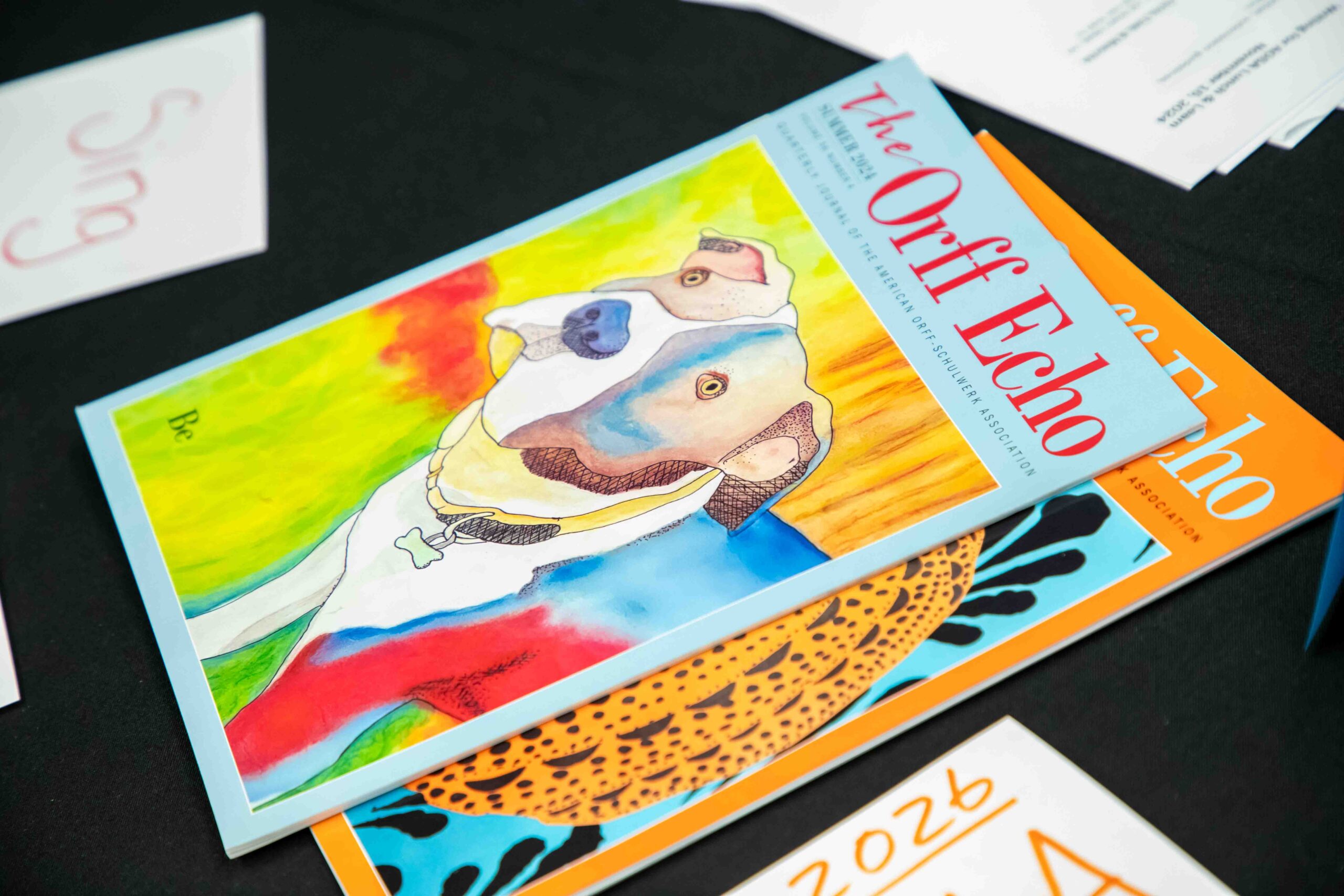
The Orff Echo is the national, peer-reviewed quarterly journal and philosophical voice of the American Orff-Schulwerk Association. Our mission is to demonstrate the value of Orff Schulwerk and promote its widespread use; to support the professional development of our members; and to inspire and advocate for the creative potential of all learners. Non-members may contact the editor for information.
Interested in writing for The Orff Echo? Check out how to get involved in the process:
Extensions to articles published in The Orff Echo can be found in the AOSA Resource Library.

List of Orff Echo Articles
Earthdance
Children’s book Review: Picture book that invites the reader to identify with and imagine becoming Earth, exploring and honoring it, and dancing with its environments and inhabitants. Lovely book to pair with Earth Day activities.
The Educational Future of Orff in the 21st Century
Explains how the Orff approach syncs with the demands of the 21st Century, including child-centered learning, process over product, and critical skill categories. And, explains how teachers can adapt effectively.
Critical Thinking and Global Music: An Active Listening Protocol Supporting 21st Century Learning
Ideas and lesson examples using the Descriptive Review Protocol for active listening in the 21st Century Learning, including diverse song material.
Creating Songs With Sounds and Rhythms of Nature
A step by step process of using natural inspirations to compose songs that teach children both music and a love of the wild.
Differentiated Instructions in the Orff-Schulwerk Classroom
An explanation linking the three foci of differentiated instruction to Schulwerk practices so that music teachers can meet the goals of both approaches. Lesson ideas presented using rhythmic building blocks.
Children’s Spontaneity in an Orff-Schulwerk Classroom: A Qualitative Study
A qualitative study that offers a definition of spontaneity and reviews existent studies relating to children’s spontaneity in an Orff classroom.
Teacher Evaluation: An Opportunity for Advocacy
This article addresses ways in which music teachers may advocate for authentic assessment of their teaching while building broad-based support for an Orff Schulwerk program in the school.
Teacher Evaluation: Supporting Classroom Observations with the Schulwerk
This article explores approaches to teacher evaluation that not only measure teacher effectiveness but encourages feedback helpful for teachers to improve.
Authentic Assessment in the Orff Schulwerk Classroom
This article explores ways that formal, informal, and summative assessments can be structured in a classroom to benefit both student learning and accurate teacher evaluation.
Evaluating Music Teachers Through Portfolios of Student Growth
This article outlines a program developed by a fine arts committee specifically for arts subjects. The Tennessee Fine Arts Student Growth Measures System enables teachers to create portfolios of evidence of student growth as the basis of their effectiveness as teachers.
Can You Danielson? Understanding How A Commonly-Used Teacher Evaluation Program Relates to the Schulwerk
Examples of how the Danielson Framework for Teaching aligns with the Orff process. Components include: Planning and Preparation, Classroom Environment, Instruction, and Professional Responsibilities.
Learning to Let Go: Informal Music Learning in the Music Classroom
Characteristics of self-directed informal music learning and links to practical application for Orff practitioners.
Dancing the Music of Gunild Keetman: A Middle School Project
This author describes how a selection of Keetman dance suites, based around a common theme, inspired younger music and dance students in a middle-school project.
The Effect of the Orff Approach on Behaviors of Two Students with Attention Deficit Disorder: A Case Study
The purpose of this project is to investigate the therapeutic benefits of musical activities typical of the Orff classroom (singing, movement, and playing classroom instruments) in terms of specific behaviors of children with attention deficit disorder (ADD).
Assessment: Perceptions and Challenges of General and Choral Music Teachers
The purpose of the study was to investigate choral and general music educators’ assessment practices, their confidence in them, and how they navigate curricular reform initiatives.
Pieces: A Year in Poems and Quilts
Children’s Book Review: This picture book is a collection of seasonal poems illustrated by photographs of handmade quilts. Rich in language and suggestive of movement and sound, each poem evokes one of the five senses.