
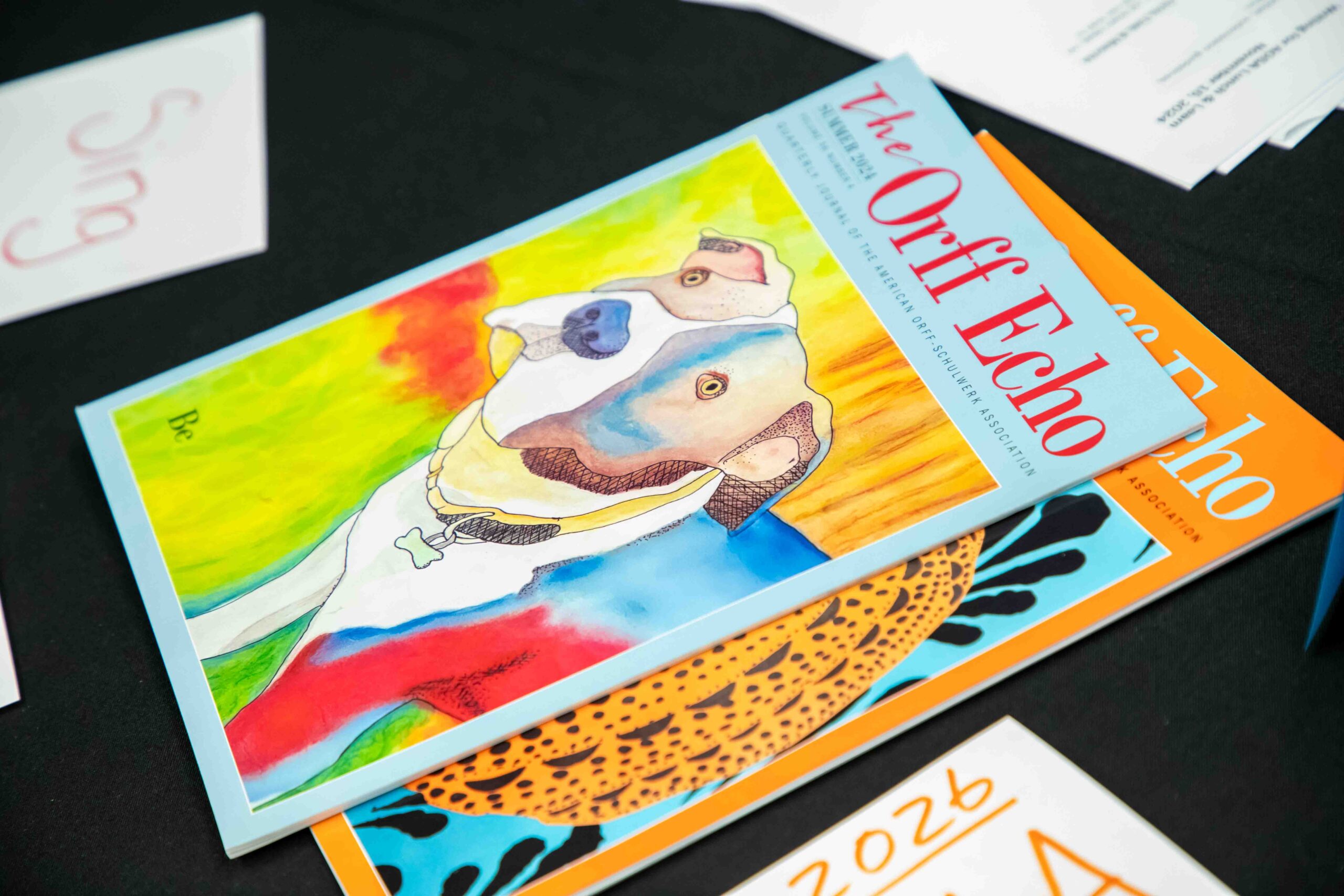
The Orff Echo is the national, peer-reviewed quarterly journal and philosophical voice of the American Orff-Schulwerk Association. Our mission is to demonstrate the value of Orff Schulwerk and promote its widespread use; to support the professional development of our members; and to inspire and advocate for the creative potential of all learners. Non-members may contact the editor for information.
Interested in writing for The Orff Echo? Check out how to get involved in the process:
Extensions to articles published in The Orff Echo can be found in the AOSA Resource Library.

List of Orff Echo Articles
Creating Meaningful Music in the Special Education Classroom
The author describes her experiences at the John A. Colman School, a school for students with profound disabilities, and her success using Orff Schulwerk based music instruction with students who struggle with rudimentary communication.
Setting a Framework for Children’s Improvisation and Choreography
The author lays out an Orff process framework by which students can develop movement ideas from free improvisation to independent choreography.
The Dance of Colors: Sonia Delaunay-Terk and Vaslav Nijinsky
The author discusses the creative connections between dance and art, relying on the example of early 20th century contemporaries, artist Sonia Delaunay-Terk and dancer Vaslav Nijinsky.
A Reflection on Process
The author reflects on writings of many early Orff theorists as well as her own experiences as a summer Levels student as she discusses the importance of process over product in applying the Orff approach in the elementary classroom.
Margaret Murray Autobiography Part II: The Orff Years
The translator of “Music for Children” into English, describes her history as part of the Orff movement. Introduction by Patty Reed.
Harold Finds a Voice
Children’s book Review: This picture book tells the story of Harold the parrot and his quest to find his own unique voice. As Harold discovers, the world is full of beautiful sounds but none more beautiful than the sounds that come from within.
From A to Zig-zag: Teaching the Vocabulary of Creative Movement
Gall talks about the importance of creative movement in the Orff classroom. He points out that Carl Orff specifically mentioned dance when he wrote his explanation of elemental music Gall also provides a checklist for creative process.
Musicians in Motion: Sequencing Movement Experiences in Elementary Music
Mileski points out that, given the limited time music teachers have with their students, sequential learning as a part of a spiral curriculum is very important.
Using Children’s Literature to Inspire Creative Movement
The author discusses using children’s literature, especially picture books, to teach creative movement in the classroom. He also provides an explanation of movement elements.
The Essence of Creative Dance in Orff Schulwerk: An Interview with Christa Coogan
Inouye interviews internationally known dance educator, Christa Coogan, about her opinions on teaching movement and dance to children through the Schulwerk.
The Catapult Dance: a Case Study in Student Self-Assessment
Cave discusses assessing movement activities in the music classroom.
Objective Measures of Student Performance: Depths of Knowledge through the Orff Schulwerk Approach
Pahl discusses ways to assess student learning in the Orff music classroom. She shares rubrics to help teachers with assessment.
Margaret Murray Autobiography Part I: The Pre-Orff Years
The Echo prints the first portion of Murray’s autobiography. Murray was author and organizer of the English version of Music for Children. Introduction by Judith Thomas-Solomon.
A Whole New Mind: Why Right-Brainers will Rule the Future
Professional Book Review: In this book, Daniel Pink examines right-brain high-concept- the ability to create artistic and emotional beauty, to direct patterns and opportunities, and to combine seemingly unrelated ideas into novel inventions.
Bridging the Racial Gap Using the Orff Process
A reflection on how the Orff process, using movement, improvisation and composition, promoted culturally responsive teaching in an urban St. Louis elementary school.
Just a Subway Ride Away: Taking the Orff Approach to the Neighborhoods of NYC
Two experienced Orff teachers share personal experiences of how the Orff approach celebrates cultural diversity in five NYC neighborhoods.