
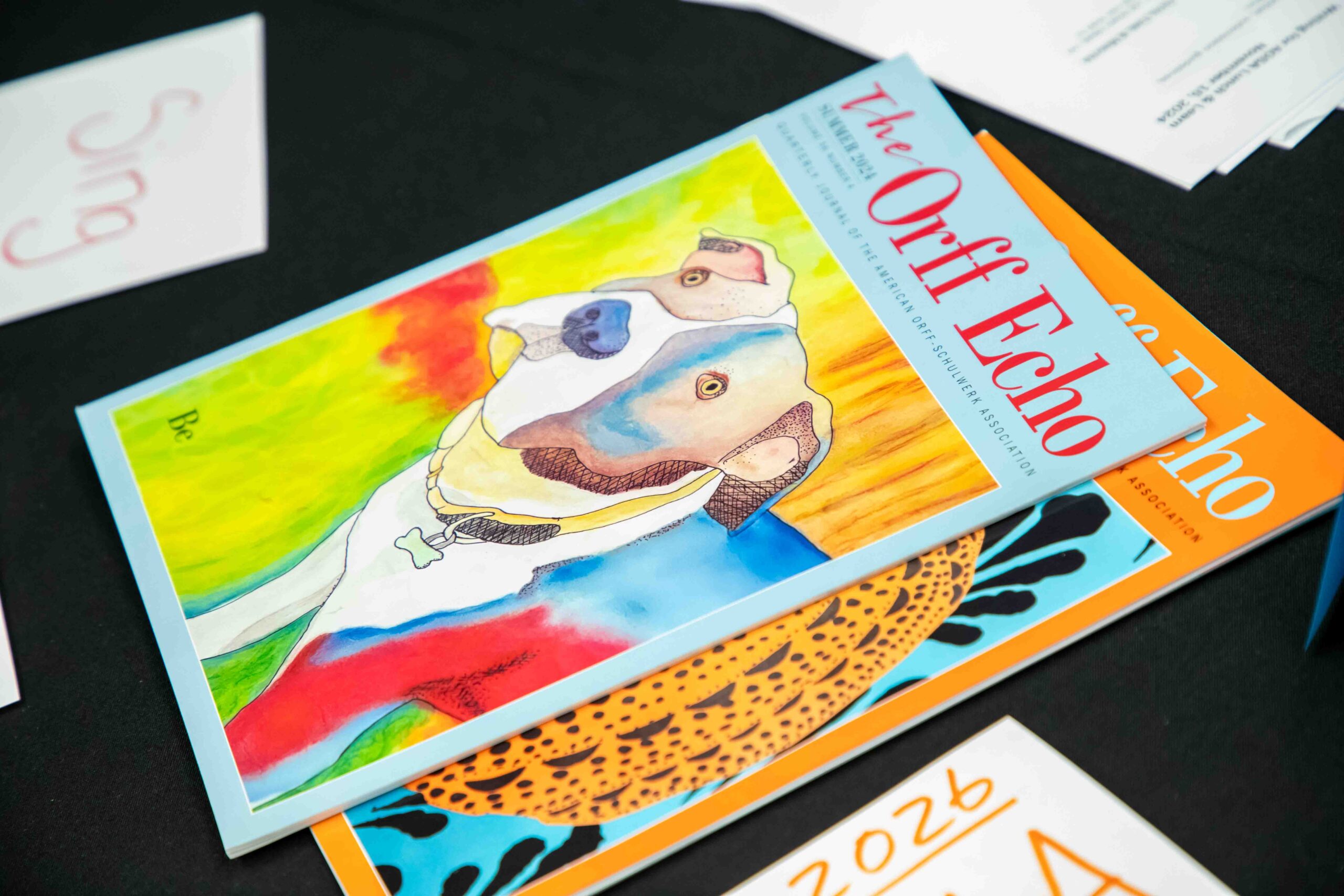
The Orff Echo is the national, peer-reviewed quarterly journal and philosophical voice of the American Orff-Schulwerk Association. Our mission is to demonstrate the value of Orff Schulwerk and promote its widespread use; to support the professional development of our members; and to inspire and advocate for the creative potential of all learners. Non-members may contact the editor for information.
Interested in writing for The Orff Echo? Check out how to get involved in the process:
Extensions to articles published in The Orff Echo can be found in the AOSA Resource Library.

List of Orff Echo Articles
Spotty, Stripy, Swirly – What Are Patterns?
Children’s Book Review: Vivid photographs capture patterns from our everyday world in the children’s book, Spotty, Stripy, Swirly – What Are Patterns? The text is simple and direct, placing the emphasis on the power of the images themselves.
Swirl by Swirl – Spirals in Nature
Children’s Book Review: Ths picture book takes readers on an exploration of the spiral patterns abundant in diverse environments using richly vibrant illustrations.
The Joy and Magic of Baby Orff
Using the Orff approach with babies and toddlers, benefits their development, resulting in increased coordination, higher self-awareness, and socialization. Suggested activities build relationships, and introduce young children to musical elements and their world.
Music and Creative Movement for Special Needs Children
Movement, or dance therapy, as pioneered by Marian Chace and Norma Canner, can be used to help special needs students to express themselves physically and emotionally, through playful, guided music, and movement experiences.
Children’s Storybooks to Address Speech and Language Challenges
Storybooks can be used to support students with communication disabilities, including hearing, language, or speech disorders. Provided examples contain diverse objectives and well-designed orchestrations to demonstrate how these students may successfully participate.
Meaningful Movement Matters: Music and Movement With the Elderly
Music and movement practices found in both Dalcroze Eurhythmics and Sacred Dance can be used effectively with the elderly. Participation in group music-making results in an increased sense of community and personal value.
The Orff Classroom Playground: the Power of Play
Discusses the importance of play to help students develop understanding, provide differentiated instruction opportunities, and contrast to more structured aspects of school experience.
Fostering Critical, Divergent Thinking in the Orff Classroom: It Starts With Academic Discourse and Dialogue
Describes strategies for helping student articulate their creative ideas and refine ability to make share aesthetic evaluations using “accountable talk.”
Beyond You, Beyond Me: Group Music Making and Creativity
Exporting magical quality of Orff and Dalcroze Eurhythmics teacher training to classroom using intersubjectivity — how students and teacher relate to each other as classroom stakeholders.
Catfish Tale
Children’s Book Review: A children’s book retelling the fairy tale, “The Fisherman and His Wife,” in a Louisiana bayou setting, alive with creatures of the swamp, riverboats, regional food, and Mardi Gras scenes, and told using regional Cajun dialect.
Schulwerk Group Creativity: Witnessing the Blossoming of Discovery
Article summarizes the importance of group composition activities in the Orff classroom, observing that students tend to be more invested aesthetically in music they create.
Bear Sees Colors
Children’s Book Review: Bear is off on another journey with his animal friends discovering colors—blue, red, green, yellow, and brown. This children’s book easily lends itself to lessons incorporating music, art, and movement.
Creating Music Together: Challenge and Opportunity in Orff Schulwerk
Defines creativity and discusses its importance in 21 century education. Organizes some of the foundational Orff Schulwerk texts according to what they have to say about group improvisation and creativity.
Group Creativity in Musical Context: Research Insights and Implications for Working With Orff Schulwerk
The author observes that university trained music educators often have problems describing the creative process, and then discussing creativity in an 0/S context; based on theorists such as Michael Kugler and Wilhelm Keller as well as Orff and Keetman.
Artful-Playful-Mindful in Action
Professional Development Book Review: A collection of lesson plans by Karen Benson, Rachel Bergeron, Leonard Davis, Diana Larsen, and Shelly Smith including self-assessment, applying the pedagogical approach of Jane Frazee.
Margaret Murray Autobiography Part II: The Orff Years
The translator of “Music for Children” into English, describes her history as part of the Orff movement. Introduction by Patty Reed.