
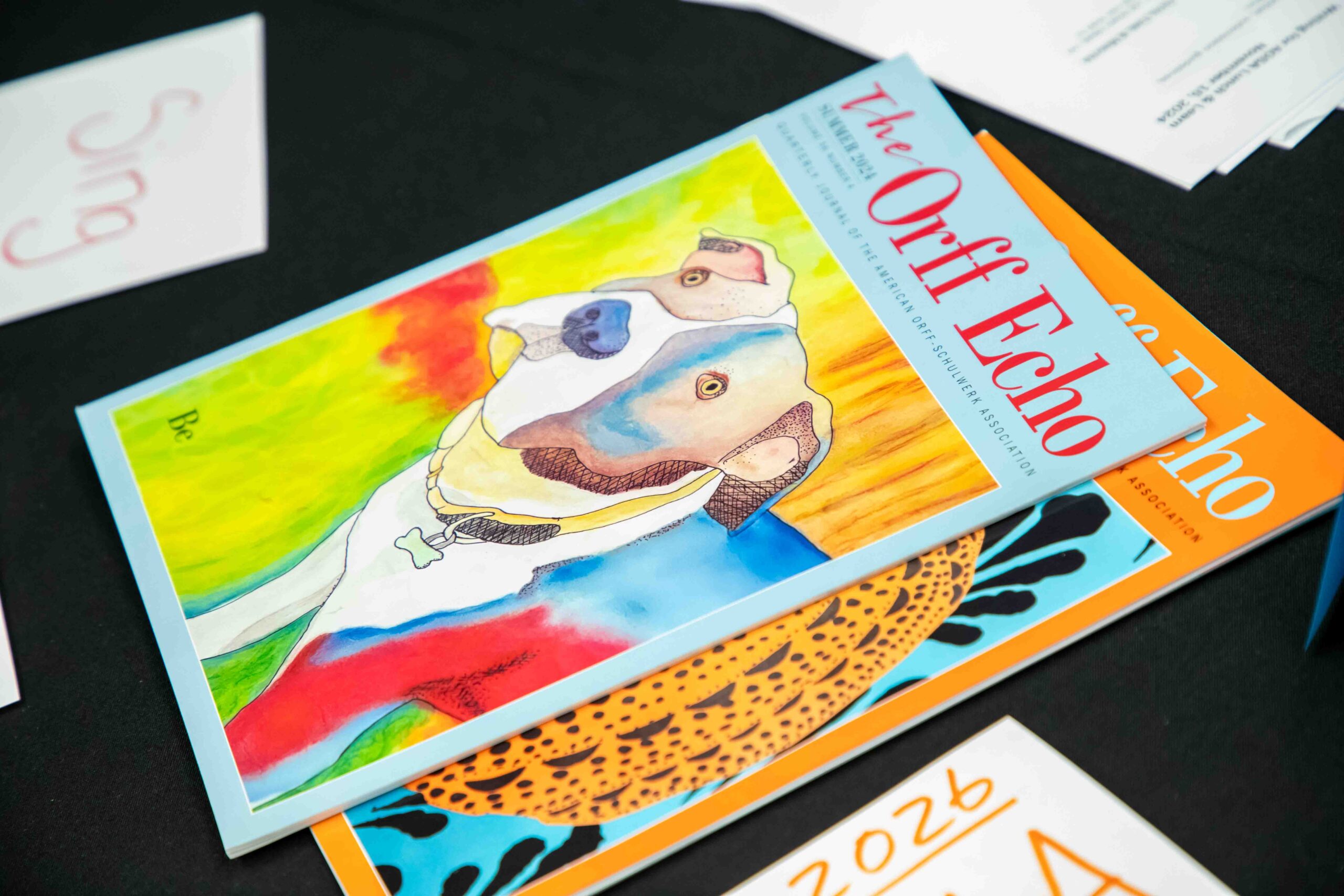
The Orff Echo is the national, peer-reviewed quarterly journal and philosophical voice of the American Orff-Schulwerk Association. Our mission is to demonstrate the value of Orff Schulwerk and promote its widespread use; to support the professional development of our members; and to inspire and advocate for the creative potential of all learners. Non-members may contact the editor for information.
Interested in writing for The Orff Echo? Check out how to get involved in the process:
Extensions to articles published in The Orff Echo can be found in the AOSA Resource Library.

List of Orff Echo Articles
Rabbityness
Children’s book Review: Picture book about a joyful rabbit who enjoyed doing normal rabbit things like jumping, burrowing, and washing his ears, but who also liked doing ‘unrabbity’ things like painting and making music.
Don’t Laugh at Me
Children’s book Review: Picture book with words and illustrations that portray victims of bullying; provides a starting point for meaningful discussion. An included CD features Peter, Paul, and Mary singing “Don’t Laugh at Me.”
Third Culture Kids and the Schulwerk
A focus on the ability to transcend cultural divides between third culture kids (children who have spent a significant part of their developmental years outside their parents’ culture) and their host countries.
Play: Evidence of a Borderless Orff Schulwerk
A description of how authentic process and play transcend cultural and musical differences and are equally effective with children in diverse settings, highlighting Zambian children. Lesson idea included.
Colors! ¡Colores!
Children’s Book Review: This picture book is a wonderful resource for a bilingual, multicultural, and multi-generational community, The poet, one of Mexico’s foremost authors for children’s books, has teamed up with one of South Africa’s most celebrated illustrators for children.
Lessons From Thailand: Why Thai Music Teachers Are So Successful
Explains how the Thailand culture teaches its music to its students, beginning with hands-on practice experiences that lead to an awareness of structure forms.
The Strengths of the Orff Classroom
Teaching children music basics through movement and play is at the heart of the Orff Schulwerk classroom. The author details how to build and accept controlled chaos within the musical learning experience and take advantage of children’s playful nature to encourage deep and abiding musical learning.
Serving English Language Learners in the Orff Schulwerk Classroom
Lewis discusses specific Schulwerk strategies that support how children learn English in particular, with its variable stresses and unique musical rhythms.
Creative Movement: Exploring Laban’s Theories in the Orff Classroom
Stuart presents a specific method of using Rudolf Laban’s theories of movement to create inclusive and creative learning experiences in an Orff context.
Carl Orff Meets Shinichi Suzuki
Whitley explores how one the Suzuki Method, compares to Orff Schulwerk. While at first glance these two approaches are very different in their orientations, they share common pedagogies.
Red Sled
Children’s Book Review: A picture book about a host of woodland creatures who take a child’s sled for a nighttime joy ride. Their whimsical ride is complemented by humorous expressions and pitch-perfect sound effects.
The Orff Angels: Adults Learning Through the Schulwerk
Dakin expands our ideas of using OS to teach people of certain ages. Carl Orff designed his approach for children, but the same techniques help older learners appreciate and embrace the joys of music making.
Snowflakes Fall
Children’s Book Review: Picture book portraying life’s natural cycle with words and illustrations that offer the promise of renewal – snowflakes fall and return as raindrops so that flowers can grow.
Letters To Isabel: An Analysis of Isabel McNeill Carley’s Recorder Works for Children
Stafford compares Carley’s pedagogical theories with her children’s recorder compositions. Her approach young learners as well as taught them the basics of music.
Digging into the Archives: Conducting Historical Orff Schulwerk Research
Stover shows readers how they can learn more about the history and approach of Orff Schulwerk through accessing original documentation in archives. Thisr article provides excellent resources for historians who may know the basics of archival work but are looking for specific Orff-related resources.
The Educational Future of Orff in the 21st Century
Explains how the Orff approach syncs with the demands of the 21st Century, including child-centered learning, process over product, and critical skill categories. And, explains how teachers can adapt effectively.