
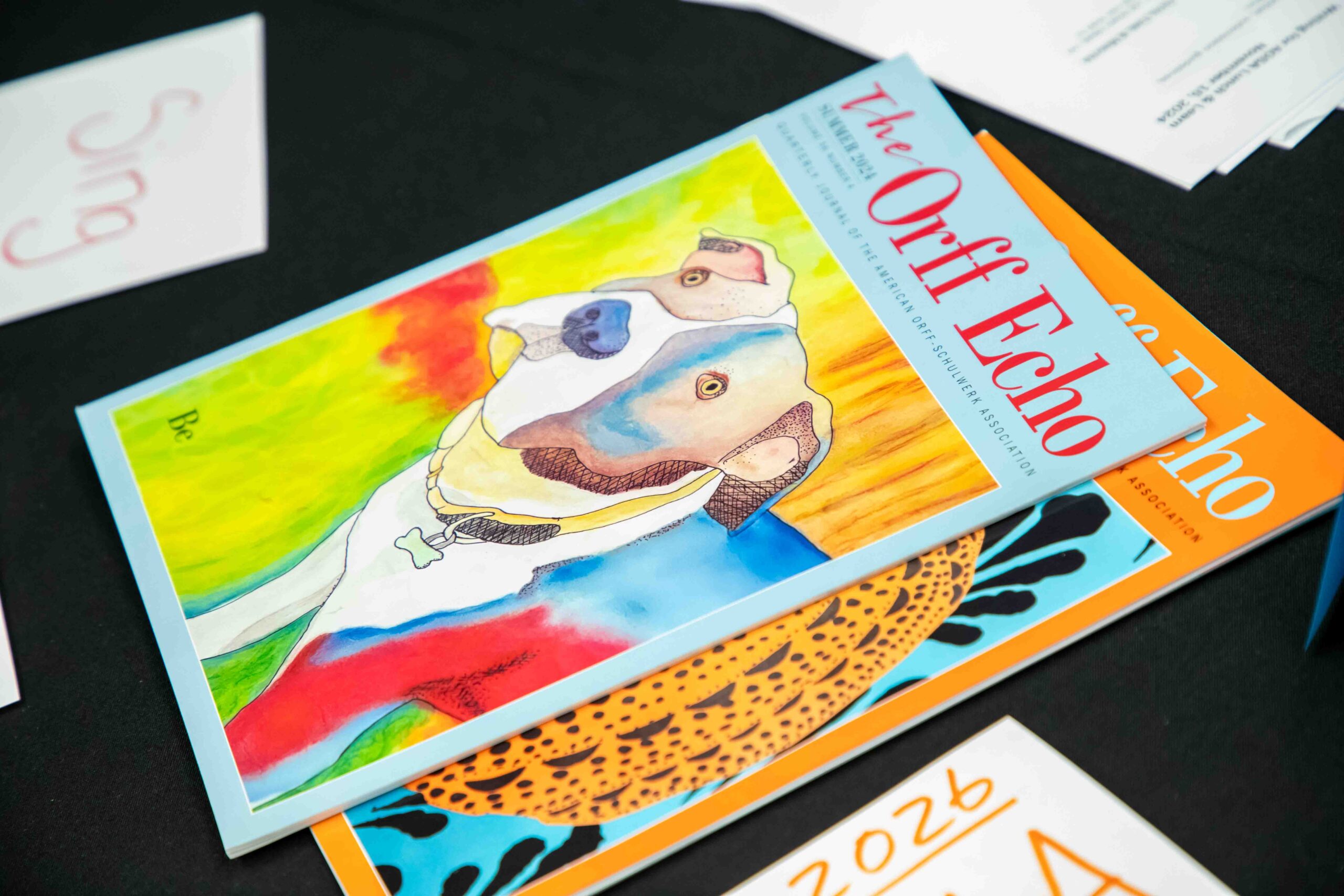
The Orff Echo is the national, peer-reviewed quarterly journal and philosophical voice of the American Orff-Schulwerk Association. Our mission is to demonstrate the value of Orff Schulwerk and promote its widespread use; to support the professional development of our members; and to inspire and advocate for the creative potential of all learners. Non-members may contact the editor for information.
Interested in writing for The Orff Echo? Check out how to get involved in the process:
Extensions to articles published in The Orff Echo can be found in the AOSA Resource Library.

List of Orff Echo Articles
A Dialogue with Louise and Laura: Orff -Inspired Practices in Urban Settings
A discussion about challenges and successful adaptations when teaching in urban settings.
Orff Oakland: Transforming Elementary Urban Music Education
Oakland, CA music educators collaborate to create an Orff-based professional developement training model for their district’s instrumental music teachers.
Music for Children: Comparing Selections of Carmina Burana with Orff Schulwerk
Similarities can be found when comparing Orff’s elemental music written for children’s voices in Carmina Burana and in the Music for Children volumes.
Schulwerk Presence: Mindful Awareness Practices and the Orff Approach
The intersection of Orff Schulwerk and mindfulness fosters creativity and well being in both students and teachers.
Content Analysis of The Orff Echo, 1968-2015
Results and discussion of 21 research-established topics published in The Orff Echo, 1968-2015.
Reminders from Margaret Murray
Author shares her experiences with Orff and Keetman: 1) use the written music as a stimulus to find your own stimuli. 2) go beyond the pentatonic scale 3) explore and connect all the arts.
Schulwerk: Before the Bars
Using historic references, the author discusses how barred instruments are one tool within the full spectrum of an elemental Orff Schulwerk curriculum that includes speech, drama, music and movement.
Yes, but Is it Orff?
Three student scenarios, incorporating movement and musical elements, are explored to demonstrate that the essence of Orff Schulwerk goes far deeper than the instrumentarium.
Music of the Body
A description of the versatility of body percussion and how students use it from a self-accompanying tool for moving through space to approximating the melodic contour of harmony.
No Orff Instruments? Well, Then…
This article is an Orff-unbarred approach using methods with speech, poems and children’s literature to inspire students’ creativity. Public domain material is discussed, while inspiring teachers/students to create their own activities. Lesson examples provided.
The Orff-Schulwerk: A Method for Adults?
Research on how the Schulwerk emerged during the 1920s and 1930s, encouraging Orff Schulwerk for adults, with an emphasis on active ensemble participation: individuals learn by doing, resulting in a sense of belonging.
Teach Your Children Bluegrass: Mining Wonderland Avenue School’s Laurel Canyon Roots for Repertoire
A processed lesson using the Orff approach to teach bluegrass to students in a String Band program. Author also addresses the history of bluegrass and the cultural connection within the community.
Teaching Choral Music as an Orff Schulwerk Instructor
A presentation, based on research, of five strategies that establish the basis for using the Orff Schulwerk process to teach choral music.
Storytelling in the General Music Classroom
Suggestions for using storytelling to engage students in a compassionate, expressive, safe and nurturing setting. Process and lesson ideas are provided.
Saint-Saens’ Danse Macabre
Children’s Book Review: This book tells the story of how Saint-Saens came to compose Dance Macabre. The story offers opportunities to explore new ways to play instruments and offers a good reason to listen to this composition.
Rabbityness
Children’s book Review: Picture book about a joyful rabbit who enjoyed doing normal rabbit things like jumping, burrowing, and washing his ears, but who also liked doing ‘unrabbity’ things like painting and making music.