
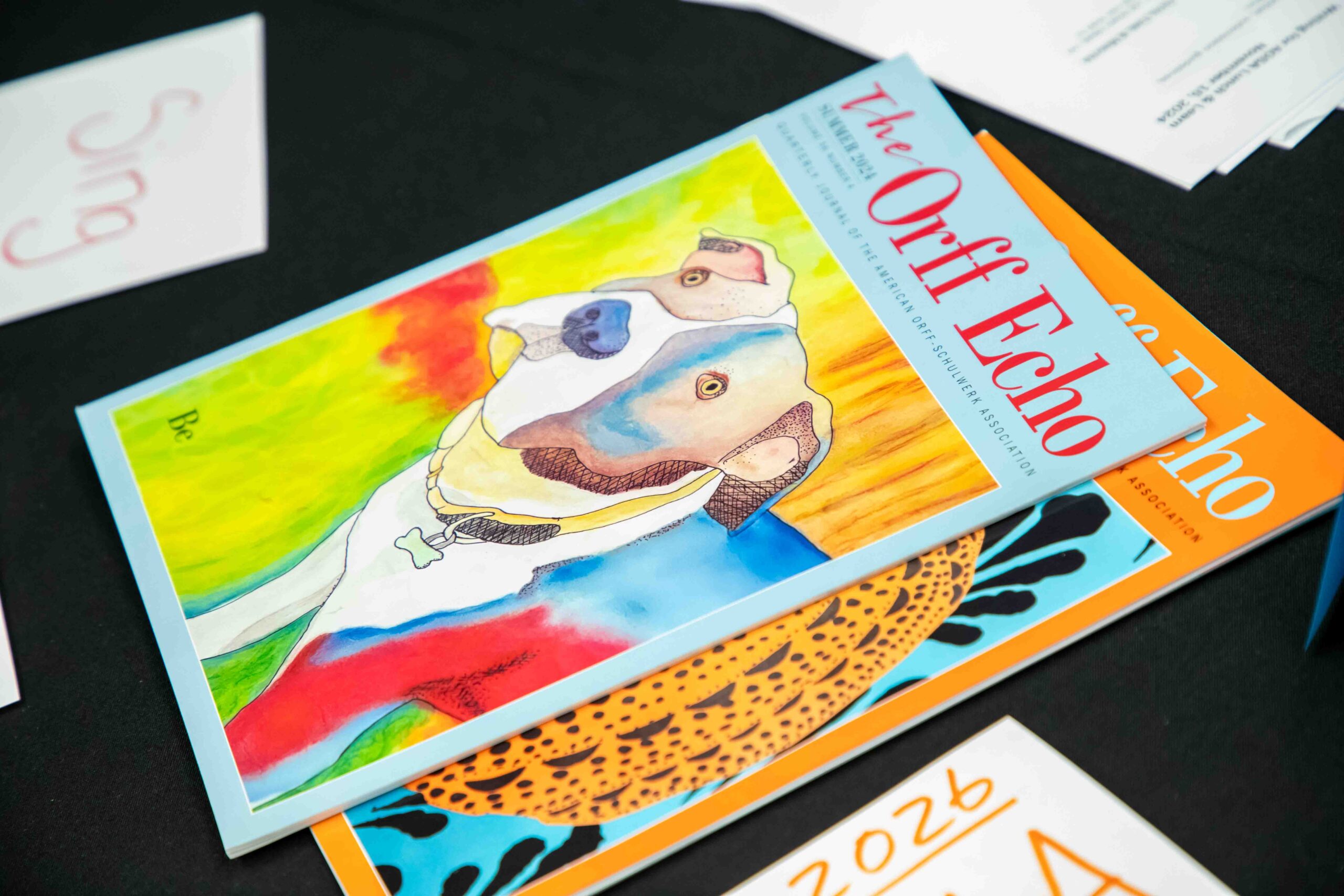
The Orff Echo is the national, peer-reviewed quarterly journal and philosophical voice of the American Orff-Schulwerk Association. Our mission is to demonstrate the value of Orff Schulwerk and promote its widespread use; to support the professional development of our members; and to inspire and advocate for the creative potential of all learners. Non-members may contact the editor for information.
Interested in writing for The Orff Echo? Check out how to get involved in the process:
Extensions to articles published in The Orff Echo can be found in the AOSA Resource Library.

List of Orff Echo Articles
All the World
Children’s Book Review: This picture book invites readers to contemplate the beauty of the simple things in life, invoking a sense of calm with soothing text and rhythms.
The Pout Pout Fish
Children’s Book Review: This book is a wonderful opportunity for children to explore their personal experiences with feelings of gloom and sadness. It can start conversations about why children feel depressed or sad. The story invites movement exploration and creation of a soundscape.
Healthy Assessment Planning: Using Focus, Variety, and Balance
Assessment elements (focus, variety and balance) used to evaluate student’s progress.
Looking at Student Work: Collaborating as a Team
Team teachers’ collaboration in developing student assessment and evaluation tools: rubrics and qualities of a collaborative team.
Reflective Technology: Using Recording Tools in the Music Classroom
Using technology to involve students in critiquing their own performances via Audacity®, smart phones, laptops, etc.
I’ll Meet You in Your Music: Observing Students’ Informal Music
An exploration of how children’s music making on the playground provides a framework for familiar and unfamiliar music in the formal music classroom.
Meeting Common Core State Standards for Speech and Language: Using Orff Schulwerk with Early Elementary Students
Use the Schulwerk to teach elementary music and while supporting other disciplines.
You Just Have to be There: The Workshop as the Heart of Orff Training
Looking at the Schulwerk from the teacher’s point of view. The “being there” transmits to being at a Orff workshop: the understanding of how the Schulwerk develops children’s musical and mental minds and bodies.
The Schulwerk and Common Core Curriculum
Connecting the Orff approach with the Bloom’s taxonomy and a list of activities that address the non-music needs of the Common Core curriculum.
Jingle, Jangle, Jingle: Using Cowboy Ballads to Teach Social Studies and Language Arts
Popular cowboy ballads link to learning about Western expansion, the genre of cowboy films and other social aspects of the West.
Building Bridges: Using Orff Practices to Increase Reading and Music literacy
How to connect music and reading to enhance the students’ learning in other subjects.
Grace Notes: Strategies to Build Dancer’s Confidence and Grace
Approaches and outlines to engage every student to build confidence and physical grace in dancing.
Taking Center Stage: The power of Elemental Drama in the Orff Schulwerk Classroom
Elemental Drama: using six dramatic elements to build a powerful experience for children.
Tracing Teacher-Student Lineages in Orff Schulwerk
Taranto studied the transmission of Orff Schulwerk principles through teachers of adult students beginning with Orff and Keetman. He surveyed current levels teachers concerning the content of their course and found remarkable consistency from course to course.
Effect of Vocal Ranges on Pitch Accuracy of Elementary-aged Children
The purpose of the study was to test elementary children’s pitch matching ability in high and low registers. Students performed significantly better in their lower registers.
Artful-Playful-Mindful: A New Orff-Schulwerk Curriculum for Music Making and Music Thinking
Professional Book Review: “Less is more” A project model plan in developing music instruction’s brief sessions. Each process presents 10 projects lasting three weeks; built on rhythm and pitch elements.