
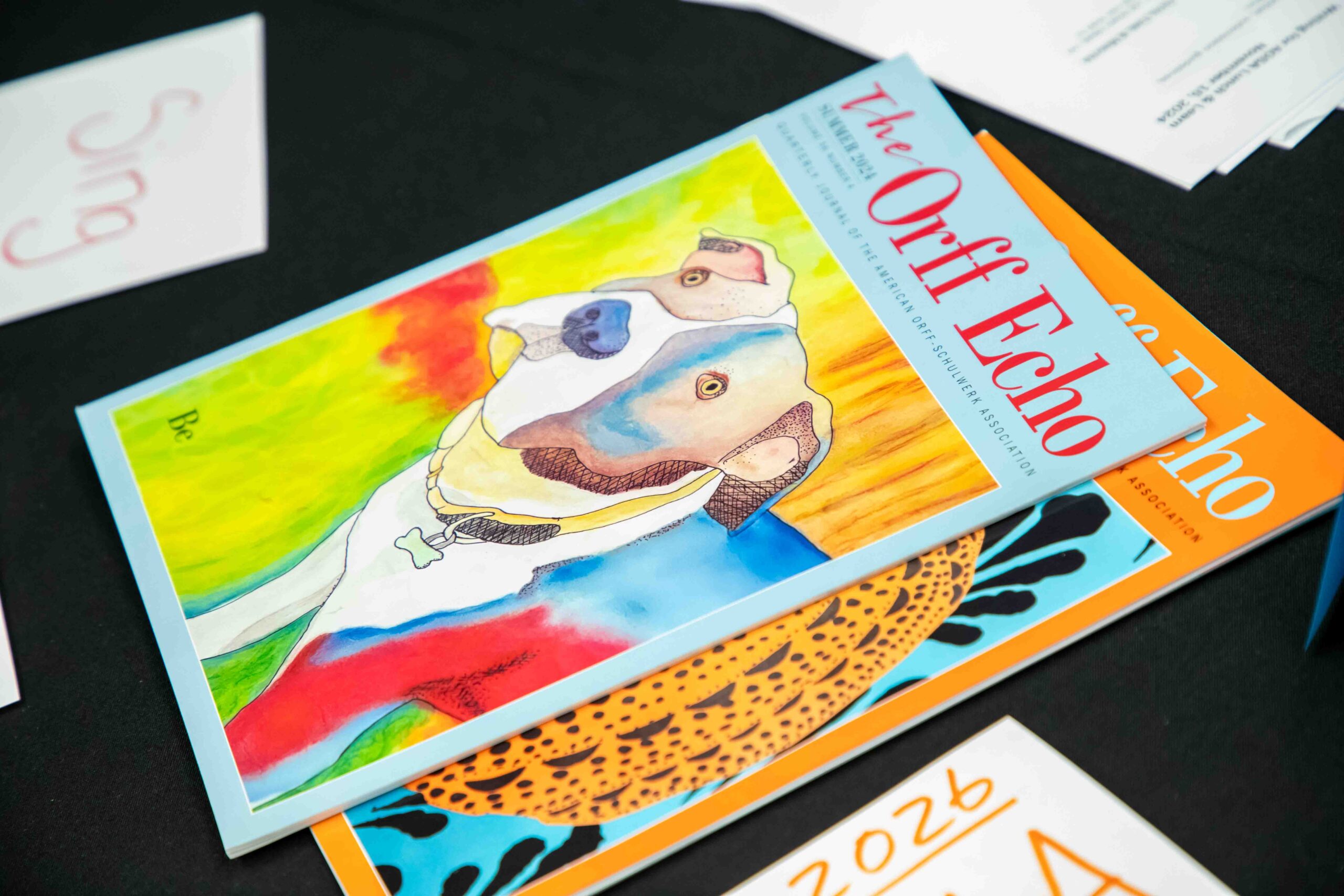
The Orff Echo is the national, peer-reviewed quarterly journal and philosophical voice of the American Orff-Schulwerk Association. Our mission is to demonstrate the value of Orff Schulwerk and promote its widespread use; to support the professional development of our members; and to inspire and advocate for the creative potential of all learners. Non-members may contact the editor for information.
Interested in writing for The Orff Echo? Check out how to get involved in the process:
Extensions to articles published in The Orff Echo can be found in the AOSA Resource Library.

List of Orff Echo Articles
Using Brain Gym and Power Teaching in the Schulwerk
Stafford discusses her use of the Brain Gym activities in her music classroom.
Students with Disabilities Making Music
The authors discuss their work introducing jazz at a school for children with limited motor skills. They talk about how they adapted instruments for the children’s use.
Brain Research Brings Clarity to Our Instructional Practice
Brain research shows how music and movement develop the whole child, from motor skills to creativity and an adaptive mind. The author describes how research validates Orff practices, demonstrating brain compatible instruction.
How Music Can reach the Silenced Brain
The author describes cases where music therapy helps people with neurological impairments or diseases. Knowing that new networks may be formed in the brain every time a new skill is learned has implications for both early childhood developemnt and recovery of function in damaged brains. Ongoing research will eventually provide more answers.
Body, Voice, and Breath: The Corporeal Means of Music Learning
Movement impacts the neural brain structure; children experience music through bodily experience. A link is shown between movement and developing the musical brain, including vocal production.
Songs that Children Sing: Clues about Innate Musicality and Cultural Influence
Using data from 100 childrens’ songs from the collection Le Chant des Enfants du Monde, the author analyizes five areas – tonality, meter, melody, structure, and endings – finding commonalities as well as more questions.
Special Issue on Music and the Brain
A brief history of ideas about the brain, brain research, brain anatomy and brain plasticity.
Music and the Brain: Resources for Further Exploration
This summary of resources published between 2008 and 2009 includes books, documentaries, podcasts, and websites about music and the brain.
From the Classroom: Practically Orff Schulwerk
Components of a brain-compatible lesson – imitation, exploration, developing skills, creating, and reflection – are described with teaching examples.
Musicophilia: Tales of Music and the Brain
Professional Development Book Review: In Musicophilia, Oliver Sacks shares his professional experiences in a very warm and personal way that results in a clinically based narrative that doesn’t require scientific training to be understood.
Music, the Brain, and Ecstasy: How Music Captures Our Imagination
Professional Book Review: Jourdain comes to the subject as both a scientist and a musician and helps us to understand how to connect the dots between findings in the laboratories and the intuitive experiences of musicians.
Using Drama in Professional Development
Lee Harris discusses teaching as a performing art. He recounts experiences in a professional development course such as Orff levels courses that encourage creativity through dramatic expression.
From Page to Stage
The author discusses ways to present a musical program that includes drama.
Integrating the Arts into the Elementary Curriculum
Gifford discusses a successful, one-semester university course that she and other professors in music, drama, visual arts, and movement taught. The course was on integrating the arts in the elementary classroom and was taught by all four professors.
Using American Folk-Heitage Folktales in Drama
AOSAs first President, Arnold Burkart, discusses his “talking points” for creating a musico-drama from a folktale.
The Alphabet Tree
Children’s Book Review: Picture book that tells the tale of the alphabet tree and how, when a fierce wind threatens to blow all the letters off the tree, the letters band together in words and sentences to create a powerful message.