
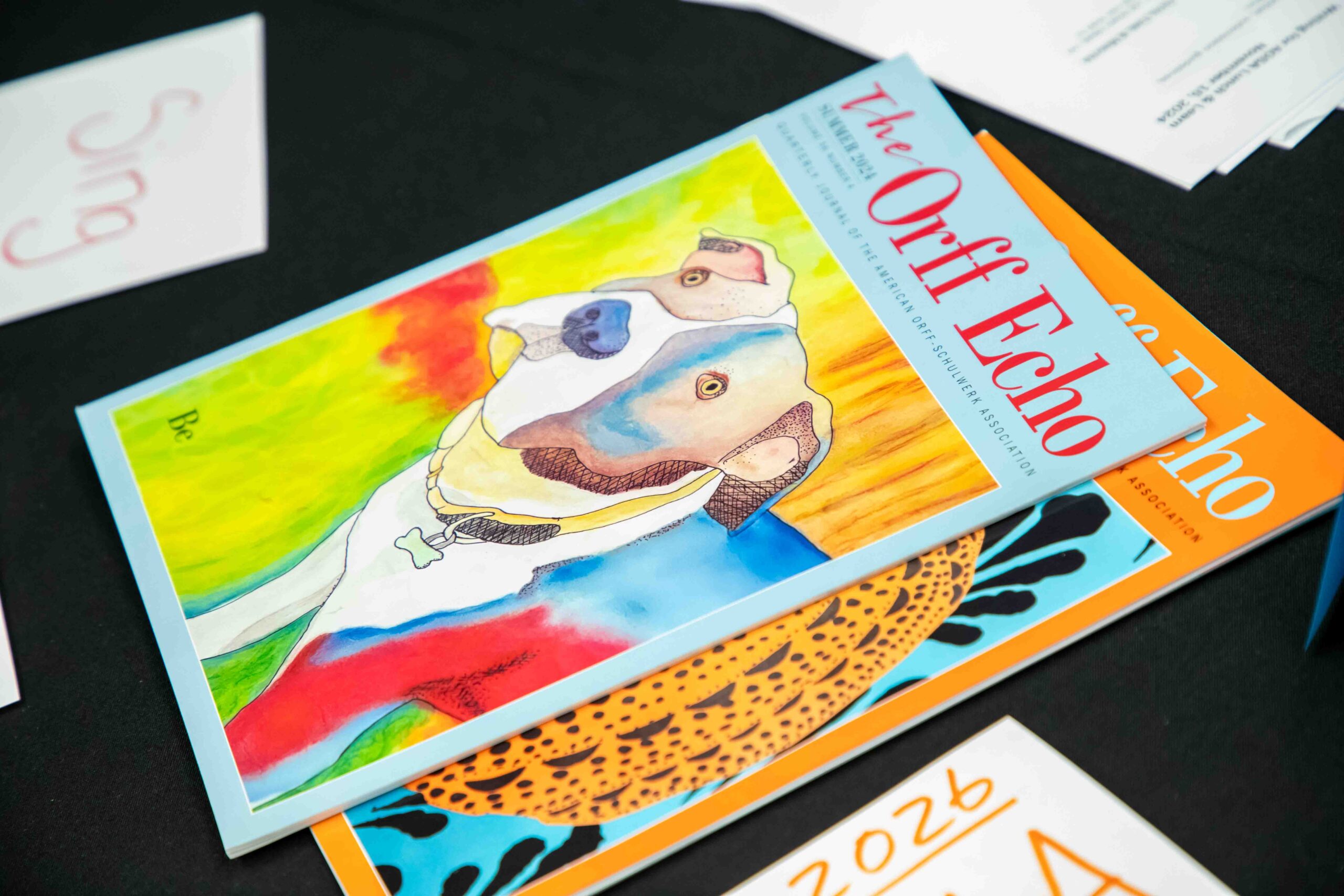
The Orff Echo is the national, peer-reviewed quarterly journal and philosophical voice of the American Orff-Schulwerk Association. Our mission is to demonstrate the value of Orff Schulwerk and promote its widespread use; to support the professional development of our members; and to inspire and advocate for the creative potential of all learners. Non-members may contact the editor for information.
Interested in writing for The Orff Echo? Check out how to get involved in the process:
Extensions to articles published in The Orff Echo can be found in the AOSA Resource Library.

List of Orff Echo Articles
Intergenerational Movement Matches “Talls and Smalls”
The philosophy, implementation, and outcomes of inter-generational dance.
Good Night, Pillow Fight
Children’s Book Review: The two-part rhythmic phrases in this picture book model how question and answer phrases are related but not identical.
The Napping House
Children’s Book Review: This picture book invites students to create vocal and instruments sounds for the descriptive text.
The Dot
Children’s Book Review: This picture book by Peter Reynolds tackles fear of failure in a way that invites both children and adults to overcome their perceived limits.
From the Classroom: Sifting Through a World of Music
Abril advocates for taking care when selecting music for the classroom. Be aware of implicit and explicit evidence of cultural, ethnic, or gender bias and consult with individuals of the culture to determine how the music represents their culture.
Hope for Our Children: Sharing the Migrant Experience Through Music
Strategies to address the educational, social, and developmental needs of Latin American migrant children in the Orff Schulwerk classroom.
Glimpses at Genius: Keetman the Person, the Composer, the Improviser
This biography of Gunild Keetman focuses on her sense of humor and shyness, her dance compositions, and her life long accomplishments in education and as an improviser.
Through Technical Mastery and Composition, Keetman Re-imagined the Recorder
After a brief history of Keetman’s contributions to the Guntherschule, many applications of Keetman’s compositions for today’s classroom, drawing from Music for Children and supplemental books are presented, with a chronological list of her publications.
Keetman Employed Emerging Technology to Teach Children
Ketman’s work with children, from 1936-1962, includes the Berlin Olympic games, Bavarian Radio shows, TV, and films.
Finding Keetman
A touching story of pilgrimage to the home and burial site of Gunild Keetman.
Guild Keetman: Dates of Note in a Notable Life
A biographical photo journal of highlights of Keetman’s life, colleagues and accomplishments.
Keetman Remembered, Revered by AOSA Members
Colleagues write about Gunild Keetman: Carley, Gagne, Salzman, Frazee, Hamm, McCreary
Blues Journey
Children’s Book Review: Illustrated children’s book featuring the poetry, art, and history of the blues. The reader can musically trace the lines of African American history through modern urban life.
Folk Song Bibliography
A short list of Spurgeon’s favorite folk songs for teaching children.
Traces of Paradise in Traditional Hawaiian Music
Hawaiian music teacher, Linda Weyman describes the Polynesian origins, dance-accompanied chanting, and other traditions, that are the foundations of Hawaiian folk music.
Focus on Research: Discovering Interconnections between Music Description and Language Development
Flowers explores the connections between language and music with implications for teaching.