
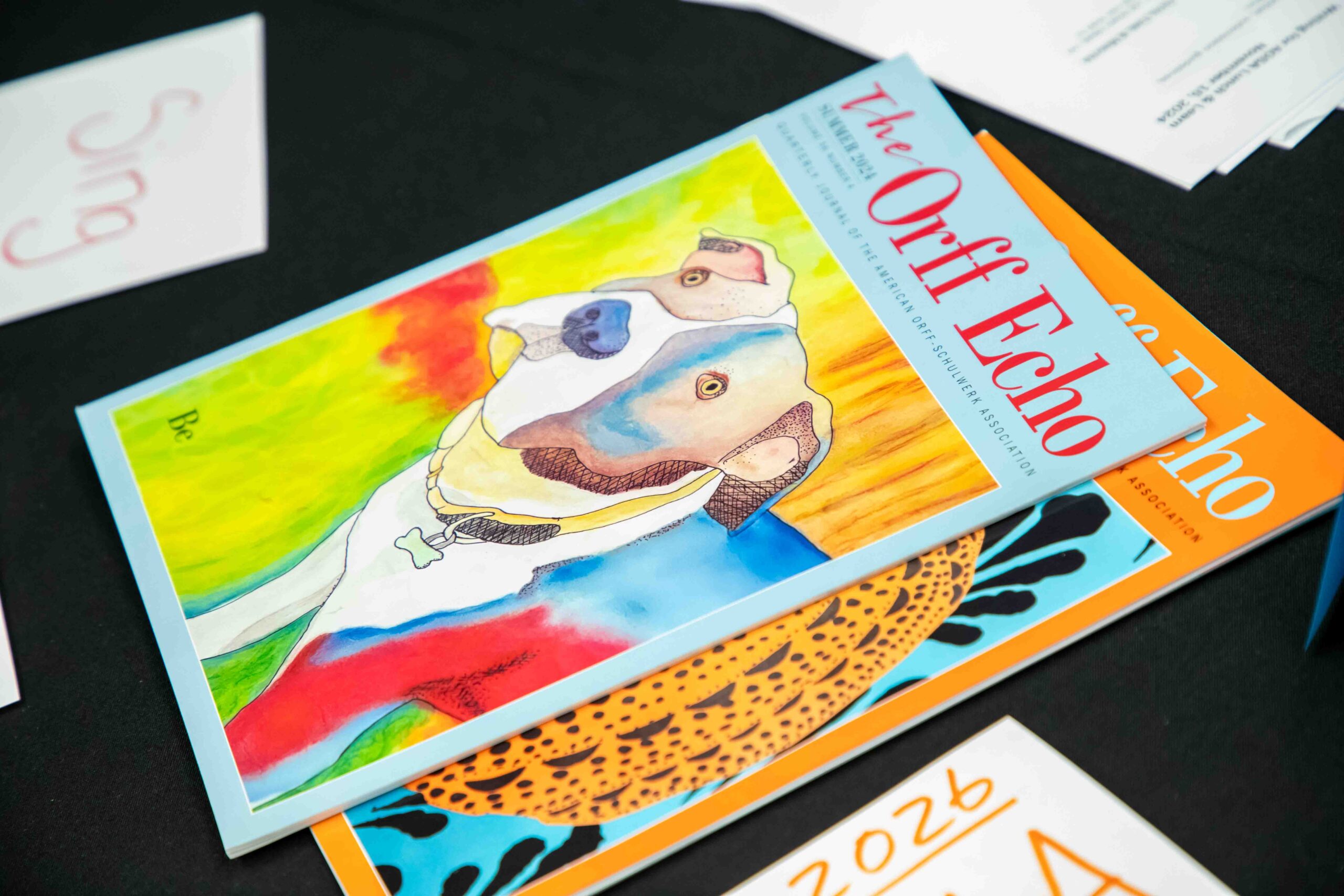
The Orff Echo is the national, peer-reviewed quarterly journal and philosophical voice of the American Orff-Schulwerk Association. Our mission is to demonstrate the value of Orff Schulwerk and promote its widespread use; to support the professional development of our members; and to inspire and advocate for the creative potential of all learners. Non-members may contact the editor for information.
Interested in writing for The Orff Echo? Check out how to get involved in the process:
Extensions to articles published in The Orff Echo can be found in the AOSA Resource Library.

List of Orff Echo Articles
Rivers Need a Spring: A Portrait of Grace Chapman Nash
This the first in the series of portraits of the founders and early pioneers of the American Orff Schulwerk Association.
Reflection on ‘Community Music’ and Musical Communities
Anthropologists, ethnomusicologists, and folklorists study community music as social expression. Music is our last and best source of “participatory consciousness.” Connecting children to future bearers provides rich potential for global social bonding.
From the Classroom: Quaker, Quaker
This singing game develops social skills such as taking turns, shaking hands and eye contact; it teaches musical question and answer, pitch matching and shared beat keeping.
Wise Up: The Challenge of Lifelong Learning
Professional Book Review: Guy Claxton urges us to embrace in our definition of learning all the ways humans perceive and respond, including the emotional , intuitive, and imagine realms, and reveals research that substantiated his argument.
Free Play: Improvisation in Life and Art
Professional Book Review: Stephen Nachmanovitch discusses improvisation in all arenas of life, not just arts. Through personal stories and illustrations from other cultures, we examine sources of inspiration, how creativity works, helpful attitudes about mistakes, and surpassing limiting beliefs.
The Story of the Incredible Orchestra
Children’s Book Review: Fact-filled children’s picture book that introduces the instruments of the orchestra, gives a brief history of those instruments, and tells how they came to be grouped together in the orchestra setting.
The Remarkable Farkle McBride
Children’s Book Review: Picture book about young Farkle McBride who drums, strums, blows, and bows his way through years of unsatisfying orchestral instrument study to eventually discover the one musical experience that does satisfy him.
The Musical Community
Examples of how music builds community, nurturing a sense of belonging and of being known – for all ages – through group musicking.
Building Community with A Collaborative Approach
Structure classroom activities for safe and respectful collaboration, honoring student ideas, scaffolding good models and provide templates for creativity.
Building Community – A Principal’s Perspective
School wide community building can be accomplished through implementing Orff Schulwerk philosophical emphasis on creativity first for all members: staff, students, parents, and surrounding neighborhood.
Building a Singing and Dancing Community
Daily, school-wide community singing in a small rural school, and evening community dances advance, the singing and dancing skills of the entire community, bringing connection and joy.
Wedding Dances: A Slice of Community Life
Inter-generational dancing at weddings are a part of every culture and help the community pass on heritage while celebrating the marriage.
An African Odyssey
The author reflects on his experiences in Ghana and draws connections between traditional W African music and Orff Schulwerk.
Folk Dance Patterns: Times and Tides
An overview of folk dances from Europe, the Balkans, and the Mediterranean and their relationships across time and national borders.
Beyond Riverdance: Irish Song and Dance
Characteristics and examples of traditional Irish folk songs, dances, and instruments.
What is Jewish Music?
A discussion of historic, religious, and cultural meanings of the word “Jewish” and how they apply to music.