
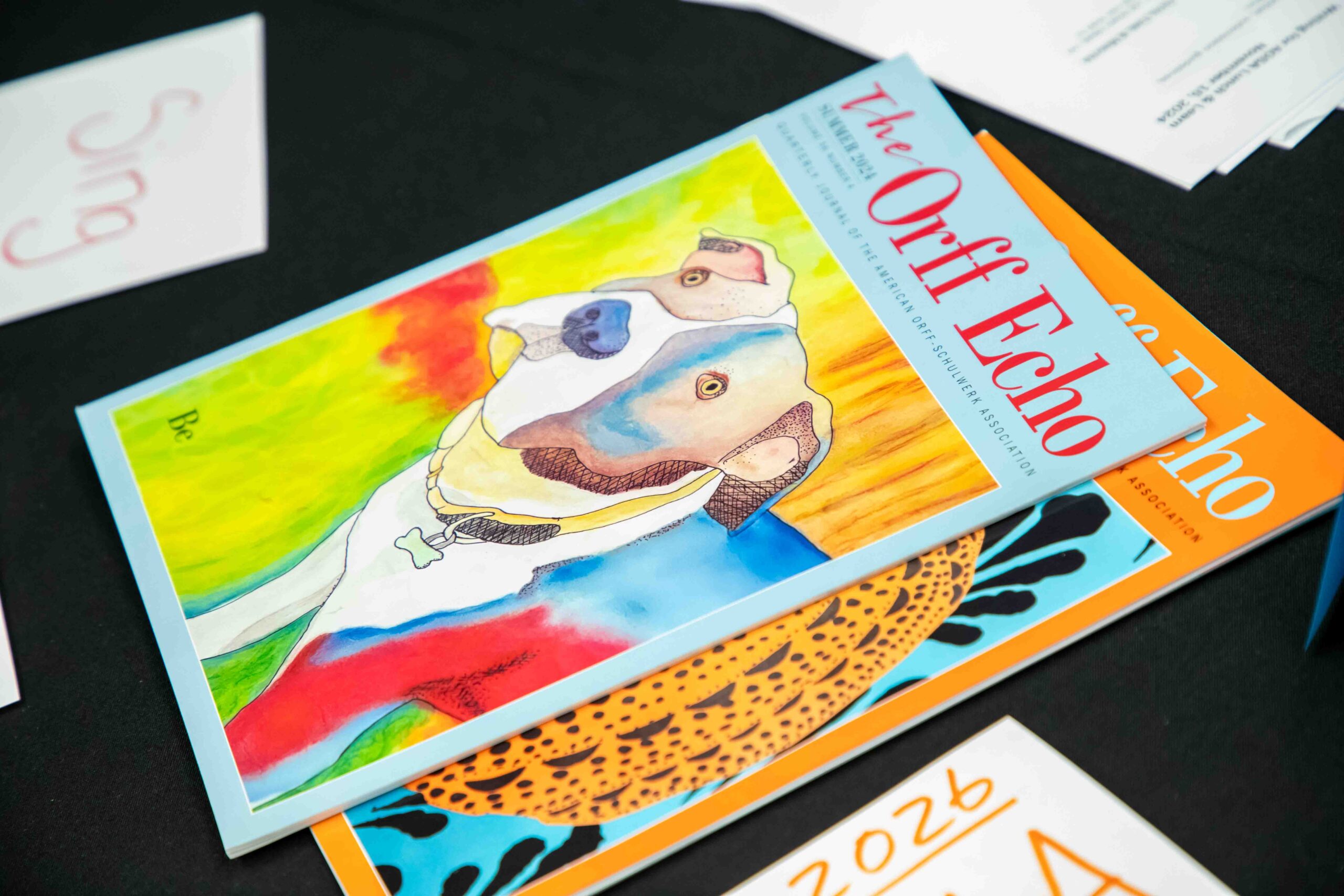
The Orff Echo is the national, peer-reviewed quarterly journal and philosophical voice of the American Orff-Schulwerk Association. Our mission is to demonstrate the value of Orff Schulwerk and promote its widespread use; to support the professional development of our members; and to inspire and advocate for the creative potential of all learners. Non-members may contact the editor for information.
Interested in writing for The Orff Echo? Check out how to get involved in the process:
Extensions to articles published in The Orff Echo can be found in the AOSA Resource Library.

List of Orff Echo Articles
The Luau
Marilyn Gunn discusses changes she made in a long-time tradition at her school in Missouri, a second grade Luau program.
Bridging the Gap: Collaborating to Serve the Needs of At-Risk Students
Yoder-White discusses a research project with the purpose of fostering relationships between university music education students and “at-risk” middle school students.
From the Classroom: The Printed Program – Destined for the Scrapbook or Scrap Heap
The author describes how a printed program can become advocacy for an Orff Schulwerk program.
Focus on Research: Unveiling the Mysteries of the Developing Child Improviser
The article presents the results of the author’s AOSA funded research study of the child as improviser.
Teachers Should Improvise Too!
Improvisation on the part of the teacher is a model for students and frees the teacher to grow along with the children.
Make No Mistake
The author discusses the balance between the development of artistic perception and creative expression. Composition and improvisation flow freely when the student can use the language of music to “speak” from the heart.
Benchmark Improvisation: An MENC Project to Help Teacher Asess Student Progress in Standard 3
A discussion of issues surrounding assessment of improvisation and creativity.
Paths to Improvisation: Using Keetman’s Elementaria
Gunild Keetman’s Elementaria is a detailed guide to organizing lessons in the elemental style that lays out paths to take from exploration to composition and improvisation.
Composing and Improvising: From Theory to Practice
A series of vignettes describing the work/play of sixth grade students as they experienced a project involving composition and improvisation.
Teaching Music in the Multi-Age Classroom
Shared experiences of Orff Schulwerk teachers in multi-age classrooms from around the country.
Encounter with Modern Art Forms
Haselbach encourages readers to include music and art from the 20th century in their classrooms. This requires the teacher to seriously study the art and music that they wish to introduce to children so that the material also allows students to master specific music or movement goals.
The Nature of Music
The author encourages teachers to take a playful approach to contemporary music. She suggests inquiry for teacher and students alike: What does it want to say? How is it made? What is it aiming for?
Orff Schulwerk and Contemporary Music
Goodkin shares examples of using contemporary music in classroom lessons.
Discovery in C: Minimalism in the Classroom
Abril shares ideas for including minimalism, serialism and other contemporary forms in the music classroom.
Four Moments in Time: Reflections on the Orff Institute
Jacque Schrader, of the Key School in Maryland, discusses her time spent studying at the Orff Institute in Salzburg.
Reflections on Teacher Research
Robbins encourages Orff-inspired teachers to be researchers in their classrooms. She advocates for keeping a journal as part of a reflective habit and joining with other teachers to form discussion groups to provide structure for thinking about teaching practice.