
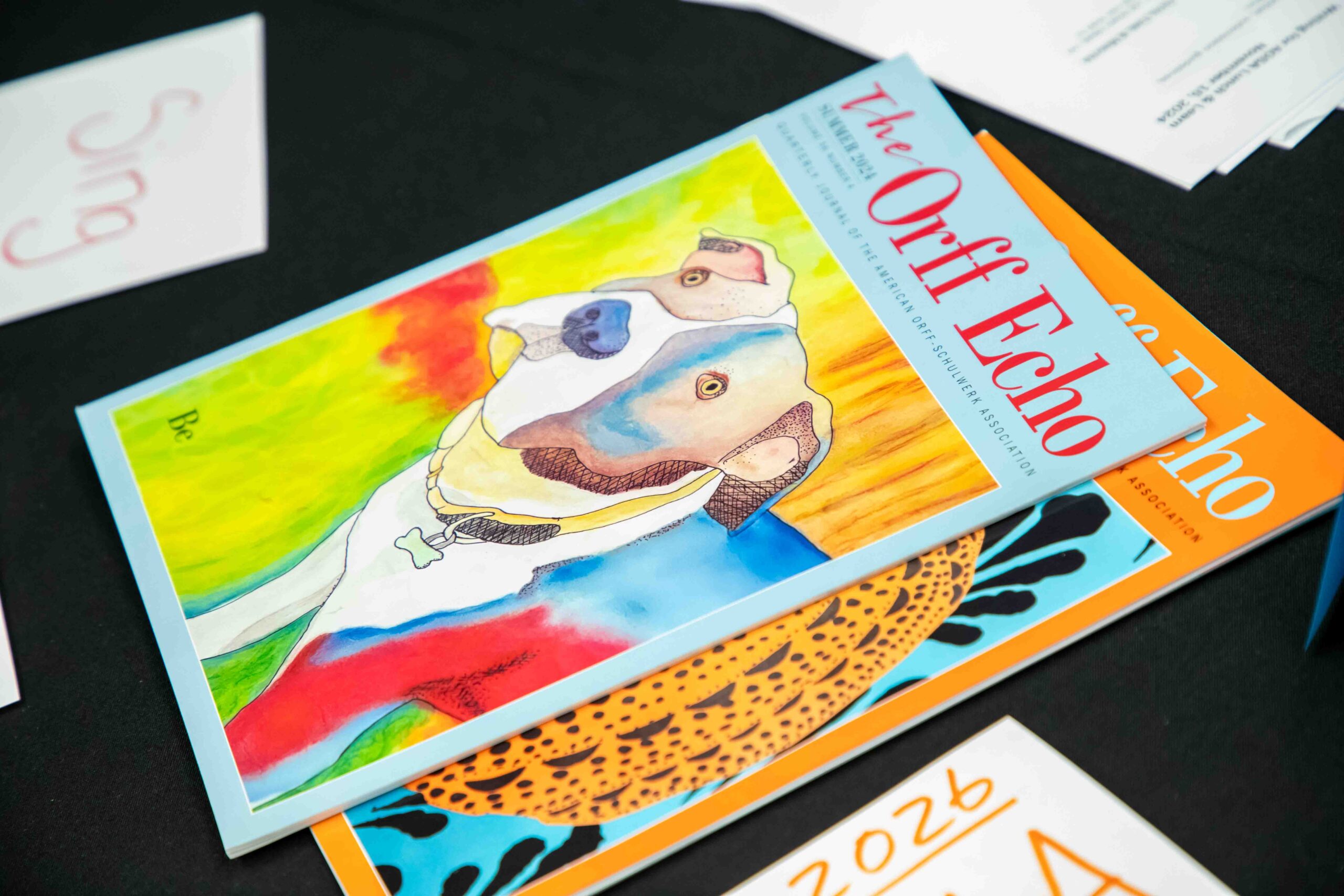
The Orff Echo is the national, peer-reviewed quarterly journal and philosophical voice of the American Orff-Schulwerk Association. Our mission is to demonstrate the value of Orff Schulwerk and promote its widespread use; to support the professional development of our members; and to inspire and advocate for the creative potential of all learners. Non-members may contact the editor for information.
Interested in writing for The Orff Echo? Check out how to get involved in the process:
Extensions to articles published in The Orff Echo can be found in the AOSA Resource Library.

List of Orff Echo Articles
Discovery in C: Minimalism in the Classroom
Abril shares ideas for including minimalism, serialism and other contemporary forms in the music classroom.
For Our Pastance, We Play and Dance: Teaching Renaissance Music and Dance to Young Performers
Practical and musical considerations for performing Renaissance music and dance.
The Language of Morris, Once-to-Yourself
Background on traditional Morris dancing and an example of a school Morris team.
Sharing in Process: Orff Schulwerk in Intergenerational Settings
The second in a set of articles about the application of Orff Schulwerk in intergenerational settings.
From the Classroom: Early Music for an Early Age – When the Consort Came to School
Student reactions to a performance of an early music ensemble.
The Disciplined Mind/Building Character in Schools
Two professional book reviews: The Disciplined Mind: What All Students Should Understand by Howard Gardner articulates the importance of application of knowledge. Building character in Schools: Practical Ways to Bring Moral Instruction to Life by Kevin Ryan and Karen E. Bohlin provides practical answers to the question, “How do we build character in our students?”
Early Music in the Schulwerk
A discussion of the influence of early Western music on Carl Orff and Gunild Keetman. The article also includes examples in the five volumes of Music for Children that use melodies, modes, and harmonies modeled on early music examples.
It’s Your Chants…
The author describes a multi-sensory classroom experience with medieval chant that extends into student composition and vocal assessment.
Games With Upper Elementary Students
When starting an Orff Schulwerk program with older students, games helped with beat competency as preparation for playing instruments.
Music for a Lifetime: Five Perspectives
In her President’s message, AOSA President, Linda Ahlstedt, interviews five leaders in elementary general music about the future of music education in the US.
Songs and Games: the Preservers of Culture
Cole presents singing games from Hispanic and Japanese cultures.
Play Parties
The author discusses the uniquely American phenomenon of the play party. She discusses where the play party came from and what distinguishes it from singing games.
Elemental Shapes of Singing Games
Cole writes about the shapes (formations) used in singing games, especially the circle.
Play: Enabling the Dreamer and Risk Taker in Every Child
Hunter talks about the importance of play in children’s development.
Babies to Grandparents: Family Music Making in Australia
Mclaughlin discusses family-oriented musical activities in Australia.
Singing Games: Researching their Historical and Cultural Context
McCarthy points out that singing games, with their singing, dance movements, dialogue and drama, are closely aligned with the ideals of elemental music of Orff and Keetman.