
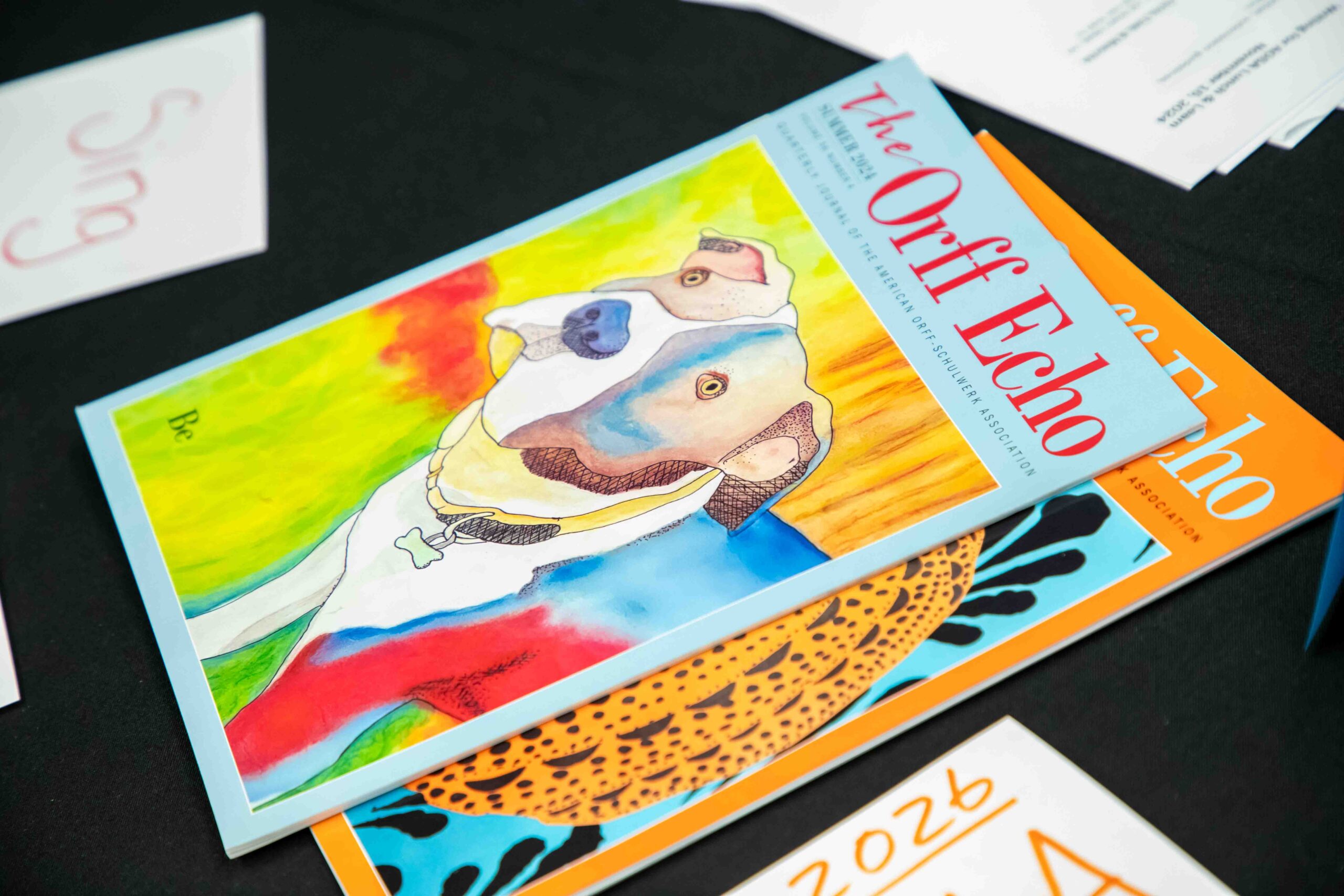
The Orff Echo is the national, peer-reviewed quarterly journal and philosophical voice of the American Orff-Schulwerk Association. Our mission is to demonstrate the value of Orff Schulwerk and promote its widespread use; to support the professional development of our members; and to inspire and advocate for the creative potential of all learners. Non-members may contact the editor for information.
Interested in writing for The Orff Echo? Check out how to get involved in the process:
Extensions to articles published in The Orff Echo can be found in the AOSA Resource Library.

List of Orff Echo Articles
Elemental Shapes of Singing Games
Cole writes about the shapes (formations) used in singing games, especially the circle.
Orff Schulwerk in Middle and Late Childhood: Developmentally Appropriate Practice
Brophy discusses the musical development of children aged 9 to 12.
Upper Elementary Years: Beautiful Singing in Parts
Wood points out that Orff-inspired teachers typically teach in a style that, when applied to singing, can easily lead to singing in parts.
The Schulwerk, Mythology, and the Upper Elementary Student
Layton discusses his student’s work to create a performance based on mythology, taking inspiration from Orff/Keetman primary source material.
Stuffing the Bag of Self: Early Experiences and Lifelong Effects
Jensen discusses early musical experiences and comments by music teachers and others that can influence an individual’s participation in music all of their lives.
D.R.U.M.: Discipline, Respect, and Unity Through Music
Solomon talks about the process of forming a student percussion ensemble. He stresses the D.R.U.M. code requiring discipline and respect.
Wandering for our Roots: Wildflowers!
Schultz tells us about a walk in the Wyoming mountains and the wildflowers she sees there. She asks that teachers consider using the beauty of our own regions and our area’s folklore in our music teaching.
From the Classroom: Beethoven, Percussion, and Composition
In this article, the author talks about ways that she motivates her upper elementary students through an activity using Beethoven’s Fifth Symphony.
Focus on Reserach: Mozart, the Muse, and the Mind: What Current Research Tells Us
Custadero presents some of the new research on music and child development.
Music Drama, Elemental Style
Widmer summarizes her father, Wilhelm Keller’s, work with music drama, a style that he perfected in Germany. It includes singing, narration, songs, speaking, instruments, dance and movement, make-up, costumes , and scenery.
The Sun, the Source, the Schulwerk: Children’s Voices
This is the keynote address at the opening session of the AOSA National Conference in Tampa, Florida, in November, 1998. The speakers were three students.
From the Classroom: For the Love of Words
Making up silly words models a way to play with speech rhythms.
Musica Poetica
Goodkin says that, if we had to describe what gives the Orff approach it’s distinct character, we would say it is the meeting point of music, movement, and speech.
The Magic of Words: Using Language to Enhance Musical Skills and Response
The author points out that using language is a non-threatening and familiar way to begin the art of musical expression as an individual or as part of an ensemble.
Connecting the Word
Huffman discusses the need for children to play with the sounds of words. This can help with learning to read.
The Spoken Word in Music: Certain Choices
Hamm writes about the spoken word and music together in various compositions. She cite several such works that can be models for our work with children.