
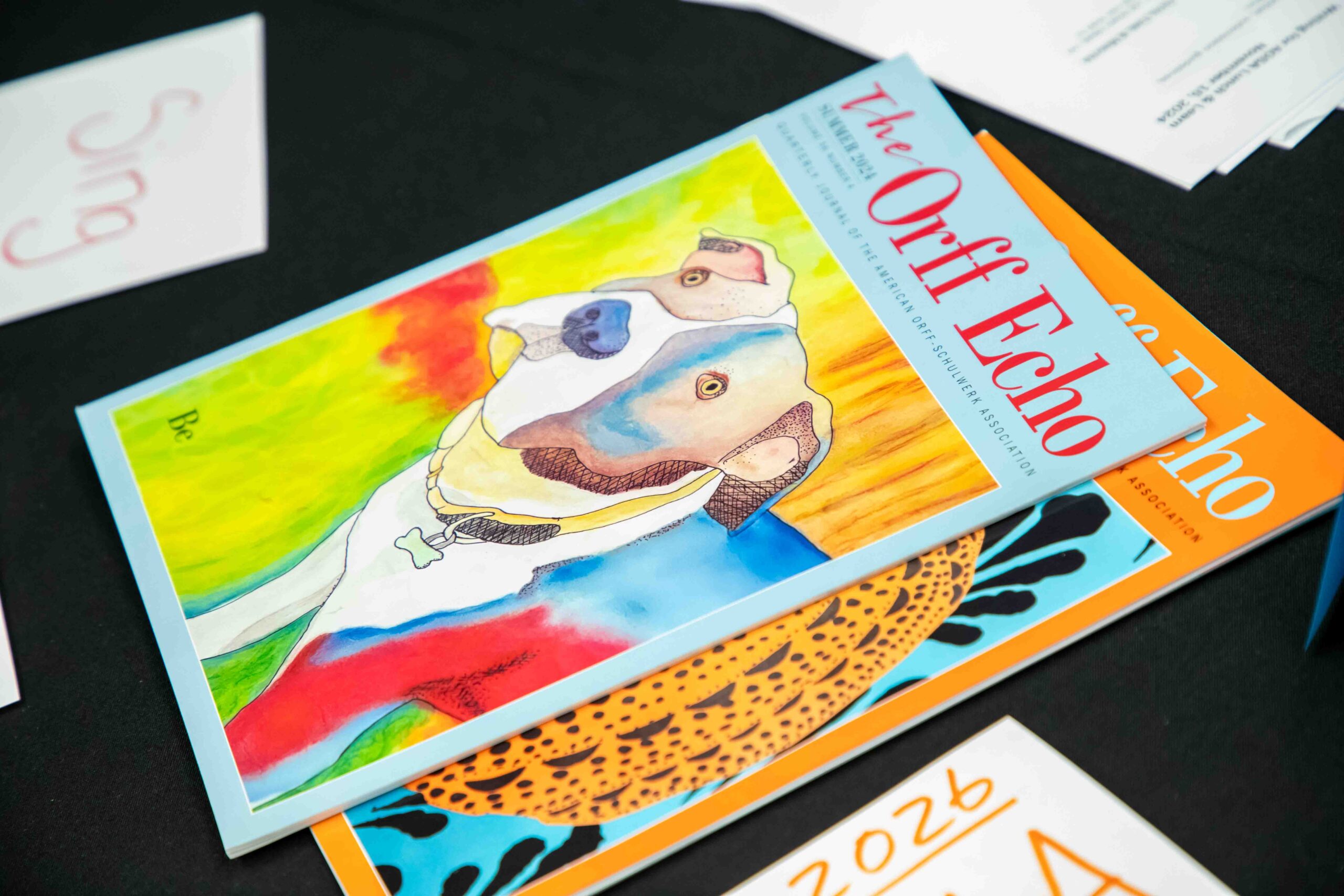
The Orff Echo is the national, peer-reviewed quarterly journal and philosophical voice of the American Orff-Schulwerk Association. Our mission is to demonstrate the value of Orff Schulwerk and promote its widespread use; to support the professional development of our members; and to inspire and advocate for the creative potential of all learners. Non-members may contact the editor for information.
Interested in writing for The Orff Echo? Check out how to get involved in the process:
Extensions to articles published in The Orff Echo can be found in the AOSA Resource Library.

List of Orff Echo Articles
Jazz Goes to School
This article describes the “natural integration” that happens when jazz is introduced into an Orff Schulwerk curriculum.
Orff Schulwerk in the Children’s Choir
Learn many strategies for using Orff Schulwerk processes and media in church and temple settings.
Move It First
Learn strategies for teaching singing games by teaching movement first.
Developing Singers: Implications from Recent Research
This a literature review on vocal pedagogy from 1988 to 1998, following upon the literature review already completed by Goetze, Cooper and brown in 1980.
The Listening Book
Professional Book Review: W.A. Mathieu’s handbook, in five sections of essays, explores musicianship as listening experiences and practices.
Chipmunks, Cicadas, and Owls
Professional Book Review: This Schott Supplement to the American Music for Children consists of songs from indigenous American people. The songs are housed at the Library of Congress and are presented here in a somewhat sketchy manner that requires the teacher to do additional research to bring the material to the classroom in an authentic way.
Coaxing Success: Developing Pitch Accuracy
Three vocal teachers reveal strategies to teach accuracy in pitch matching to children, middle school students, and adults.
Singing Can Be Moving
Learn techniques for using movement and gesture to guide vocal warmups, learning song repertoire, achieving unified vowels, and expressing emotion in the melodic line and vocal timbre for choral and classroom singing.
Rounds and Canons
Use various strategies such as instruments, recording devices, improvisation, composing new forms, and movement to teach teach rounds and canons.
New Songs to Sing
Learn elemental strategies for guiding students in vocal composition and use suggested repertoire from the five volumes of Music for Children for choral performances.
Kids and ‘Kid Pix:’ Looking at Pitch Accuracy
Use Kid Pix to teach pitch accuracy.
On Change
Using many registers and timbres for singing is useful for performing songs from other cultures; Goetze discusses her change of heart about insisting on “head voice” as “the best” register for all choral singing.
Perspectives on African Music
Countering popular racist misconceptions about African music, from the concept of a unified African culture to the idea of African rhythmic superiority, the author reveals through a history of the scholarship how such stereotypes have come about and been perpetuated. Compositional techniques and songs used in the Ewe piece Agbadza are discussed, illustrating critical misunderstandings of Ewe music Orff educators know through Komla Amoaku’s book African Songs and Rhythms for Children, A Selection from Ghana.
Moon Lore: Magic, Myth, and Mystery
Burnett presents some folk tales and defines terminology often used in the folk tale world.
Tricksters We Know and Love
Jessup writes about tricksters, such as the hare, that are often found in folk tales.
A Comparison of Black and Appalachian Storytelling
Jones draws parallels between black folk tales and those of white Appalachia. Neither group were part of mainline culture and needed hero figures who could out-smart those in control.