
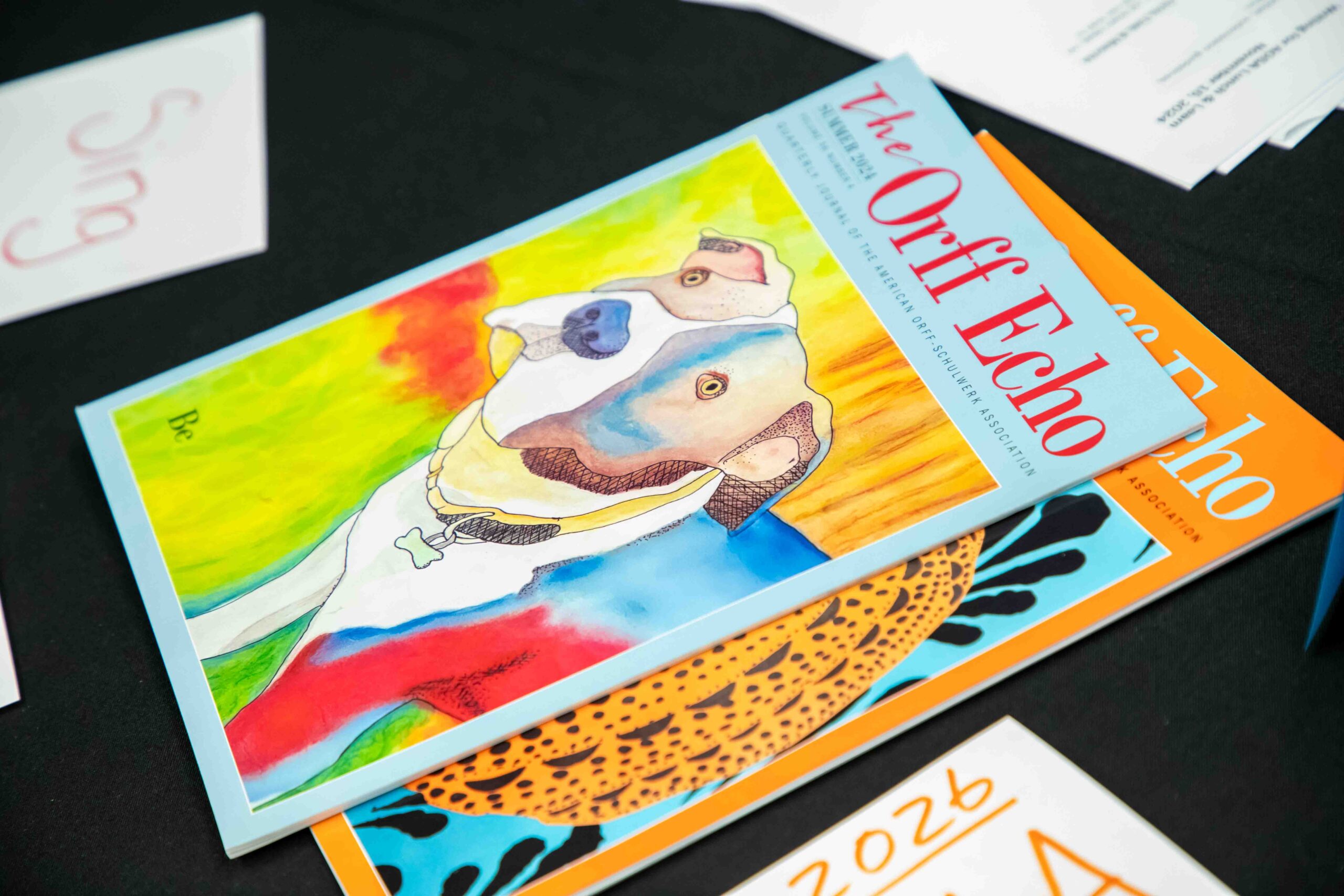
The Orff Echo is the national, peer-reviewed quarterly journal and philosophical voice of the American Orff-Schulwerk Association. Our mission is to demonstrate the value of Orff Schulwerk and promote its widespread use; to support the professional development of our members; and to inspire and advocate for the creative potential of all learners. Non-members may contact the editor for information.
Interested in writing for The Orff Echo? Check out how to get involved in the process:
Extensions to articles published in The Orff Echo can be found in the AOSA Resource Library.

List of Orff Echo Articles
Listening, Spirituality, and The Musical Ear: The Tomatis Method
This article describes the Tomatis method that differentiates between listening and hearing. This approach links the ear, listening, and spirituality and offers insights for Orff Schulwerk teachers.
Listening to Learn
Harwood states that “listening is moving,” an idea very consistent with an Orff Schulwerk classroom. She also encourages beginning a listening experience with the whole, rather than in part, and planning for repeated listening of the same material.
Some Thoughts on Technology and the Orff Teacher.
Many practical applications of technology for management/ instructional purposes and student use illustrate varied ways technology can be a valuable tool in the Orff classroom (and not an end in itself).
Good News for Music Education
This advocacy piece draws upon recent publications that promote the important role music plays in schools as “food for the soul…and for the brain.”
Point-Counterpoint: TV/Video in the Music Classroom
This column includes replies to a question of whether TV and music videos for children help or hinder the music education process.
Focus on Research – Context and Discovery: Rethinking the Nature of Creativity.
This column draws upon the work of Csikszentimihaly’s tri-partite framework for studying creativity, and offers ideas for researching children’s creative “problem-finding” in the home and classroom context.
Thinking in Music: Encouraging the Inner Voice
Author suggests ways to encourage students to think creatively in sound and argues for the importance of enabling and listening for children’s musical voices.
Creativity: Reflections on a Conundrum A Teacher’s Thoughts
One teacher reflects on “what is creativity” in her middle/high school performance classes. Working with a composer-in-residence affirmed the ways creativity can thrive alongside Orff teaching processes.
Into Gold: Alchemy in the Movement Class
Stories from one teacher’s movement classroom, illustrate the ways she uses questions to evoke and frame creative movement. Children’s reactions come alive as they experiment with sound and movement.
Creating with Children
Sequential steps for building children’s creative habits provide a practical guide, along with specific strategies for applying the Orff process: imitation-exploration-creation- literacy.
Ballads: USA
A discussion of themes and roots of traditional ballads of European and African-American influence provide a useful guide to U.S. music culture and history. Several songs are included, along with selected resources.
Orff and the Hurried Child
The activities and materials used in an Orff Schulwerk curriculum educate the whole child and are developmentally appropriate for young children.
Meeting Their Needs: Developmentally Appropriate Music for Young Children
An overview of developmentally appropriate practices and music activities for children from birth to age 8.
Vocal Development in Early Childhood
The author shares vocal techniques, songs, and activities that help preschool children find and develop their singing voices.
Celebrate with Dance
Advantages and examples of creative movement activities for preschool children.
Early Childhood and the Electronic World
The author argues that the preschool child’s developmental needs of language enrichment, movement exploration and fantasy are not met by electronic media.