
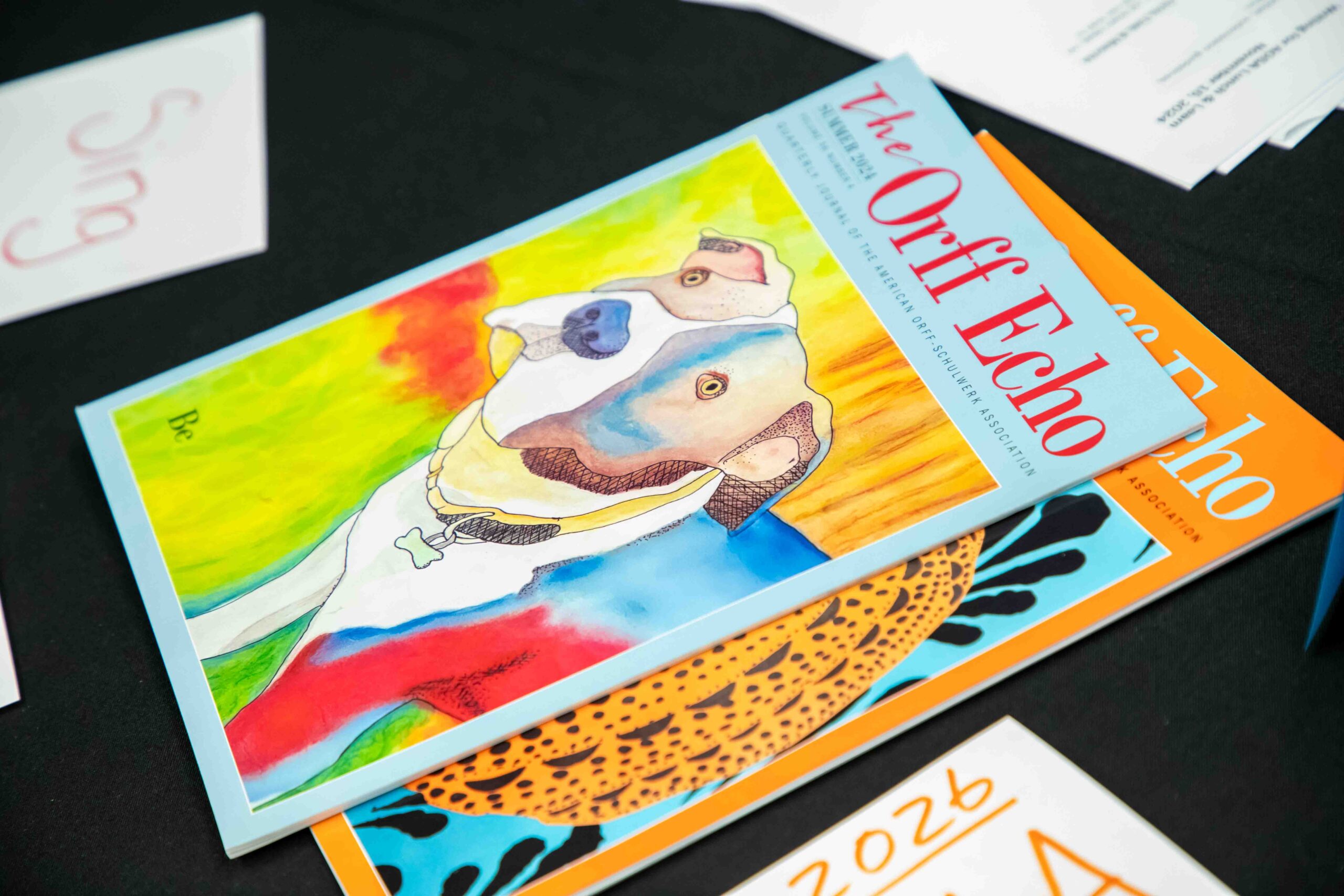
The Orff Echo is the national, peer-reviewed quarterly journal and philosophical voice of the American Orff-Schulwerk Association. Our mission is to demonstrate the value of Orff Schulwerk and promote its widespread use; to support the professional development of our members; and to inspire and advocate for the creative potential of all learners. Non-members may contact the editor for information.
Interested in writing for The Orff Echo? Check out how to get involved in the process:
Extensions to articles published in The Orff Echo can be found in the AOSA Resource Library.

List of Orff Echo Articles
The International Summer Course: Thoughts on Cross-Cultural Understanding
Personal experiences and insights of a participant in the International Summer Course at the Orff Institute in Salzburg.
Reflections on Musica Humana: From Classroom to Concert Hall
Personal reflections on the Orff Centenary Celebration, July 28-30, 1995, Minneapolis, MO presented by the University of St. Thomas; Jane Frazee, chair.
Point-Counterpoint: Good Repertoire
AOSA members respond to the question, “What constitutes good repertoire in Orff Schulwerk instruction?”
From the Classroom: Vocal Experiences as Play
Strategies for encouraging young children to participate in singing activities.
Concept Mapping: an Alternative Assessment
Brophy discusses concept mapping as a tool that can be adapted to the assessment of musical concept learning.
Ballad: a Story Told in Song
Aaron discusses traditional ballads and their use in the classroom. She says that they are most appropriate for middle school students.
Point-Counterpoint: Assessment
Two questions are discussed: 1. What role does assessment play in Orff Schulwerk-based education? 2. What constitutes good repertoire in Orff Schulwerk Instruction?
Focus on Research: Journaling in Music: a Different Kind of Assessment
In this article, the author discusses her experiences using student journals in the music classroom.
From the Classroom: Books are for Moving Children
Morris shares how she chooses picture books for movement activities in the classroom. Includes a list of books and teaching ideas.
Orff Schulwerk and the New National Standards
Ball says that, when reading the 1994 National Standards in Music, it is clear that Orff Schulwerk strategies are among the best ways to accomplish some of the standard’s goals.
Assessment in General Music: an Overview
Shuler discusses the importance of assessing student learning in music classes. He points out the importance of students being able to carry out three aesthetic processes: creating, performing, and responding.
Music Portfolios: What, Why, and How
The author discusses how student portfolios can be used for assessment in the music classroom.
Teach, Perform, Assess: A Cycle for Success
Lind offers examples of assessment tools for the music classroom. Includes sample rubics and checklists.
Music Literacy and Orff Schulwerk
Warner discusses the issue of when children are ready to learn to read musical notation. She says that children must be prepared before teaching music literacy and compares the Orff and Kodaly philosophies of teaching.
Using Folk Songs as a Means for Achieving Musical Literacy
Trinka says that folk songs are the best literature to teach children to read music but that we must take into consideration the cultural from which the music arises so that the notation accurately reflects authentic performance.
Dance Literacy
Levine writes about notation symbols for dance and shares graphic examples from a variety of sources.