
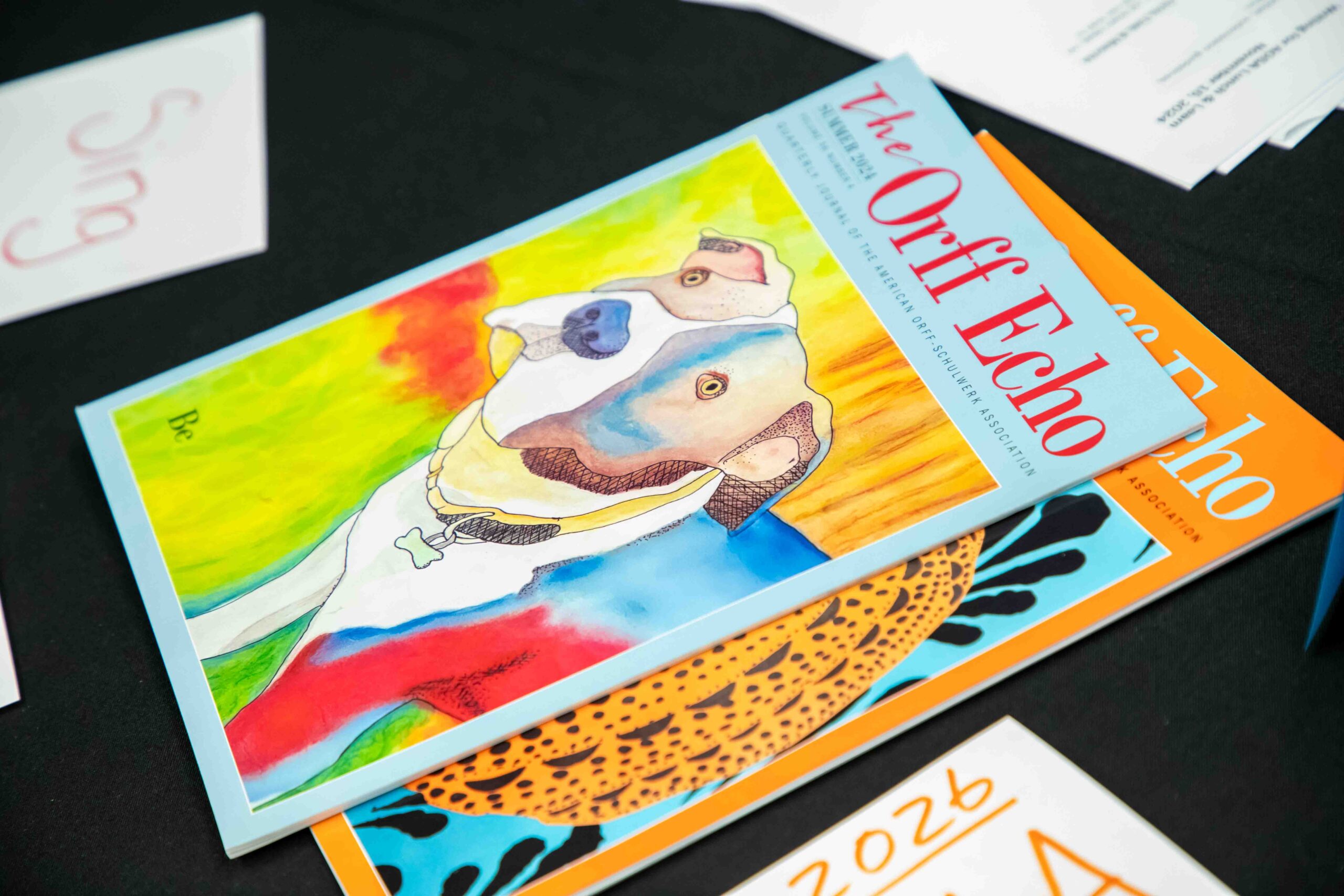
The Orff Echo is the national, peer-reviewed quarterly journal and philosophical voice of the American Orff-Schulwerk Association. Our mission is to demonstrate the value of Orff Schulwerk and promote its widespread use; to support the professional development of our members; and to inspire and advocate for the creative potential of all learners. Non-members may contact the editor for information.
Interested in writing for The Orff Echo? Check out how to get involved in the process:
Extensions to articles published in The Orff Echo can be found in the AOSA Resource Library.

List of Orff Echo Articles
Rote vs Note, 1720-1995
Hardy discusses the teaching of music notation in elementary music classes in the U.S. While some teach literacy and some do not, the primary goal is to make music a part of children’s lives.
Focus on Research – Discovered Literacy
Gromko writes about a project in which she and several classroom teachers experimented with invented notation.
Point-Counterpoint: Music Notation
Echo readers respond to the question: “Should early experiences with music notation be traditional or iconic?”
Discovering the Inner Dancer
Schorn discusses the reluctance of some adult students in levels courses to participate fully in movement classes. She talks about getting in touch with one’s inner dance.
Winds of Change: Orff Schulwerk in Russia
The author writes about the growth of the Orff approach in Russia and discusses the use of the Schulwerk in 1995.
From the Classroom: Wordmaker, Wordmaker… Creating and Playing with Language
Schulz discusses how she used of the poem “Wordmaker, Wordmaker” in a lesson for her Wyoming classroom.
Orff Schulwerk: Past and Future
Speech given by Carl Orff at the opening of the Orff Institute in Salzburg, 1963, chronicling the evolution of the Schulwerk and the establishment of a training center at the Orff Institute.
The Mysteries of Creation: A Conversation with Libby Larsen
An interview with composer Libby Larsen sheds light on her creative process and her work on “Song dances to the Light” commissioned by AOSA for the 1995 Carl Orff Centenary.
The Role of Myth in Native American Art and Culture
Discussion of the role of origin stories in indigenous American culture and art, along with teaching suggestions and resources for exploring the cultures of tribal nations in the classroom.
Primal Fires
One teacher’s reflection on the importance of including a song’s cultural context and function as a way to bring wonder and magic into her teaching and students’ learning.
The Magic of Myth
The author makes a case for the importance of myth in society and education, and takes the reader into her elementary classroom where myth inspired music, dance, and poetry .
The Myth of Creativity
The mysterious and spiritual side of creativity is explored, and steps for uncovering creativity in our work as performers, composers, and teachers are discussed.
Reflections: Voice of Adolescence
An interview with a group of six male teens enrolled in classes at the Grenoble Studio reveal valuable insight into their Orff Schulwerk experience and teaching strategies they favored.
From the Classroom: Creating Theater
Creating Theater in the Music Classroom: One teachers’ favorite aural and visual techniques for creating a classroom atmosphere that transforms teaching spaces into theatrical spaces.
Music of the Spirit, Intertribal American Indian Music from Michigan/Indiana
Riley discusses the traditional music of the indigenous people from the upper Midwest.
The Play-Party in Indiana
This article is an excerpt from Leah Wolford’s 1915 masters thesis, published as a book in 1958. She discusses her experiences at play parties in the first years of the 20th century.