
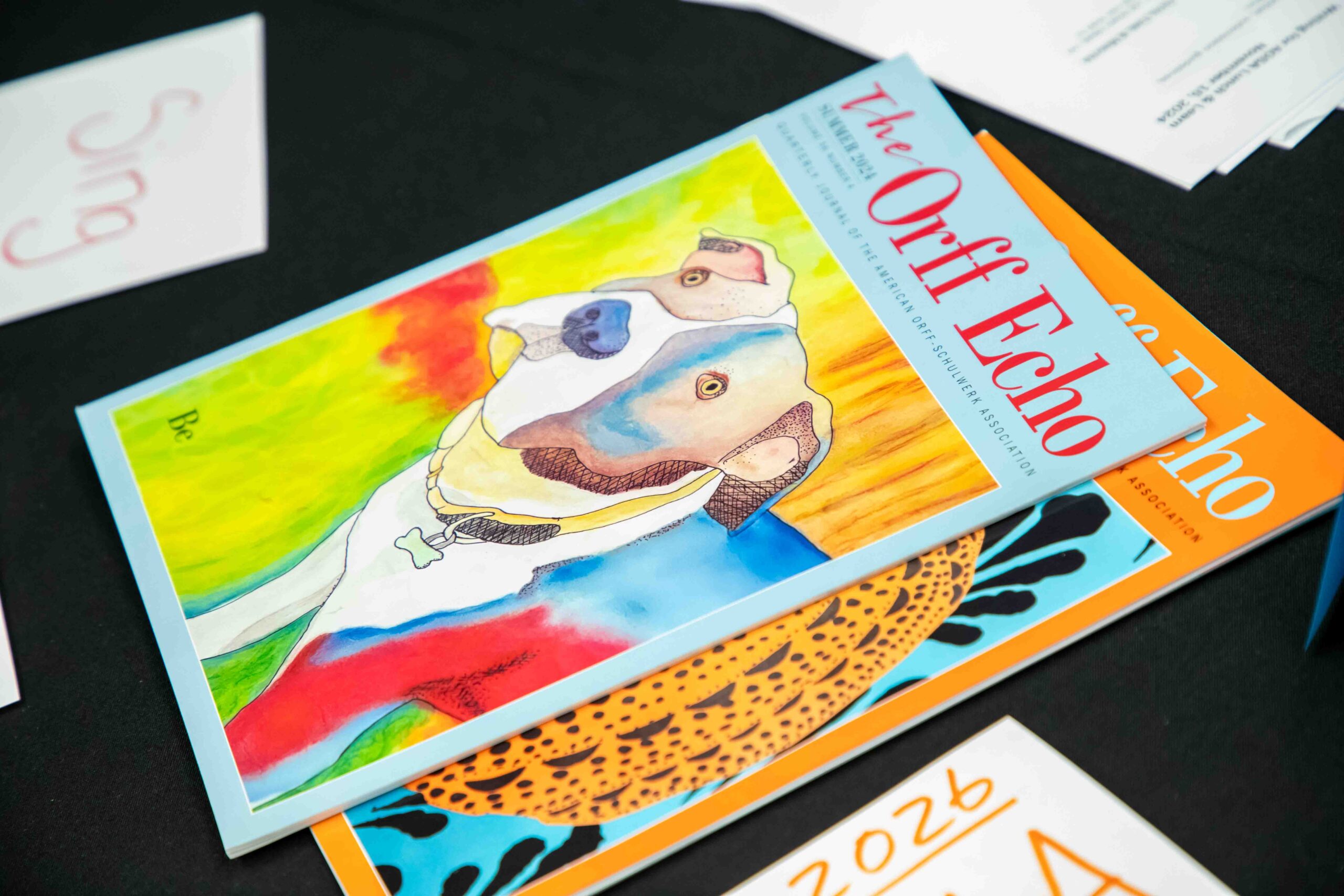
The Orff Echo is the national, peer-reviewed quarterly journal and philosophical voice of the American Orff-Schulwerk Association. Our mission is to demonstrate the value of Orff Schulwerk and promote its widespread use; to support the professional development of our members; and to inspire and advocate for the creative potential of all learners. Non-members may contact the editor for information.
Interested in writing for The Orff Echo? Check out how to get involved in the process:
Extensions to articles published in The Orff Echo can be found in the AOSA Resource Library.

List of Orff Echo Articles
Intentional and Aesthetic Movement: A Look into Dalcroze Eurhythmics
This article presents intentional and aesthetic movement through the application of Jaques-Dalcroze’s philosophy. The author provides specific examples of how to approach and teach duple, triple, and asymmetrical meter using Dalcroze activities.
Creating Movement Stories: Integrating LMA and Technology
In this article, the author illustrates the process of designing enriched movement stories using Laban Movement Analysis and technology with teacher- and student-created materials.
Activating the Voice: Orff Schulwerk in the Elementary Choral Classroom
In this article the author provides ideas for reimagining how to include warmups and vocal technique lessons using song, movement, collaboration, improvisation, creation, resonant speech, instruments, and body percussion.
Breathe In. Breathe Out. Exploring the Use of Breath in Our Bodies
The author explores the importance of the breath and its relationship to us as human beings, musicians, and educators.
Children’s Literature and Creating Schulwerk Text
The article discusses creative ways to utilize children’s literature musically to develop language arts skills as well musical skills.
Refugee Populations and Orff Schulwerk: Resiliance, Relationship, Imagination, Hope
The author discusses the challenges and rewards of teaching Orff Schulwerk to refugees, particularly unaccompanied minors, in her native Germany.
The Effect of Structure on Student Compositional Preference and Products: A Pilot Study
This article discusses the results of a research study of student composition in structured and unstructured settings funded by an AOSA Research Partnership Grant.
AOSA Beginnings and The Orff Echo
An AOSA founder describes the early days of AOSA and the founding of The Orff Echo.
Lifelong Kindergarten: Cultivating Creativity Through Projects, Passion, Peers, and Play
Professional Development Book Review: This book, by Mitch Resnick, discusses the immersive, exploratory aspects of kindergarten and their suitability as a framework for the rest of schooling.
Sidewalk Flowers
Children’s Book Review: Beautifully illustrated, wordless picture book with a theme of nature and kindness allow space for students to create and to recognize that even the smallest gestures can bring joy to others.
Singing the Bridge: Orff Schulwerk as a Metaphor for All Arts
The author explores the possibility to re-imagine physical objects in musical ways and asks what the application in Orff Schulwerk might be.
Varieties of the Orff Schulwerk Wildflower in North America
The author describes and compares the historical/ontogenetic model and folk song model as the two primary instructional styles of Orff Schulwerk in North America.
The Ukulele as a Tool for the Schulwerk
The author makes the case that the ukulele is a suitable tool for teaching elemental music.
The Efficacy of Cool: Using Popular Music as an Instructional Framework
The use of popular or venacular music to create improvisatory music making opportunities – primarily on recorder – is explored.
An Orff Musical: Connecting Orff and Drama
The author discusses the applicability for an Orff approach to teaching drama and the development of student-composed musical theater.
Experiencing Music Composition in Grades 3-5
Professional Development Book Review: Authors Michele Kaschub and Janice Smith detail a variety of composition projects that general music teachers can use to facilitate composition by upper elementary school students.