
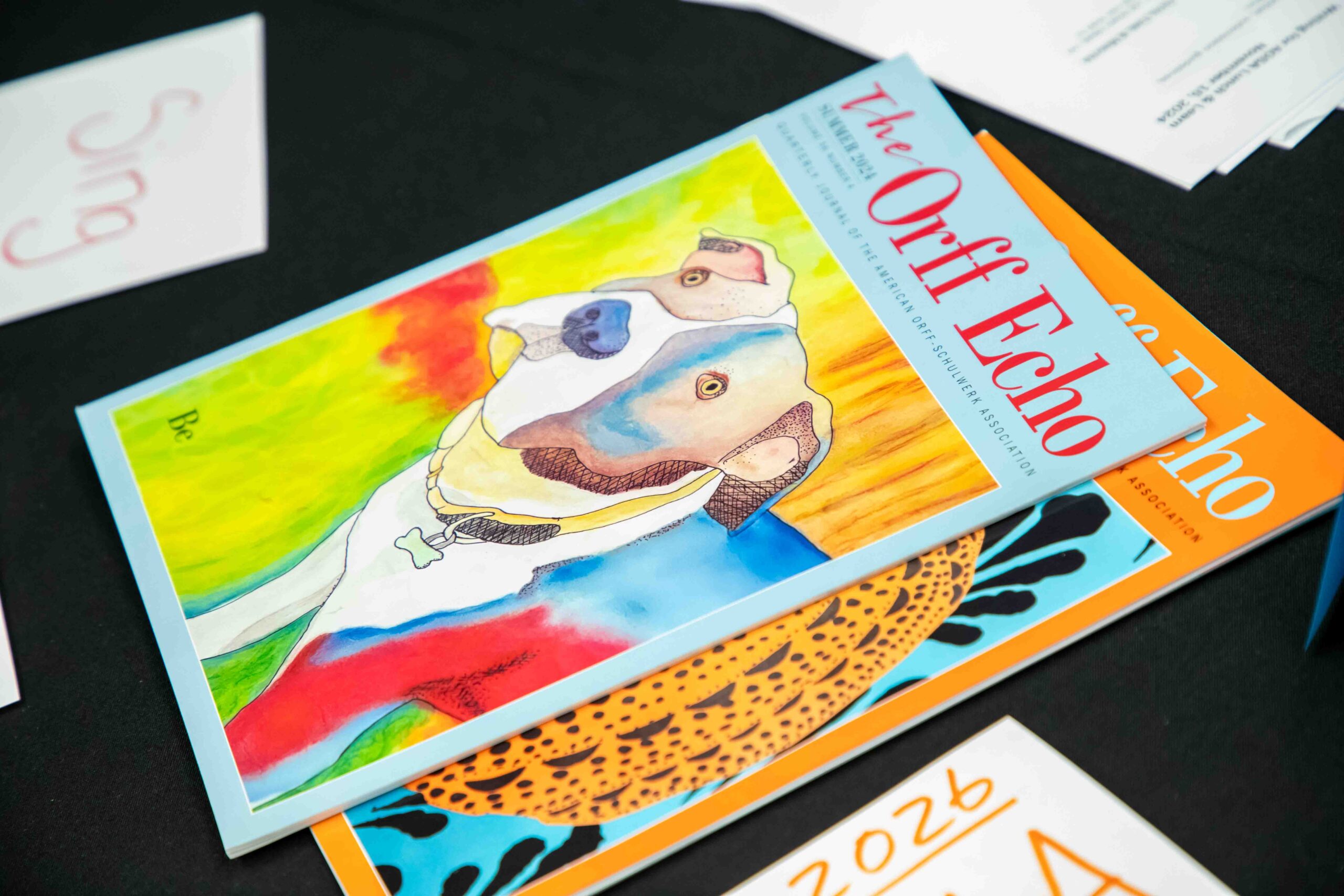
The Orff Echo is the national, peer-reviewed quarterly journal and philosophical voice of the American Orff-Schulwerk Association. Our mission is to demonstrate the value of Orff Schulwerk and promote its widespread use; to support the professional development of our members; and to inspire and advocate for the creative potential of all learners. Non-members may contact the editor for information.
Interested in writing for The Orff Echo? Check out how to get involved in the process:
Extensions to articles published in The Orff Echo can be found in the AOSA Resource Library.

List of Orff Echo Articles
Hi Hao! Sing and Chant Your Way to China!
Professional Development Book Review: Authentic Chinese songs and chants for students in pre-K through Grade 5. Includes DVD and SMART Board files.
The Inclusive General Music Classroom
Cognitive and physical disabilities are explained and specific strategies are provided for successful inclusion in an Orff general music classroom.
Marginalized Voices in Music Education
Professional Development Book Review: Through an examination of marginalization and privilege, this book challenges prevailing assumptions and seeks to redefine and expand the role of music education as a powerful contributor to equity.
Considering Black Voices: Dialogue to Foster an Inclusive Educational Environment
Inclusion is promoted through honest dialogue between Black and White educators, especially with respect to the historic context of music materials.
Gunild Keetman’s Contribution to the Schulwerk
As a music and movement educator and composer, Gunild Keetman’s collaboration with Carl Orff created and shaped the Schulwerk.
Moving Toward Gender Equality in American Music
An overview of gender inequality in professional music and how Orff Schulwerk teachers can close the gender gap by promoting work by female composers, performers, and conductors.
All Are Welcome: Orff Schulwerk for Children With Physical and Neurological Challenges
Explore Orff Schulwerk activities that support children with physical and neurological challenges.
Trauma-Informed Teaching Practices in the Orff Schulwerk Classroom
How trauma is processed in the brain, its behavioral effects in children, and ways Orff Schulwerk supports trauma-informed teaching practices.
Orff Schulwerk and Inclusivity
This issue of The Orff Echo examines how Orff Schulwerk can be responsive and adaptive to the needs and circumstances of all learners, allowing for inclusivity.
A Tale of Two Philosophies: Functional Harmony in the Orff Schulwerk Classroom, Part II
Three Orff Teacher Educators share their approaches to teaching functional harmony within their Orff Schulwerk curriculum.
I Got the Rhythm
Children’s Book Review: A little girl embarks on an adventure of sound as she walks with her mother, exploring her neighborhood and reflecting on sights, sounds, smells. Along her journey, she transforms her experiences into movement, song, and dance.
Urban Music Education: A Practical Guide for Teachers
Professional Development Book Review: This book invites us to consider which ideas are beneficial to our specific school situation, to evaluate how our attitudes influence our students, and continually seek out resources that will further our growth as teachers.
Good Morning Yoga – A Pose by Pose Wake up Story
Children’s Book Review: This picture book, with repetition, sequencing, and basic movement vocabulary, will help cultivate an open and accepting learning environment that embraces the power of the body, mind, and spirit through yoga.
Utilizing the Body to Anchor New Learning
The author discusses the strategies and benefits of utilizing the body through movement activities to bring a deeper focus in the learning process.
Elemental Movement in the Modern Age
Elemental movement in our current practice remains closely tied to many of the historical pedagogical and philosophical ideas of the Schulwerk. This article addresses ways to keep movement education vital and vibrant in the future.
Intentional and Aesthetic Movement: A Look into Dalcroze Eurhythmics
This article presents intentional and aesthetic movement through the application of Jaques-Dalcroze’s philosophy. The author provides specific examples of how to approach and teach duple, triple, and asymmetrical meter using Dalcroze activities.