
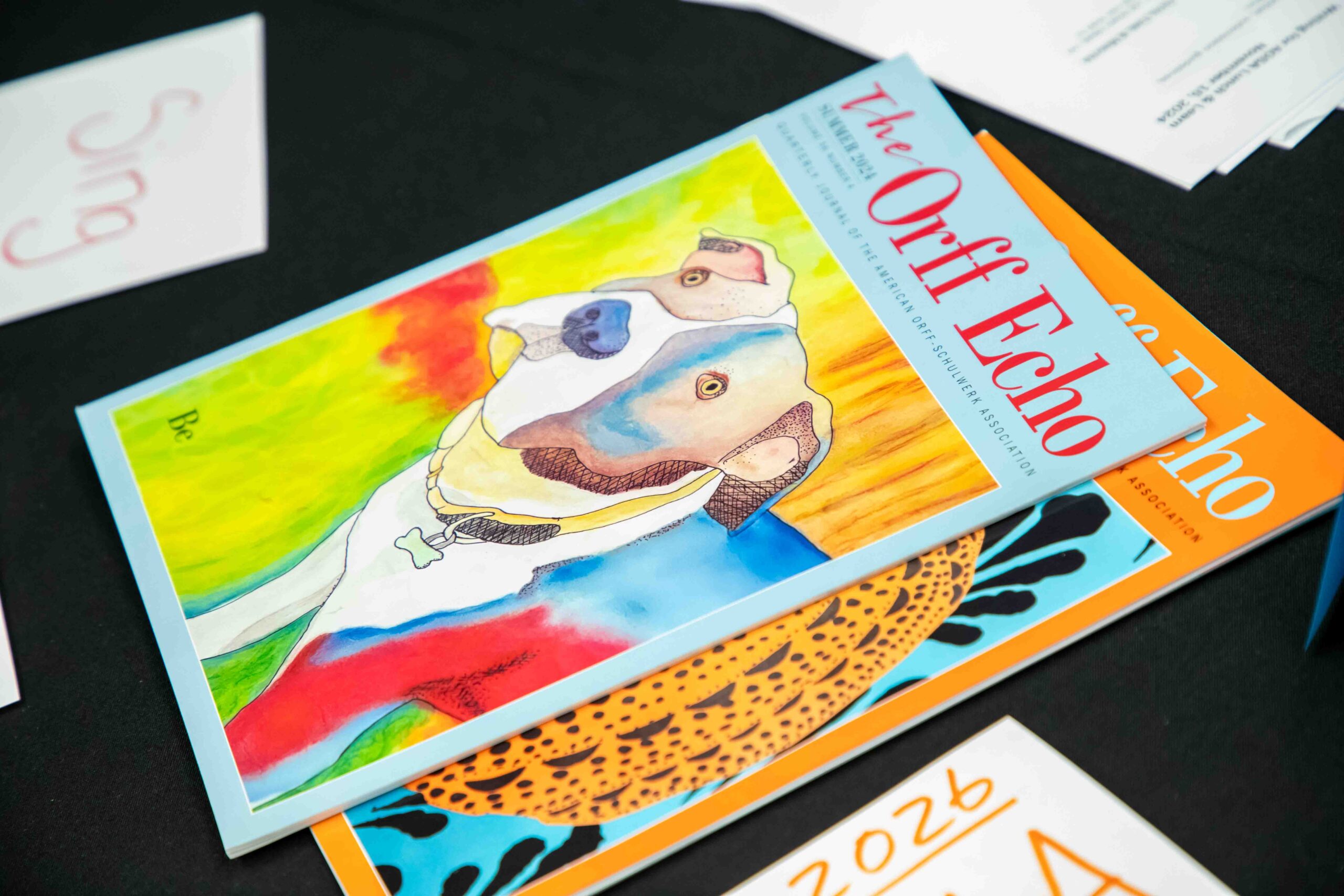
The Orff Echo is the national, peer-reviewed quarterly journal and philosophical voice of the American Orff-Schulwerk Association. Our mission is to demonstrate the value of Orff Schulwerk and promote its widespread use; to support the professional development of our members; and to inspire and advocate for the creative potential of all learners. Non-members may contact the editor for information.
Interested in writing for The Orff Echo? Check out how to get involved in the process:
Extensions to articles published in The Orff Echo can be found in the AOSA Resource Library.

List of Orff Echo Articles
My First Five Years: an Orff Journey
The author writes about challenges facing new teachers and how the Orff approach provides tools for navigation.
A Special President’s Message
In her President’s Message, current AOSA President, Tiffany English presents quotes from past presidents.
Artistic Citizenship: Artistry, Social Responsibility and Ethical Praxis
Professional Development Book Review: This book is an essential compendium for anyone who believes our work as teachers is not complete without providing our students with a social and cultural context for their creative explorations.
The Schulwerk
Professional Development Book Review: The Schulwerk, Volume 3 of Carl Orff’s autobiography, tells in his own words (translated by Margaret Murray) the story of how the Schulwerk was born, developed with young adults, re-developed for children, and ultimately became an internationally recognized music/movement pedagogy.
Orff Schulwerk and Contemporary American Educational Thought
Burkhart discusses how the Schulwerk fits in with current educational philosophy.
Chapter One
The author writes about the founding of the Greater Cleveland Orff Chapter, AOSAs first chapter.
In The Beginning… Orff Schulwerk Teacher Training in the United States
Brandon discusses the origins and growth of Orff teacher training courses in the US.
Interwoven Journeys: a Memoir of Two Lives in Friendship and Orff Schulwerk
The authors, both part of AOSA from the beginning, discuss how their lives became interwoven through the Schulwerk.
Danai Gagne and Orff Schulwerk: Ever Growing, Ever Flowing
Block interviews Danai Gagne about her career and her studies with Gunild Keetman at the Orff Institute in Salzburg.
The Tale of Peter Rabbit
Children’s Book Review: The original classic picture book by Beatrix Potter tells the story of a very mischievous rabbit and the trouble he encounters in Mr. McGregor’s vegetable garden! The review includes suggestions for creative movement and more.
Orff in the Urban Setting: Turning Challenges into Opportunities
Boyer shares the challenges of having a successful Orff program in an urban school and also discusses the role AOSA can play in bringing Orff music-making into urban settings.
Techno-Schulwerk: Electronic Inspiration for Elemental Music Making
The author discusses how Orff teachers can use techno-inspired musical ideas and instruments in the classroom.
The Music of Spoken Language in the 21st Century Orff Classroom.
Gray discusses the place of spoken language in the Schulwerk. She talks about her work with children in “Rhythm and Rhyme” sessions and also gives suggestions for working with speech and music for older students.
The Story of Ferdinand and Walter the Wolf
Children’s Book Review: Children’s literature often functions as an artful, disarming way to speak about cultural or human themes that are at once timely and timeless. Beloved Orff teacher Judith Thomas-Solomon recommends two such delightful children’s classics, both of which share themes of being true to oneself and peace as a matter of choice.
The Impact of Cognitive Neuroscience on Music Pedagogy
Staveley discusses the research in cognitive neuroscience and it’s relationship to music education for children.
Past is Prologue: Beyond Orff-Schulwerk’s First Half-Century in America
Frazee writes about the the growth and transformation of the Orff approach in the United States. She discusses how the Schulwwerk has been enriched by adding material from American culture. She also discusses criticisms of the Orff approach as it has evolved in the US.