
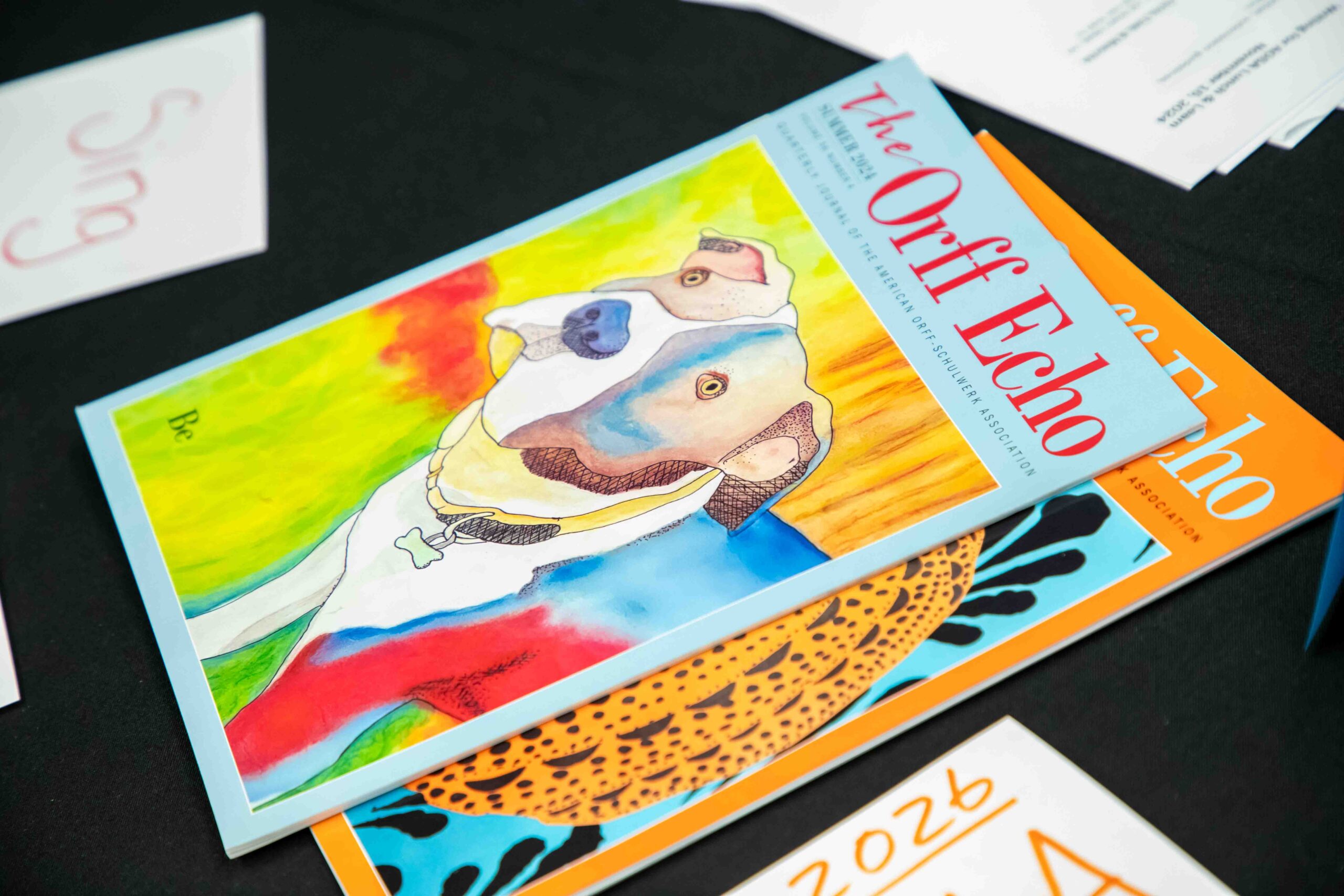
The Orff Echo is the national, peer-reviewed quarterly journal and philosophical voice of the American Orff-Schulwerk Association. Our mission is to demonstrate the value of Orff Schulwerk and promote its widespread use; to support the professional development of our members; and to inspire and advocate for the creative potential of all learners. Non-members may contact the editor for information.
Interested in writing for The Orff Echo? Check out how to get involved in the process:
Extensions to articles published in The Orff Echo can be found in the AOSA Resource Library.

List of Orff Echo Articles
The Many Facets and Faces of Orff Process
This well-researched article focuses on how process is defined in Orff Schulwerk, focusing on commonalities and differences while offering alternative definitions and descriptions of what exactly process is and what other words we may use to describe how Orff Schulwerk educates and enables.
Crafting a Playful Process
The author provides a background and tools for balancing play and process in the classroom, with particular attention paid to student voice, multiple explorative entry points, and ensuring safety in risk-taking.
Play Is Not Just for Children
A look at the International Sunday Sharing group first started by JaSeSoi in 2020 during COVID-19 and a description of how the light-hearted and playful workshops kept spirits alive during a challenging pandemic.
Engaging With Orff Schulwerk: Elementary General Education Majors’ Experiences in a Music Fundamentals Course
Elementary education majors learn how the processes of teaching music reflect important teaching processes in general. Cross-curricular connections are readily available in the general classroom when using musical techniques, concepts, and skills.
Why We Imitate
Imitation is a foundational practice of the Schulwerk and the author explores the physiological and psychological implications of its application in the classroom and shares some important culturally responsive and social emotional outcomes as well.
Working in Harmony: A Collaborative Orff Festival
Description of the organization of an Orff Festival that includes committee needs, repertoire selection/development, and recording. Collaboration is the foundation for this event which includes various components of community partnership with other organizations and universities.
Echo Indices
Indices include: Subject, Author, Title from 1968-2006; Focus Topics Index 1994-Present
Working Together: Para and Peer Support in Music Classrooms
Inclusion in the music classroom, collaboration between music teachers and paraprofessionals to aid students with disabilities.
Starting with Trees: Stimulating Curiosity and Collaboration in Young Children
Experiences at the Orff Institute inspire the author to guide her preschool students in collaborative, integrative investigation and creation with found sounds and the art of Mondrian.
A Javanese Musical Playground: Traditional Tembang Dolanan Anak Singing Games in Early Childhood
The author introduces the Javanese singing game genre tembang dolanan anak, drawing parallels with Orff Schulwerk.
Ontogenetic Approach to Teaching Improvisation
Multi-case research study of teacher-educators’ use of improvisation in upper elementary general music classroom that includes an ontogenetic approach.
The Orff Echo Index: Focus Topics
Since 1994, most issues since of The Orff Echo have a focus topic around which feature articles are organized. Issues may also include articles on topics other than the focus topic.
Before Morning
Children’s Book Review: A child’s invocation becomes the gift of a snow day spent with her family. This picture book is appropriate for composition or musical soundscape projects and relevant throughout the winter months.
The Night Parade
Children’s Book Review: This picture book offers a whimsical tale of what children do after they go to bed for the night. The reviewer details several speech-rhythm and instrument ideas for this picture book.
Teach Like It’s Music: An Artful Approach to Education
Professional Book Review: Goodkin’s book, written in sonata form, rekindles the reader’s own passion for great teaching and learning. Making connections between culture, philosophy, neuroscience and music, he paints his own picture of a “Pedagogy of Possibility.”
Project-Based Learning in the Orff Schulwerk Classroom
Developing and implementing Project-Based Learning (PBL or PjBL) via colleague collaboration among specials teachers across disciplines is described. Parallels are drawn between PjBL and Orff Schulwerk.