
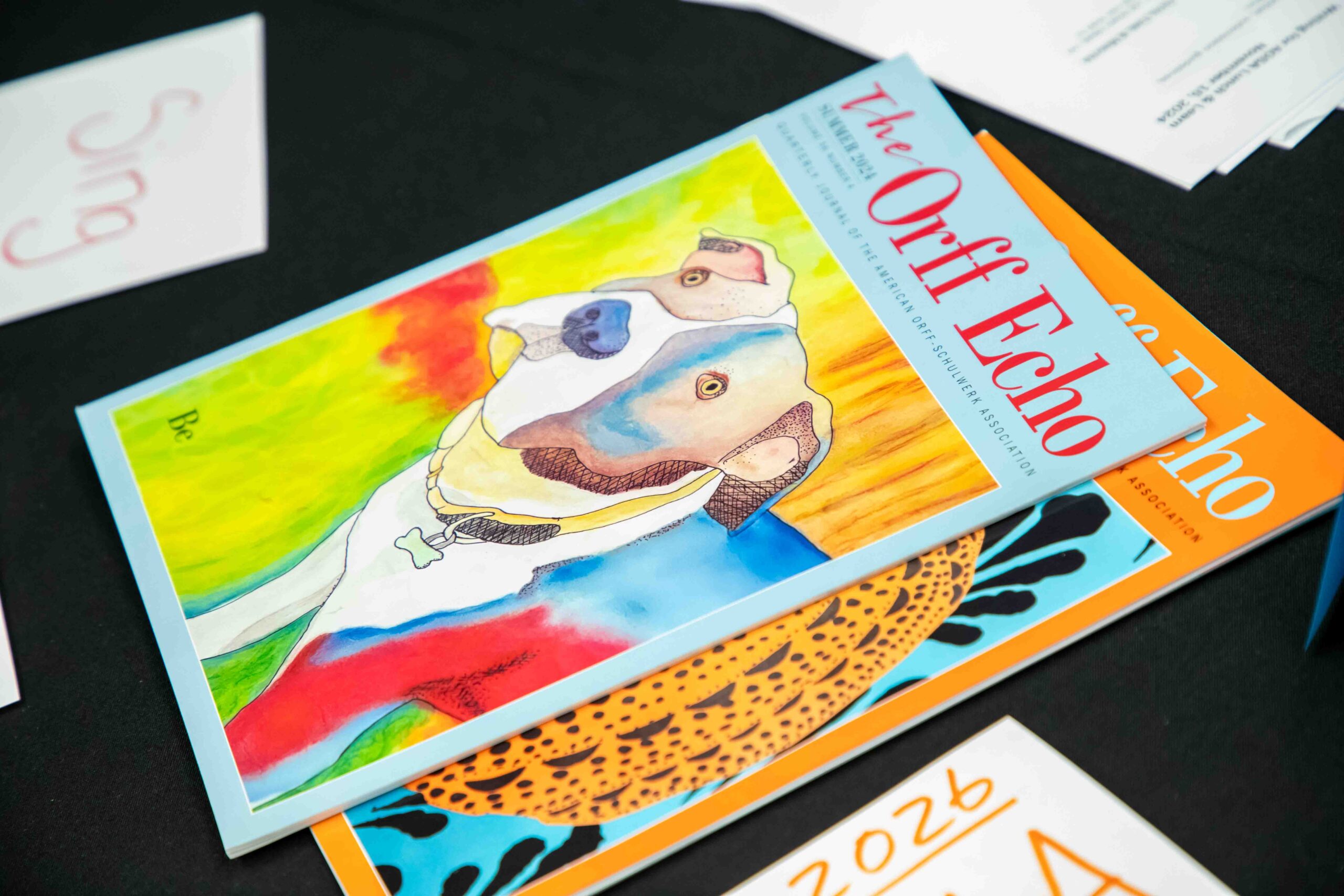
The Orff Echo is the national, peer-reviewed quarterly journal and philosophical voice of the American Orff-Schulwerk Association. Our mission is to demonstrate the value of Orff Schulwerk and promote its widespread use; to support the professional development of our members; and to inspire and advocate for the creative potential of all learners. Non-members may contact the editor for information.
Interested in writing for The Orff Echo? Check out how to get involved in the process:
Extensions to articles published in The Orff Echo can be found in the AOSA Resource Library.

List of Orff Echo Articles
The Rabbit Listened
Children’s Book Review: Shares tale of helping a friend.
Before We Teach Music
Teaching Taiwanese Folk Songs: Orff Schulwerk versus Traditional Practices
Explores a study investigating the role of the Orff Schulwerk approach in enhancing interest in singing by students at Yonghe Junior High School in Taiwan. The application of the Orff Schulwerk approach in folk song instruction included using vocal improvisation, movement, performance, and Orff-style percussion and recorder to accompany singing.
folk songs, culturally relevant, repertoire, Taiwan, singing, adolescents
How the Orff-Schulwerk Approach Supports Informal Music Learning
Article provides insights into how the Orff Schulwerk approach directly supports Informal Music Learning (IML). In IML settings, students choose and learn popular music by ear through imitation and experimentation, which supports modern curricular approaches. Blending these two pedagogies can foster student autonomy and comprehensive musical skill development.
Informal music learning; curriculum, pedagogy, student autonomy, development
The Ever-Evolving Musical Mosaic: Reflecting on Identity in the Music Room
Through the image of a mosaic, this article reflects on educator practice and on discussions of literature as they relate to teacher and student identity. Two guiding questions that shape this evolving mosaic and center on the experiences of ethnically and culturally diverse student populations in the classroom are introduced.
mosaic, educator/student identity, reflection, ethnic, culturally diverse
Teaching the Civil Rights Movement Through Orff Schulwerk
Article explores integration of the Civil Rights Movement into the elementary music classroom through the Orff Schulwerk approach. Drawing from experiences with urban learners, the author illustrates how, by situating music within its historical and social context, educators can connect sound, movement, and narrative to themes of democracy, justice, and resilience.
civil rights, children’s literature, social justice
Fostering Intercultural Awareness through Orff-Schulwerk Practices
Music shapes culture and self identity. Exploring diverse musical styles helps children understand the life experiences of others. This article offers ways to invite students into one another’s worlds—engaging with the cultures, music, communities, and traditions in their classroom—through playful learning and the Orff Schulwerk approach.
Orff Schulwerk pathways, intercultural awareness, cultural immersion, playful learning, exploratory music making
Orff Schulwerk and Didactics
Didactic considerations are the task of every individual teacher. Although Orff Schulwerk practitioners have been trained to look for a didactic order within the approach, this article challenges readers to think about what Orff had in mind regarding didactics as he developed his concept of elemental music and dance education 100 years ago, and to assess his progressive, quite radical, and open concept.
curriculum, self-creation, elemental music, pedagogy, didactics
Finding Community in AOSA
Echo editorial board details of experiencing community throughout AOSA and invites readers to connect with colleagues in meaningful ways.
levels courses, community, chapter workshops, Professional Development Conference, PLN, Orff Institute
Music Is So Much Fun this Way
The Memphis music project emphasized experiential learning over technical mastery, subsequently inspiring over 100 Memphis school music teachers and transforming elementary music education.
creative adventures, playful, fun, childlike, Memphis music project, personal growth
Engaging English Language Learners in the Music Classroom
Highlights tools inherent in the Orff Schulwerk approach that foster an environment of creativity and collaboration practitioners can use to encourage and nurture English language learner participation.
English Language Learners (ELL), Culturally Responsive Teaching, visual aids, nonverbal communication, imitation
The Lights that Dance in the Night
Children’s Book Review: Story and illustrations inspire movement and performance.
Creating and Sustaining Community Through Music and Movement Alliances
Explores how the AAMM encourages collaboration among music education organizations and showcases how community can be built through pedagogical practices that center collaborative, participatory music making.
Orff Schulwerk; AAMM, music and movement; Kodály; Dalcroze; Music Learning Theory; active music making
Konnie K. Saliba—Creating a Community for Orff Schulwerk in Memphis and Beyond
Authors draw on personal conversations and archival materials housed in the Memphis Room of the Benjamin L. Hooks Public Library to provide a historical account and tribute to Saliba’s enduring impact on music education.
Orff, Konnie K. Saliba, Memphis, Memphis Orff Institute, Memphis history, University of Memphis, Ferguson, McRae, Carol King
Texts on Theory & Practice of Orff Schulwerk, Volume III – Movement and Dance in Orff Schulwerk
Professional Development Book Review: Compilation of historical background and applications for incorporating movement and dance into the classroom.
Orff Schulwerk: A Curriculum Critique
Examines how Schwab’s five curriculum commonplaces work within the Orff Schulwerk approach and details how this combination supports a caring environment while building community.
Orff Schulwerk, curriculum, Joseph Schwab, democratic curriculum